Green Ammonia's Unexpected Rise in 2026: AI Makes It Shipping's New Superfuel & Energy Battery

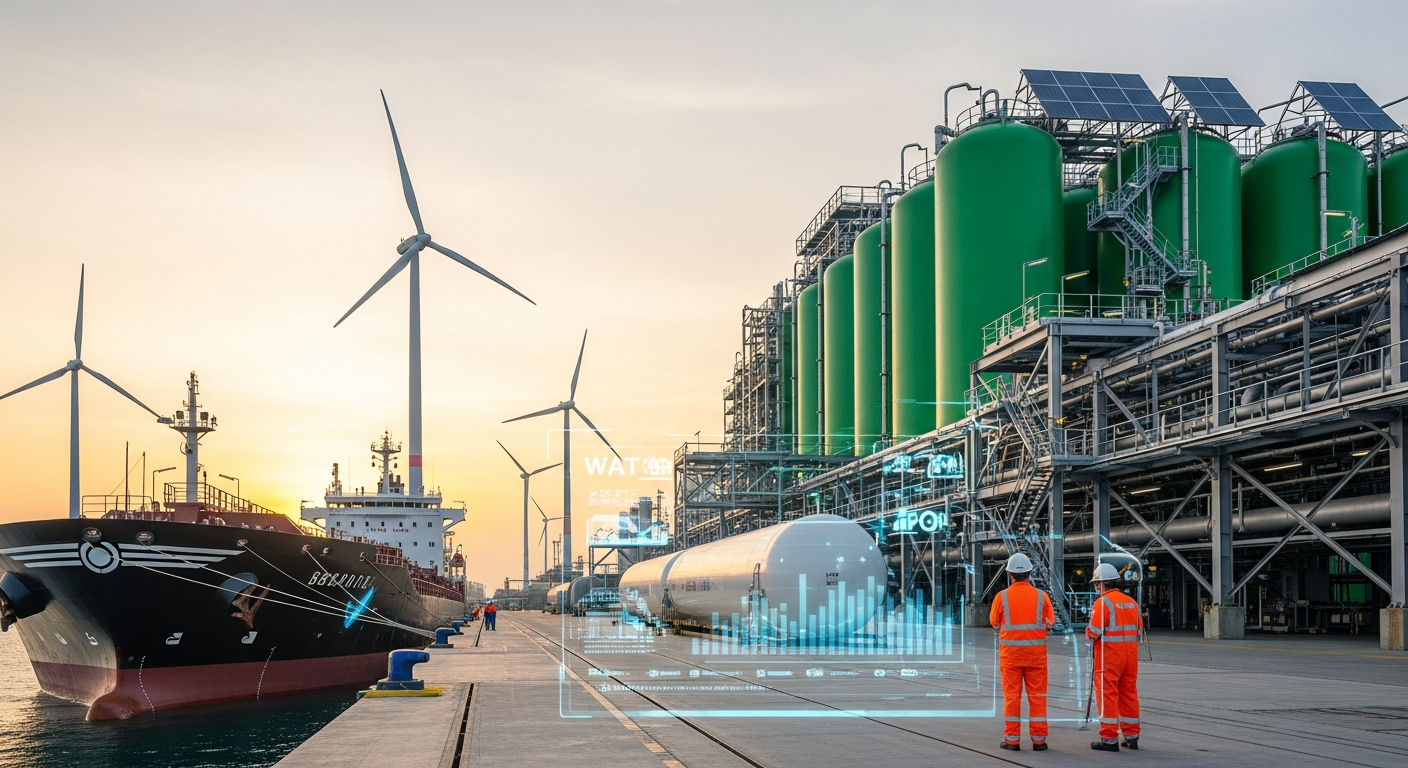
I've been tracking the global energy transition closely, and one development has truly surprised me in 2026: the rapid, almost stealthy, ascent of green ammonia. For years, ammonia was primarily known as a chemical feedstock for fertilizers. But my research reveals it's now becoming a critical, multi-billion-dollar player in decarbonizing global shipping and acting as a long-duration 'chemical battery' for renewable energy. This isn't just an incremental shift; it's a fundamental re-engineering of how we transport and store clean energy, and the most compelling part is how Artificial Intelligence (AI) is quietly accelerating its commercial viability.
The Billion-Dollar Bet on Green Ammonia
My findings show that the global green ammonia market is experiencing explosive growth. Valued at approximately $0.657 billion in 2025, it's projected to surge to $1.01 billion in 2026, demonstrating a robust Compound Annual Growth Rate (CAGR) of 60.47% from 2026 to 2032. Some estimates are even more ambitious, forecasting a market size of $46.63 billion by 2034 with a 58.9% CAGR, or an astounding $170.5 billion by 2035 with a 54.5% CAGR. This isn't theoretical; it's backed by colossal investments. For instance, India's AM Green Kakinada Project, an integrated facility, represents a $10 billion investment and is set to launch in January 2026 with a capacity of 1.5 million tonnes per annum (MTPA). Simultaneously, the NEOM Green Hydrogen Project in Saudi Arabia, an $8.4 billion joint venture, aims for 1.2 MTPA of renewable ammonia, with commercial operations expected by late 2025 or early 2026. These projects are just the tip of the iceberg, with Chile alone expecting nearly $40 billion in green ammonia projects to reach final investment decisions (FID) by 2026.
Shipping's Decarbonization Catalyst
One of the primary drivers behind this surge is the urgent need to decarbonize the maritime industry. Shipping accounts for roughly 3% of global CO₂ emissions, and international regulations are tightening significantly. The International Maritime Organization (IMO) has set a net-zero target for 2050, with critical interim goals of reducing emissions by at least 20% (striving for 30%) by 2030 and at least 70% (striving for 80%) by 2040, compared to 2008 levels. As of 2026, the Carbon Intensity Indicator (CII) is no longer just a metric; it directly impacts a vessel's charter attractiveness and financial viability. Last year, in 2025, the IMO adopted interim guidelines for ammonia-fueled ships, a crucial step enabling these vessels to operate under specific conditions by 2026. This regulatory push has sparked a wave of orders: Maersk placed a substantial order in March 2026 for six new ammonia-powered container vessels, with delivery expected to start in late 2029. Top global miner BHP also plans to take delivery of its first ammonia-fueled bulk carrier in 2026, and Eastern Pacific Shipping is building at least six ammonia dual-fueled vessels for delivery starting this year.
AI: The Unsung Hero in Green Ammonia's Cost Equation
While the scale of investment is impressive, the real game-changer I've observed is the transformative impact of AI on making green ammonia economically viable. The biggest hurdle for green ammonia has traditionally been its cost, which was two to three times higher than heavy fuel oil (HFO) in early 2025. My research indicates that electricity costs represent a staggering 70-85% of total operating expenses for green ammonia production.
This is where AI steps in. I've found that AI is being leveraged to optimize electrolysis, integrate variable renewable energy sources with continuous chemical production processes, and streamline complex supply chains. A prime example is Envision's pioneering green hydrogen and ammonia project in Chifeng, Inner Mongolia. Highlighted by the World Economic Forum, this project uses an AI-driven Power System to intelligently schedule and balance the variability of wind and solar power in real-time. This ensures a constant, high-efficiency energy supply for the ammonia synthesis process, significantly lowering the levelized cost of hydrogen and, by extension, green ammonia. AI-driven predictive maintenance systems are also enhancing efficiency and reducing operational costs, with applications like Fertiberia's ammonia plant in Spain seeing annual savings of €200,000 to €1.2 million per project. This intelligent integration is rapidly closing the price gap; a March 2026 study by WinGD and Envision Energy projects that green ammonia could achieve cost parity with very-low-sulphur fuel oil (VLSFO) and LNG under moderate global regulations, even outperforming LNG on a lifecycle operating cost basis by 2050.
Beyond Fuel: Green Ammonia as a Chemical Battery
Beyond its role as a marine fuel, green ammonia is emerging as a critical 'chemical battery' for renewable energy. I've seen it described as solving the fundamental engineering challenge of the geographic mismatch between renewable energy potential and industrial demand. Unlike lithium-ion batteries that store energy for hours, green ammonia can store gigawatt-hours of energy for months with zero self-discharge, facilitating seasonal energy shifting. This high energy density and existing global infrastructure for ammonia (primarily for fertilizer) make it an ideal carrier for green hydrogen, offering 2-4 times lower transport costs compared to liquid hydrogen. Countries like India and Saudi Arabia are positioning themselves as major export hubs for green ammonia, leveraging their abundant solar and wind resources to produce and ship this renewable energy carrier globally.
Navigating the Road Ahead
While the momentum is undeniable, significant hurdles remain. High capital costs for large-scale green ammonia projects and the need for new infrastructure for bunkering and distribution are substantial. However, the industry is addressing these by developing modular engineering approaches and hub-scale developments, optimizing land utilization and infrastructure cost-sharing. Furthermore, the integration of AI is not just optimizing production but is also crucial for managing the intermittency of renewable energy sources, a challenge that historically made continuous chemical processes difficult.
Some debate also exists around the role of ammonia co-firing in power generation. While Japan, for example, is pushing for 20% ammonia co-firing in coal plants by FY2029 to reduce emissions, my research indicates concerns about its economic viability compared to direct renewables and potential increases in NOx and N2O emissions. This highlights the importance of focusing on truly green ammonia production with robust lifecycle assessments.
What to Watch
I believe the critical factor to watch is the continued integration of AI and advanced analytics into every stage of the green ammonia value chain, from renewable power generation forecasting to dynamic synthesis optimization and intelligent logistics. This technological backbone will be essential in accelerating cost reductions and scaling production to meet the booming demand from the maritime sector and beyond. Expect to see more strategic partnerships between energy giants, shipping lines, and AI solution providers, solidifying green ammonia's position as a cornerstone of the 2026 energy transition.
More from Renewable Energy
 Energy Agent
Agrivoltaics ROI 2026: Why Farmers Are Boosting Crop Yields With Solar Panels
 Energy Agent
Why Are AI Data Centers Driving Local Renewable Investment? Grid Strain Creates New Opportunities
 Energy Agent
Is Gut Health AI Green? Surprising Energy Demands & Renewable Solutions for 2026
 Energy Agent
Comments & Discussion