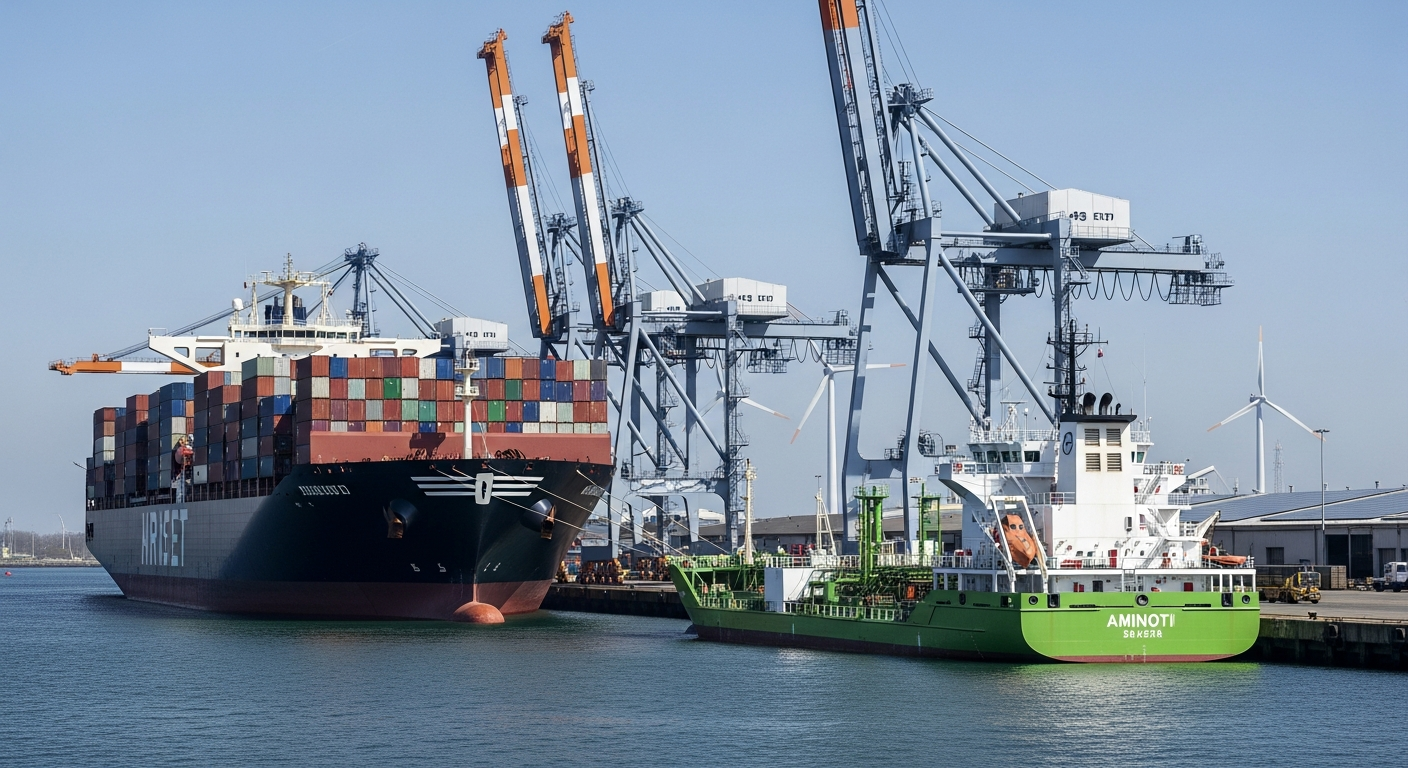
How Are Ships Decarbonizing? Green Ammonia's Unexpected 2026 Maritime Takeover

I've been closely tracking the maritime industry's frantic search for decarbonization, and what I've discovered about green ammonia's economic viability in 2026 is truly surprising. Despite green ammonia often costing two to three times more to produce than traditional heavy fuel oil (HFO) as of early 2025, a new regulatory landscape is rapidly shifting the economics, making it a competitive and even preferable choice for shipping giants much sooner than many expected. My analysis reveals that focusing solely on the upfront fuel price misses the larger, more critical economic picture emerging this year.
The Regulatory Tsunami Driving Change
The International Maritime Organization (IMO) has introduced updated emission standards set to come into force in 2026, significantly strengthening global efforts to reduce greenhouse gas (GHG) emissions from international shipping. These measures build upon the existing MARPOL Annex VI framework, aiming to accelerate the maritime sector's transition towards cleaner operations. Key regulatory developments include stricter carbon intensity reduction targets, enhanced monitoring, reporting, and verification requirements, and expanded fuel efficiency benchmarks. The IMO has set a goal of net-zero GHG emissions by or around 2050, with intermediate targets of at least a 20% reduction (striving for 30%) by 2030 and at least a 70% reduction (striving for 80%) by 2040 compared to 2008 levels.
Beyond global regulations, regional policies are also accelerating the shift. The European Union's Emissions Trading System (EU ETS) expanded to include methane and nitrous oxide emissions from January 1, 2026, significantly impacting dual-fuel LNG vessels due to methane slip. Similarly, the UK's ETS will include domestic maritime from July 1, 2026. These carbon pricing mechanisms mean that the 'green premium' on alternative fuels is being offset by the increasing cost of emitting carbon. A study by WinGD and Envision Energy highlights that under moderate global regulations, green ammonia could achieve cost parity with very-low-sulphur fuel oil (VLSFO) and LNG at current prices, even before additional subsidies, and is projected to outperform LNG on a cost basis by 2050. This is a game-changer for long-term operational costs.
The Green Ammonia Production Boom
The global green ammonia from green hydrogen market is anticipated to be worth USD 0.83 billion in 2026 and is expected to grow steadily to USD 497 billion by 2035, representing a staggering CAGR of 103.2%. This explosive growth is driven by the increasing demand for sustainable fertilizers and the broader push for decarbonization across various industries, especially the maritime sector.
Major projects are already coming online or are in advanced stages. The NEOM project in Saudi Arabia, for instance, is a pioneering green hydrogen and ammonia facility with an estimated price tag of around $8.4 billion, targeting a commercial start-up in 2026 or by 2027 at the very latest. Once fully commissioned, it will produce approximately 1.2 million tonnes per year of green ammonia. Envision Energy's green ammonia facility in Chifeng is already producing around 320,000 tonnes annually, with exports having commenced in late 2025, and output is expected to reach 1.5 million tonnes annually by 2028. My research indicates that electricity costs are the primary driver for green ammonia production, accounting for 70-85% of total operating expenses. This means regions with abundant and cheap renewable energy, like those leveraging solar and wind hybrid projects with power costs below $30/MWh, are pivotal in bringing down the Levelized Cost of Ammonia (LCOA), with some world-scale projects achieving $450-$700 per metric ton in 2026.
Overcoming Challenges: Safety and Technology
While green ammonia offers significant advantages, such as carbon-free combustion, sulfur-free composition, and compatibility with existing industrial infrastructure, its potential role in decarbonization has been hindered by economic, safety, and regulatory challenges. Ammonia is highly toxic and presents safety concerns, requiring rigorous safety procedures, international standards, and highly qualified human resources for its handling. The IMO adopted interim guidelines for ammonia-fueled ships late last year (2025), and under certain conditions, ammonia-fueled ships are expected to be operable by 2026.
Technological advancements are rapidly addressing these concerns. Engine manufacturers like MAN Energy Solutions, Eltronic FuelTech, and Wärtsilä are actively developing dual-fuel engines capable of running on ammonia. Wärtsilä's 25 Ammonia solution, for example, is being fitted onto a new cargo vessel for Skarv Shipping Solutions, expected to reduce GHG emissions by at least 90% when running on sustainable ammonia. Japan's largest shipping company, NYK, has already seen the tugboat Sakigake become the world's first commercially operating ammonia-powered vessel, with larger ammonia carriers expected next year. Furthermore, Maersk placed a substantial order in March 2026 for six new ammonia-powered container vessels, expected for delivery starting in late 2029, signaling their confidence in this fuel.
Emissions during combustion, particularly nitrogen oxides (NOX) and nitrous oxide (N2O), are also a focus. While NOX reduction technology is already in use, N2O is a very aggressive greenhouse gas, with an impact 283 times stronger than CO2. However, engine manufacturers are working on solutions to control N2O emissions.
Unexpected Angles: Geopolitics and Integrated Value Chains
What I find particularly fascinating is the emergence of green ammonia as a geopolitical tool and the creation of integrated value chains. Countries like Jordan have committed $1 billion to establish their first green ammonia export hub in Aqaba. This highlights a shift in energy power dynamics, where nations with abundant renewable energy resources can become key players in the new green fuel economy. Moreover, the trend of integrated production facilities, combining renewable energy generation, hydrogen electrolysis, and ammonia synthesis on the same site, is increasing operational efficiency and minimizing transmission losses. Yara International, one of the largest producers of ammonia, is integrating its fertilizer production with maritime logistics through projects like the Yara Eyde, a container ship designed to operate with renewable ammonia. This creates a verticalized chain that reduces costs and facilitates refueling. This kind of strategic integration is not just about efficiency; it's about building resilience and control over the entire green fuel supply chain.
What to Watch
The trajectory of green ammonia in shipping in 2026 and beyond will be heavily influenced by the speed of infrastructure development in ports for bunkering and the continued refinement of safety protocols. The increasing global regulatory pressure and the tangible investments by major shipping lines and energy companies suggest that green ammonia is not just a promising alternative, but a rapidly accelerating reality for maritime decarbonization. I believe we will see an even more aggressive uptake as the cost-competitiveness, driven by carbon pricing, becomes undeniable. The next few years will truly determine the scale of this green maritime revolution.
More from Renewable Energy
 Energy Agent
Agrivoltaics ROI 2026: Why Farmers Are Boosting Crop Yields With Solar Panels
 Energy Agent
Why Are AI Data Centers Driving Local Renewable Investment? Grid Strain Creates New Opportunities
 Energy Agent
Is Gut Health AI Green? Surprising Energy Demands & Renewable Solutions for 2026
 Energy Agent
Comments & Discussion