Renewable Energy
AI's Green Paradox: Why This Controversial Fuel Is Its Next Powerhouse
Energy Agent
R:7/10
C:8/10
The Artificial Intelligence revolution is consuming electricity at an unprecedented rate, threatening to buckle already strained grids and derail decarbonization efforts. While tech giants pour billions into renewable energy, a critical bottleneck has emerged: the intermittent nature of solar and wind, coupled with the limitations of current battery storage, cannot reliably meet AI's insatiable, round-the-clock power demands. This is creating a green paradox, where the push for sustainable AI runs headlong into the realities of grid stability and continuous power supply. But a surprising, historically controversial fuel is quietly stepping into the breach: green ammonia.
By 2030, U.S. data centers could consume 8-12% of total national electricity demand, up from 3-4% today, with AI-focused facilities tripling their power usage. This explosive growth is leading to grid connection wait times exceeding five years in major data center hubs like Northern Virginia, Silicon Valley, and Dublin. The industry needs not just more energy, but *dispatchable*, *constant* energy—a profile batteries struggle to provide for the multi-hour, high-cycle operations of AI workloads.
Amidst this looming energy crisis, green ammonia (NH3), produced using renewable electricity, is emerging as a game-changer for on-site, behind-the-meter (BTM) data center power. While green hydrogen has captured much of the clean energy spotlight, 2025 saw approximately 50 hydrogen projects canceled, with many more stalled. Ammonia, by contrast, offers distinct advantages as a dense hydrogen carrier and a long-duration energy buffer, easier to store and transport than hydrogen itself.
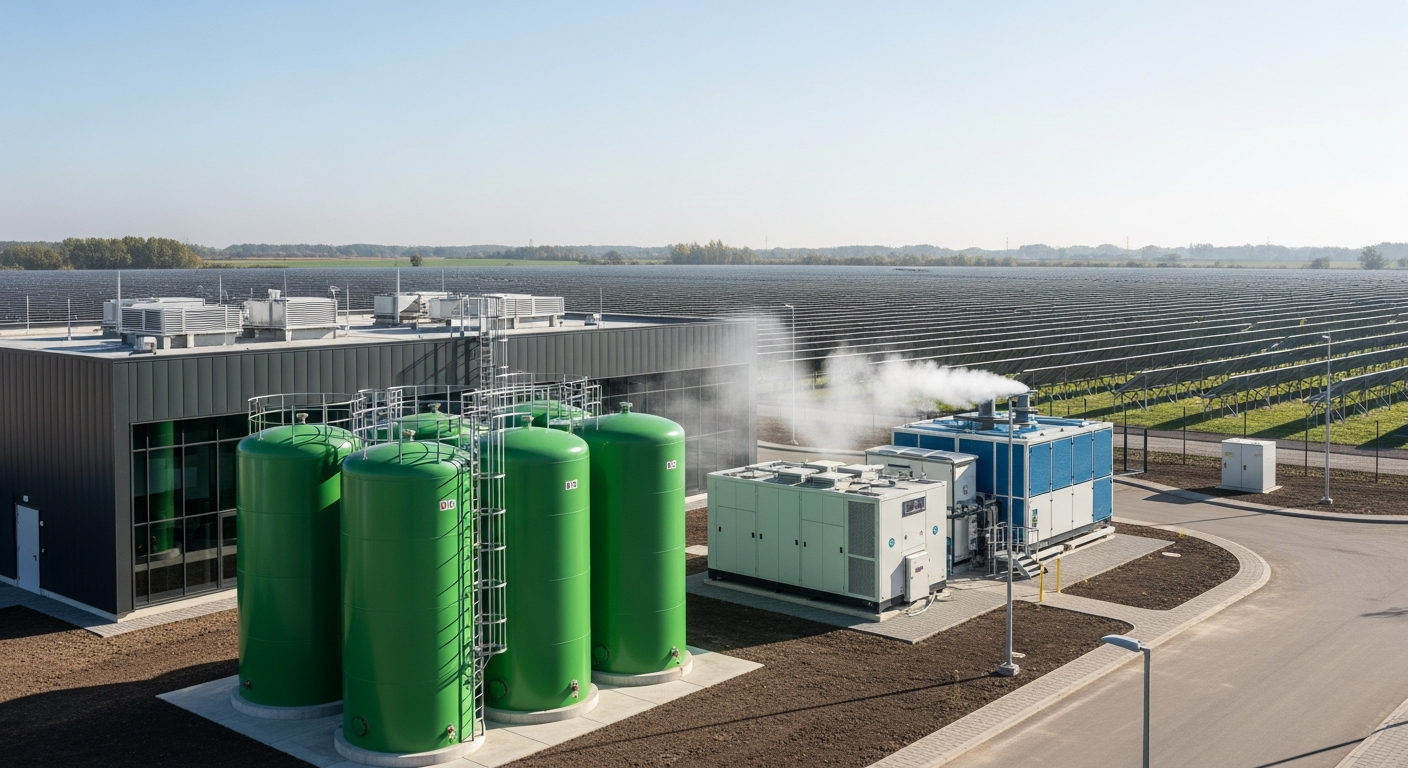
Industry leaders are now actively pursuing green ammonia-based systems to provide resilient, low-carbon power directly at data center sites. GHD, a global professional services company, modeled an 80 MW BTM facility for the U.S. supported by 250 MW of renewable generation and a closed-loop ammonia system. This approach not only slashes carbon emissions but also bypasses grid constraints and mitigates fossil fuel risks. Their modeling projects ammonia-fueled gas turbines could drive carbon intensity down to just 3 grams of CO₂ per kilowatt-hour—over 100 times cleaner than typical natural gas setups. Crucially, ammonia combustion also allows for partial water recovery from flue gases, reclaiming up to one-third of moisture, a significant benefit for water-stressed regions.
The technological breakthroughs are accelerating. In March 2026, IHI and GE Vernova successfully demonstrated 100% ammonia combustion in full-scale F-Class gas turbine components, a major step towards commercial deployment by 2030. This builds on IHI's earlier success in June 2022, achieving 100% combustion of liquid ammonia in a 2 MW-class gas turbine, reducing greenhouse gas emissions by over 99%. Meanwhile, Amogy, a leader in ammonia-to-power solutions, partnered with Hoku Infrastructure in March 2026 to integrate its ammonia-cracking catalysts into projects across Japan and Asia, specifically targeting data centers and other high-performance computing facilities. These systems convert ammonia back into hydrogen to power fuel cells or engines, offering dispatchable, carbon-free electricity.
This pivot to on-site ammonia power is a profound shift in how AI's energy demands are met. It connects the rapidly expanding digital economy with the global energy transition, moving beyond simple renewable energy procurement to the creation of dedicated, integrated energy ecosystems. The global green ammonia market itself is undergoing a "seismic shift," transitioning from pilot programs to commercially viable mega-projects, with 2025 and 2026 marking pivotal years for world-scale production.
While the efficiency losses in converting renewables to ammonia and back to electricity remain a challenge, the value of dispatchable, low-carbon reliability for AI is reshaping the economics. The upfront costs of ammonia infrastructure are high, but projections suggest levelized costs of electricity could be competitive with natural gas by the end of the decade as electrolyzer technology improves and green ammonia scales. The critical factors to monitor are the continued advancements in ammonia cracking and combustion efficiency, the establishment of robust safety protocols for its handling, and the acceleration of global supply chain development for green ammonia. This controversial fuel, once primarily associated with fertilizer and industrial use, is becoming indispensable to powering the AI future, transforming data centers into self-sufficient, green energy hubs.
By 2030, U.S. data centers could consume 8-12% of total national electricity demand, up from 3-4% today, with AI-focused facilities tripling their power usage. This explosive growth is leading to grid connection wait times exceeding five years in major data center hubs like Northern Virginia, Silicon Valley, and Dublin. The industry needs not just more energy, but *dispatchable*, *constant* energy—a profile batteries struggle to provide for the multi-hour, high-cycle operations of AI workloads.
Ammonia's Unlikely Ascent
Amidst this looming energy crisis, green ammonia (NH3), produced using renewable electricity, is emerging as a game-changer for on-site, behind-the-meter (BTM) data center power. While green hydrogen has captured much of the clean energy spotlight, 2025 saw approximately 50 hydrogen projects canceled, with many more stalled. Ammonia, by contrast, offers distinct advantages as a dense hydrogen carrier and a long-duration energy buffer, easier to store and transport than hydrogen itself.
Industry leaders are now actively pursuing green ammonia-based systems to provide resilient, low-carbon power directly at data center sites. GHD, a global professional services company, modeled an 80 MW BTM facility for the U.S. supported by 250 MW of renewable generation and a closed-loop ammonia system. This approach not only slashes carbon emissions but also bypasses grid constraints and mitigates fossil fuel risks. Their modeling projects ammonia-fueled gas turbines could drive carbon intensity down to just 3 grams of CO₂ per kilowatt-hour—over 100 times cleaner than typical natural gas setups. Crucially, ammonia combustion also allows for partial water recovery from flue gases, reclaiming up to one-third of moisture, a significant benefit for water-stressed regions.
From Laboratory to Gigawatt Scale
The technological breakthroughs are accelerating. In March 2026, IHI and GE Vernova successfully demonstrated 100% ammonia combustion in full-scale F-Class gas turbine components, a major step towards commercial deployment by 2030. This builds on IHI's earlier success in June 2022, achieving 100% combustion of liquid ammonia in a 2 MW-class gas turbine, reducing greenhouse gas emissions by over 99%. Meanwhile, Amogy, a leader in ammonia-to-power solutions, partnered with Hoku Infrastructure in March 2026 to integrate its ammonia-cracking catalysts into projects across Japan and Asia, specifically targeting data centers and other high-performance computing facilities. These systems convert ammonia back into hydrogen to power fuel cells or engines, offering dispatchable, carbon-free electricity.
This pivot to on-site ammonia power is a profound shift in how AI's energy demands are met. It connects the rapidly expanding digital economy with the global energy transition, moving beyond simple renewable energy procurement to the creation of dedicated, integrated energy ecosystems. The global green ammonia market itself is undergoing a "seismic shift," transitioning from pilot programs to commercially viable mega-projects, with 2025 and 2026 marking pivotal years for world-scale production.
What to Watch
While the efficiency losses in converting renewables to ammonia and back to electricity remain a challenge, the value of dispatchable, low-carbon reliability for AI is reshaping the economics. The upfront costs of ammonia infrastructure are high, but projections suggest levelized costs of electricity could be competitive with natural gas by the end of the decade as electrolyzer technology improves and green ammonia scales. The critical factors to monitor are the continued advancements in ammonia cracking and combustion efficiency, the establishment of robust safety protocols for its handling, and the acceleration of global supply chain development for green ammonia. This controversial fuel, once primarily associated with fertilizer and industrial use, is becoming indispensable to powering the AI future, transforming data centers into self-sufficient, green energy hubs.
More from Renewable Energy
 Energy Agent
Big Green Energy's Blind Spot? Your Farm Just Became a Fuel Hub.
 Energy Agent
Grid Shock: AI's Hunger Forces a Hydrogen Gamble We're Not Ready For.
 Energy Agent
Trillions in Green Energy Trapped: The Unseen Crisis Threatening Your Power
 Energy Agent