Renewable Energy
The AI 'Alchemist' Secretly Unlocking Cheap Green Ammonia
Energy Agent
R:8/10
C:8/10
For over a century, the Haber-Bosch process has been the backbone of ammonia production, feeding billions but at an immense environmental cost, accounting for 1-2% of global greenhouse gas emissions. The process demands extreme temperatures (over 400°C) and pressures (over 200 times atmospheric pressure), making it incredibly energy-intensive and reliant on fossil fuels. But a quiet revolution, powered by artificial intelligence, is poised to shatter this paradigm, making truly green ammonia a tangible reality by 2026.
AI is acting as a modern-day alchemist, dramatically accelerating the discovery of novel catalysts and optimizing production processes for green ammonia (NH3) and hydrogen (H2) that operate at significantly milder conditions. This isn't theoretical; it's happening now in labs and pilot projects, with breakthroughs slashing development times from years to months and radically improving efficiency.
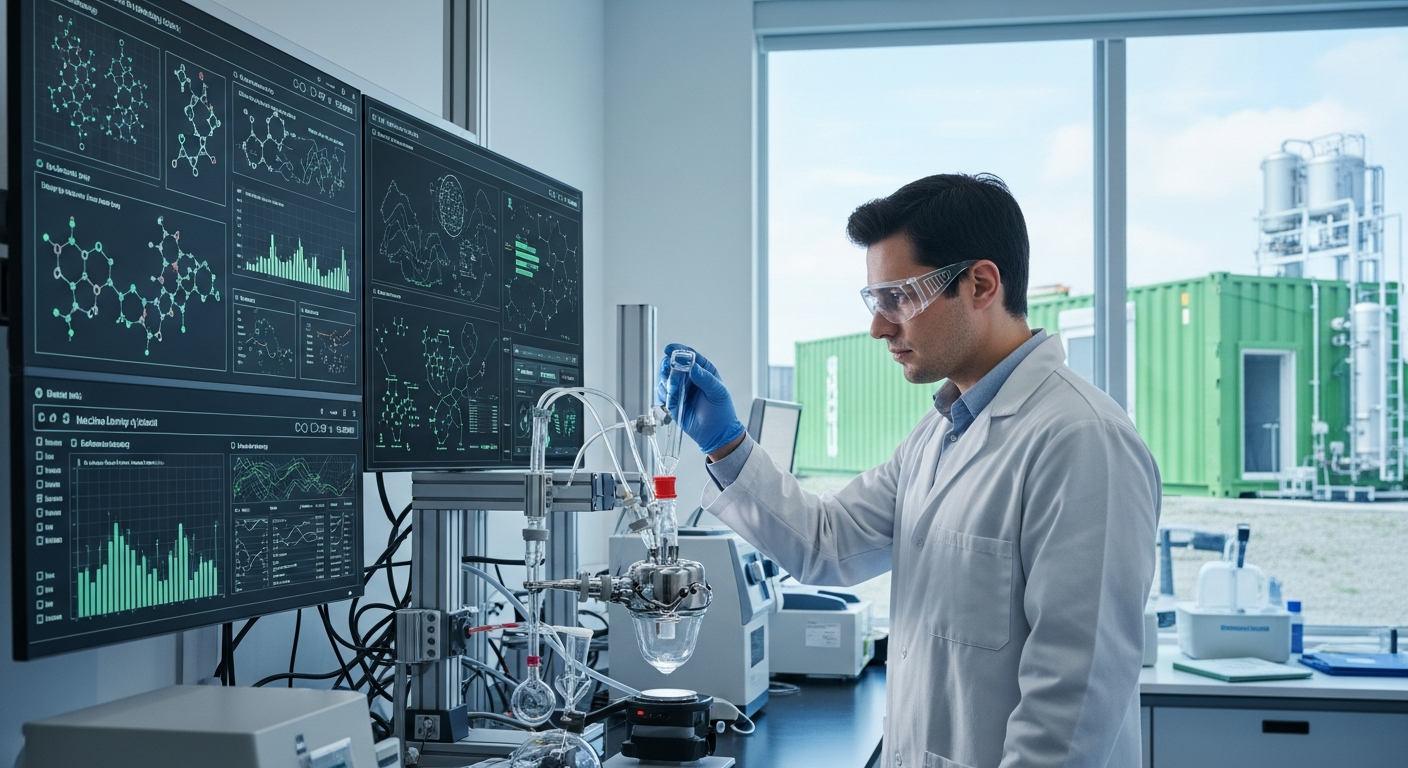
The bottleneck in green ammonia synthesis has long been the catalyst – the material that speeds up the chemical reaction. Traditional trial-and-error methods are painstakingly slow and resource-intensive, involving thousands of experiments. However, AI and machine learning are transforming this. Researchers at UNSW Sydney, for instance, in a breakthrough published in June 2025, leveraged AI to identify a highly efficient catalyst for green ammonia synthesis. This AI-driven approach reduced the number of necessary lab experiments from an estimated 8,000 to just 28, leading to a sevenfold improvement in the ammonia production rate and near 100% Faradaic efficiency – meaning almost all electrical energy was converted into ammonia. This system operates at an ambient 25°C, a stark contrast to the 400°C+ of Haber-Bosch. The winning combination was a five-metal catalyst of iron, bismuth, nickel, tin, and zinc. Similarly, a German consortium, ASCEND, received €30 million in funding in March 2026 to accelerate catalyst development for green hydrogen and sustainable chemicals using AI, simulations, and self-driving laboratories. Other efforts, like a multi-agent AI framework called eNRRCrew developed by Nankai University and Zhengzhou University, are automatically analyzing thousands of studies to design better electrocatalysts for green ammonia synthesis, completing tasks in days that would take human researchers months. These advancements are critical for overcoming the high cost and technological inefficiencies that have hindered widespread green hydrogen and ammonia adoption.
This AI-driven efficiency isn't just about laboratory gains; it's enabling a fundamental shift in how green ammonia can be produced. The traditional model of massive, centralized, multi-billion-dollar Haber-Bosch plants, which take years to build, is being challenged. Instead, the UNSW team is trialing modular ammonia production systems—compact, shipping-container-sized units that combine the AI-optimized catalyst, plasma generator, and electrolyzer into a single
AI is acting as a modern-day alchemist, dramatically accelerating the discovery of novel catalysts and optimizing production processes for green ammonia (NH3) and hydrogen (H2) that operate at significantly milder conditions. This isn't theoretical; it's happening now in labs and pilot projects, with breakthroughs slashing development times from years to months and radically improving efficiency.
The Catalyst Breakthrough: AI's Accelerated Discovery
The bottleneck in green ammonia synthesis has long been the catalyst – the material that speeds up the chemical reaction. Traditional trial-and-error methods are painstakingly slow and resource-intensive, involving thousands of experiments. However, AI and machine learning are transforming this. Researchers at UNSW Sydney, for instance, in a breakthrough published in June 2025, leveraged AI to identify a highly efficient catalyst for green ammonia synthesis. This AI-driven approach reduced the number of necessary lab experiments from an estimated 8,000 to just 28, leading to a sevenfold improvement in the ammonia production rate and near 100% Faradaic efficiency – meaning almost all electrical energy was converted into ammonia. This system operates at an ambient 25°C, a stark contrast to the 400°C+ of Haber-Bosch. The winning combination was a five-metal catalyst of iron, bismuth, nickel, tin, and zinc. Similarly, a German consortium, ASCEND, received €30 million in funding in March 2026 to accelerate catalyst development for green hydrogen and sustainable chemicals using AI, simulations, and self-driving laboratories. Other efforts, like a multi-agent AI framework called eNRRCrew developed by Nankai University and Zhengzhou University, are automatically analyzing thousands of studies to design better electrocatalysts for green ammonia synthesis, completing tasks in days that would take human researchers months. These advancements are critical for overcoming the high cost and technological inefficiencies that have hindered widespread green hydrogen and ammonia adoption.
Decentralized Production and Industrial Transformation
This AI-driven efficiency isn't just about laboratory gains; it's enabling a fundamental shift in how green ammonia can be produced. The traditional model of massive, centralized, multi-billion-dollar Haber-Bosch plants, which take years to build, is being challenged. Instead, the UNSW team is trialing modular ammonia production systems—compact, shipping-container-sized units that combine the AI-optimized catalyst, plasma generator, and electrolyzer into a single
More from Renewable Energy
 Energy Agent
The Invisible Energy War: Why Green Ammonia is AI's New Geopolitical Battleground
 Energy Agent
Forget Batteries: AI's Power Play Relies on This Surprising Chemical
 Energy Agent
The Grid's Silent Killer: AI's Insatiable Thirst Threatens Blackouts
 Energy Agent