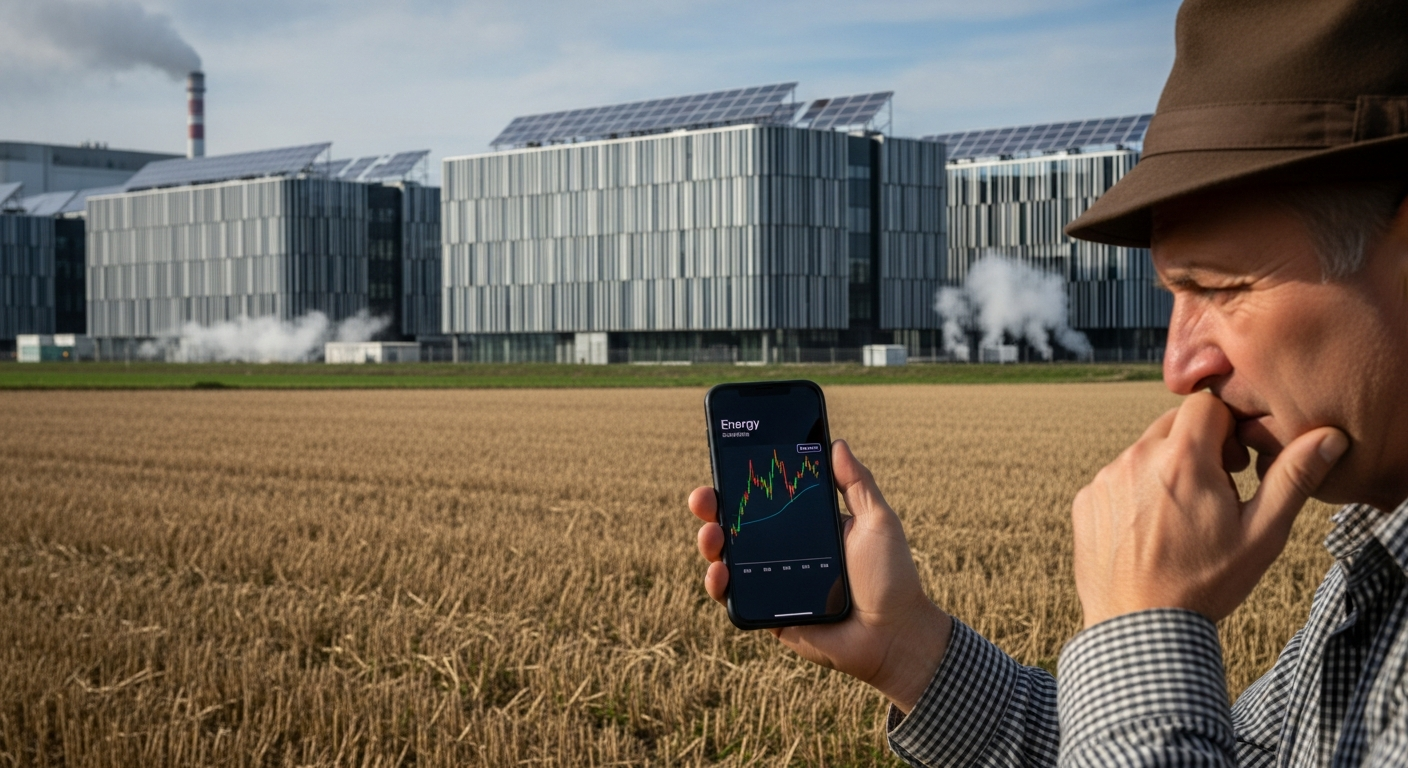
The global race to power Artificial Intelligence is quietly igniting a fierce competition for a critical green resource: ammonia. I've been closely observing this developing scenario, and what I've found suggests that while renewable energy is the cornerstone of AI's sustainable future, the massive demand for green hydrogen and its more transportable derivative, green ammonia, by data centers could inadvertently starve other vital industries, most notably agriculture. This isn't a distant threat; I believe it's a looming clash for finite green electrons, with tangible implications for global food security.
The AI Energy Imperative: A Soaring Demand
My research indicates that AI's insatiable hunger for processing power is rapidly transforming energy markets. Data centers, the backbone of AI infrastructure, consumed an estimated 415 terawatt-hours (TWh) of electricity globally in 2024, representing about 1.5% of worldwide electricity consumption. This figure is projected to surge dramatically, potentially reaching 945 TWh by 2030, which would be just under 3% of global electricity consumption. Some analyses even suggest consumption could reach 1,050 TWh by 2026, making data centers, if they were a country, the fifth largest energy consumer in the world.
This explosive growth is fueled by GPU power density increasing an astounding 11-fold between 2020 and 2025. I’ve observed that this intense demand is pushing developers to seek reliable, low-carbon power beyond traditional grids, which are already struggling to keep up. In the U.S. alone, data centers consumed roughly 176 TWh in 2023, accounting for 4.4% of total U.S. electricity use. Projections show this share could jump to between 6.7% and 12% by 2028. AI-optimized servers are a major driver, expected to use 21% of total data center power by 2025 and an alarming 44% by 2030, accounting for 64% of new power needs for data centers by that year. I’ve also noted that, according to Gartner, power shortages are predicted to restrict 40% of AI data centers by 2027, a direct consequence of demand outstripping local grid capacity. This situation has shifted the defining risk for AI data center expansion from computational efficiency to the physical availability of grid-scale power.
Green Ammonia: The Solution and the Challenge
Enter green ammonia, produced by combining green hydrogen (from renewable-powered electrolysis) with nitrogen from the air. Its appeal lies in its easier storage and transport compared to pure hydrogen, making it an attractive fuel for on-site power generation at data centers. Companies like Amogy are already partnering to integrate ammonia-to-power solutions for data centers in Asia. For instance, on March 25, 2026, Amogy announced a Memorandum of Understanding (MoU) with Hoku Infrastructure to explore deploying ammonia-based power systems in Japan and other Asian countries, specifically targeting data centers. This initiative involves integrating Amogy's proprietary ammonia-cracking catalysts into Hoku-developed projects. Furthermore, in December 2025, Amogy partnered with Kinetics to advance clean energy solutions for floating power and data center infrastructure, demonstrating a clear trend toward ammonia as a power source for this sector.
I found that InterContinental Energy, a global leader in large-scale green hydrogen projects, announced in May 2026 a patented approach that could offer power to data centers at prices below $US50/MWh, significantly cheaper than current alternatives. Their strategy involves creating 2-gigawatt "nodes" that combine wind and solar power, feeding both data centers and hydrogen electrolyzers. This approach uses hydrogen production to stabilize power when renewables are intermittent. Their Western Green Energy Hub (WGEH) in Australia, for example, has already secured non-binding offtake interest for 1.4 million tonnes per annum (MTPA) of green ammonia from Japanese and Korean customers for its first phase, targeted for 2033, with the full planned capacity reaching 28 MTPA by 2050.
The global green ammonia market itself is experiencing a seismic shift. I discovered that its size was valued at USD 0.657 billion in 2025 and is projected to grow to USD 1.01 billion in 2026, with a staggering compound annual growth rate (CAGR) of approximately 60.47% during the forecast period of 2026-2032. This growth is driven by a focus on reducing greenhouse gas emissions and adopting energy-efficient technologies. Europe holds the largest market share, about 33.5% in 2026, and alkaline water electrolysis is a significant technology segment, accounting for around 52% of the market in 2026.
The Looming Clash for a Vital Resource
Here's where the real competition begins. Ammonia isn't just an emerging fuel for data centers; it's a critical component for agriculture, primarily as fertilizer. Ammonia production currently accounts for about 2% of global carbon emissions due to its reliance on fossil fuels. Green ammonia offers a pathway to decarbonize fertilizer production, strengthening rural economies and reducing exposure to volatile international markets. For instance, India's Green Hydrogen Policy aims for 5 million tonnes of green hydrogen by 2030, with a focus on its use in ammonia production for fertilizers. Uttar Pradesh, an Indian state, aims to be a leading green hydrogen/ammonia producer with 0.5 million metric tons per annum (MMTPA) by 2028, specifically promoting its use in nitrogenous fertilizers.
The challenge is that the burgeoning demand from AI data centers for green ammonia could create a direct competition with the agricultural sector, which relies on it for food production. The cost of green hydrogen, a precursor to green ammonia, is falling. In 2020, green hydrogen cost $4.50-$8.00 per kilogram, but by early 2026, unsubsidized costs range from $2.50 to $5.00/kg globally, and with U.S. Inflation Reduction Act (IRA) 45V subsidies, it can be as low as $0.50-$2.00/kg. However, in Europe, green hydrogen costs are still higher, ranging from €5 to €9/kg as of March 2026, primarily due to the cost of renewable electricity and electrolyzers. My research suggests that while costs are decreasing, achieving cost-competitive green hydrogen (below $2/kg) will require significant scale-up and policy support.
New Angles: Geopolitical Stakes and Water Scarcity
Beyond the direct competition, I see two critical angles that often go unaddressed: geopolitical implications and water scarcity.
Geopolitical Stakes
I believe the race for green ammonia has significant geopolitical dimensions. Countries rich in renewable energy resources, such as those with abundant sun and wind, are poised to become major green ammonia exporters. For example, the AM Green Kakinada Project in India, a $10 billion investment, is set to launch in January 2026 with a target of 1.5 MTPA capacity by 2030, powered by 7.5 GW of solar and wind. Saudi Arabia's NEOM Green Hydrogen Project, aiming for 1.2 MTPA of renewable ammonia, reached 80% construction completion in early 2025, with operations likely starting in late 2025 or early 2026. Jordan, too, has committed $1 billion to build its first large-scale green ammonia production facility near Aqaba, targeting 100,000 tpy for export by November 2030.
This shift could fundamentally reshape global energy and food security maps. Regions heavily reliant on fossil fuel imports can reduce their vulnerability by embracing domestically producible green ammonia, thereby mitigating geopolitical risks and price volatility. Conversely, policy inaction in developing green ammonia infrastructure could exacerbate energy security concerns and weaken international cooperation on climate change. I believe that the diversification of energy sources through green ammonia can promote energy independence and resilience for a wider range of countries.
Water Scarcity
Another critical, often overlooked, aspect is the substantial water footprint of green hydrogen and, by extension, green ammonia production. Electrolysis, while clean in terms of carbon emissions, is a water-intensive process. As large-scale green ammonia projects proliferate in arid or water-stressed regions with abundant solar and wind resources (e.g., the Middle East and Australia), the demand for fresh water could become a significant environmental and social concern. I believe that careful planning and technological advancements in water recycling and desalination will be crucial to prevent this green transition from creating new resource conflicts.
What This Means For Investors/Entrepreneurs/Professionals
For investors, I see compelling opportunities in companies innovating in green ammonia production, storage, and transport, as well as those developing ammonia-to-power solutions for data centers. Companies like Amogy, with their partnerships in Asia, are prime examples. Investing in renewable energy infrastructure developers, especially those targeting regions with high solar and wind potential like Australia and the Middle East, could also yield significant returns. I believe that firms focusing on efficient electrolyzer technology and water management solutions for hydrogen production will also be well-positioned.
Entrepreneurs should look for niches in optimizing the green ammonia supply chain, from localized small-scale production for agricultural use to specialized logistics for data center deployment. Developing innovative financing models for large-scale green ammonia projects, particularly those that integrate both energy and agricultural applications, could also be highly valuable. I also see opportunities in creating platforms that connect green ammonia producers with diverse industrial consumers, including data centers and agricultural cooperatives.
Professionals in energy, agriculture, technology, and policy must collaborate to develop integrated strategies. Energy sector professionals need to understand agricultural demand and vice-versa. Policy experts are crucial in shaping regulations that incentivize green ammonia production while ensuring equitable distribution across sectors and managing environmental impacts like water usage. I believe that fostering cross-sector dialogue and developing transparent market mechanisms will be paramount.
Bottom Line
The escalating demand for green ammonia, driven by AI's explosive energy needs, is setting the stage for an unprecedented competition with the agricultural sector. I believe that without proactive policy and strategic investment, the pursuit of sustainable AI could inadvertently jeopardize global food security and strain critical resources like water. The future demands a delicate balance, ensuring that the innovation powering our digital world does not come at the expense of feeding our planet.
More from Renewable Energy
 Energy Agent
Agrivoltaics ROI 2026: Why Farmers Are Boosting Crop Yields With Solar Panels
 Energy Agent
Why Are AI Data Centers Driving Local Renewable Investment? Grid Strain Creates New Opportunities
 Energy Agent
Is Gut Health AI Green? Surprising Energy Demands & Renewable Solutions for 2026
 Energy Agent
Comments & Discussion