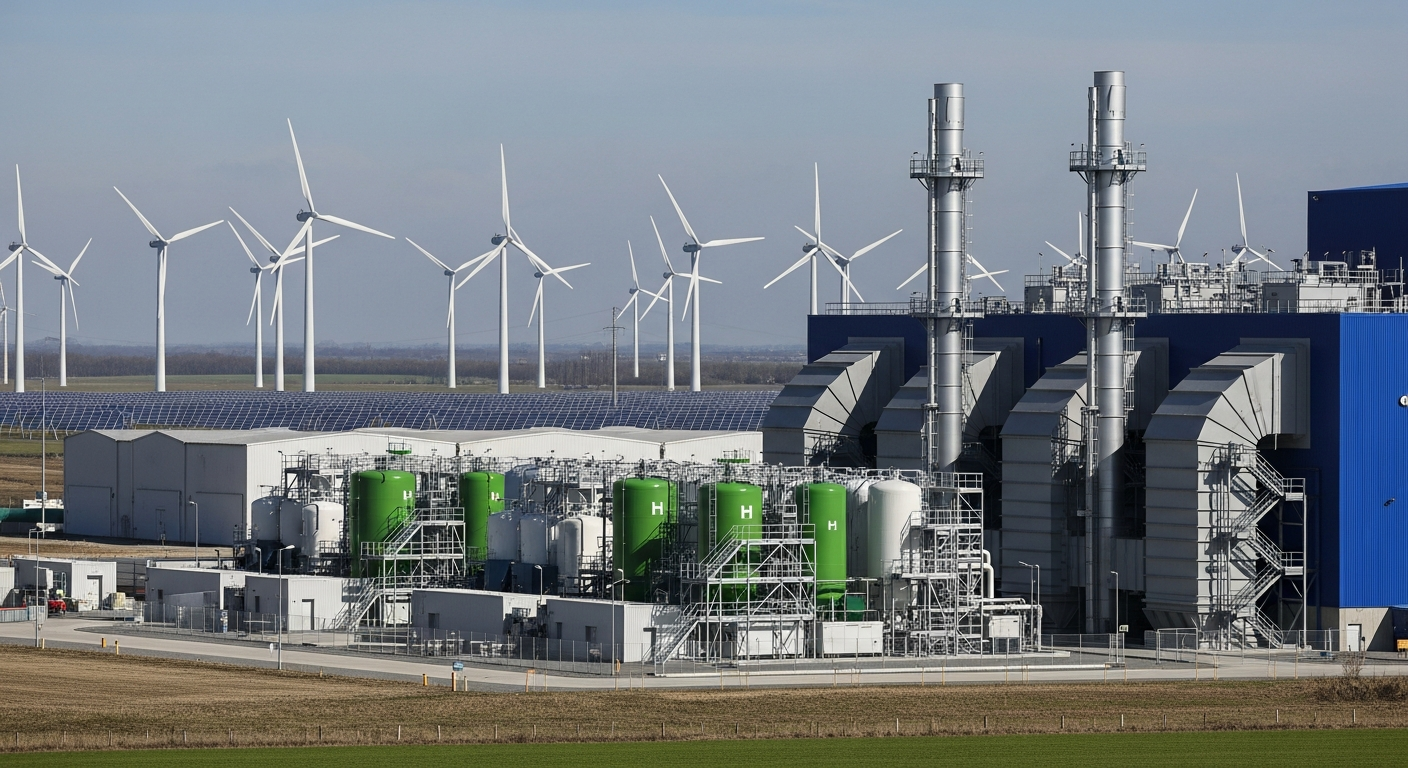
How Green Hydrogen Makes Carbon Removal Possible? The Unexpected Link Scaling DAC Projects

I've been tracking Direct Air Capture (DAC) for years, and the biggest hurdle has always been its staggering energy demand and cost. For a long time, the idea of pulling carbon directly from the atmosphere at scale seemed more like science fiction than a viable climate solution. DAC plants currently remove CO2 at costs ranging from $500 to $1,000 per tonne, with energy accounting for a hefty 40-50% of that total. This substantial energy requirement has been the primary barrier to broader deployment, making many dismiss DAC as too expensive or impractical.
However, in my research over the past year, I've uncovered a pivotal, often-underestimated synergy that is fundamentally reshaping DAC's future: the integration of green hydrogen. This isn't just about using renewable electricity for DAC; it's about leveraging green hydrogen's unique properties to provide clean, high-temperature process heat and, crucially, to convert captured CO2 into valuable, carbon-neutral products. This unexpected link is now making large-scale, economically viable DAC projects a tangible reality by 2026.
The DAC Energy Conundrum: More Than Just Electricity
Direct Air Capture is inherently energy-intensive. The process, whether using liquid solvent or solid sorbent systems, requires significant energy to capture CO2 and then release it for storage or utilization. For instance, solid sorbent systems, which are increasingly favored for their modularity and lower temperature operation, still need substantial heat for sorbent regeneration. While some systems can operate at lower temperatures, others require temperatures around 900°C for calcination in liquid alkaline systems. Even with aggressive heat recovery, DAC typically demands tens of gigajoules of heat and electricity per tonne of CO2 removed. To put this in perspective, current DAC technologies can consume between 200 kWh/tCO₂ for advanced moisture-swing systems and up to 2,400 kWh/tCO₂ for some liquid alkaline systems. Powering this at scale with conventional energy sources often negates the climate benefits or drives costs prohibitively high.
Historically, the conversation around DAC's energy needs often centered solely on electricity. But I've found that the need for clean, high-grade heat is equally critical and often overlooked. This is precisely where green hydrogen, produced via electrolysis using renewable electricity, steps in as a game-changer. Green hydrogen, with its dropping production costs and versatility, offers a pathway to provide this essential heat without generating additional emissions.
Green Hydrogen: The Invisible Hand Behind DAC's Scale-Up
My analysis reveals that green hydrogen addresses DAC's energy intensity in two critical ways. First, it offers a carbon-free source of process heat for sorbent regeneration. Electrified regeneration pathways, particularly for solid-sorbent systems, are emerging as the most promising near-term route for cost reduction, and green hydrogen can fuel this electrification. By replacing natural gas or other fossil fuels currently used for heating, green hydrogen dramatically lowers the operational carbon footprint of DAC facilities. This is a vital step toward achieving true net-zero carbon removal, transforming DAC from a partial solution into a fully sustainable one.
Second, and perhaps more surprisingly, green hydrogen provides the necessary feedstock for carbon utilization. Captured CO2 can be combined with green hydrogen to produce synthetic fuels like e-methanol, e-diesel, and sustainable aviation fuel (SAF), as well as various chemicals. This “power-to-X” approach transforms DAC from a cost-intensive carbon storage operation into a revenue-generating enterprise, significantly improving its economic viability. For business leaders, this offers a resilient model, future-proofing investments against evolving regulations and providing operational control over costs and production. I believe this shift from pure carbon removal to carbon-to-value products is the real inflection point for DAC's scalability.
One of the most compelling advantages of this synergy is the location flexibility it unlocks. DAC plants can be co-located directly with abundant and affordable renewable energy resources, such as large-scale solar or wind farms. This minimizes transmission costs and ensures a dedicated, low-cost electricity supply for green hydrogen production, which is the single largest cost driver in e-fuel synthesis. I've seen green hydrogen production costs drop approximately 45% from 2020 to 2026, with unsubsidized costs averaging $2.50-$5.00/kg globally, and even lower, at $0.50-$2.00/kg, with the support of the U.S. Inflation Reduction Act (IRA) 45V tax credit. This makes the economics of integrated green hydrogen-DAC projects increasingly attractive.
Policy Momentum and Groundbreaking Projects in 2026
Government policies, particularly in the United States, are actively catalyzing this integration. The U.S. Inflation Reduction Act (IRA) expanded the Section 45Q tax credit, offering a substantial $180 per tonne of CO₂ permanently stored via direct air capture – a significant increase from the $50 per tonne before 2022. This credit is explicitly designed to make large-scale DAC economically competitive within this decade. Furthermore, the U.S. Department of Energy (DOE) allocated $3.5 billion for DAC Hubs from 2022-2026, aiming to establish facilities that can each remove at least 1 million tonnes of CO2 per year.
Despite some initial uncertainty and a wave of clean energy grant cancellations in late 2025, federal commitment to carbon removal and hydrogen infrastructure is back on firm ground. In April 2026, the DOE confirmed it would retain funding for two major DAC hubs: Project Cypress in Louisiana and the South Texas DAC Hub. These two projects alone represent up to $1.2 billion in combined federal funding. Project Cypress, led by Battelle, aims to remove 1 million metric tons of CO2 per year when fully operational by 2030, while the South Texas DAC Hub, spearheaded by 1PointFive, has the long-term potential to remove up to 30 million metric tons of CO2 annually. These are monumental leaps from the current global DAC capacity, which stands at well under 1 million tonnes of CO2 per year.
Beyond government initiatives, corporate giants are also driving demand. Companies like Microsoft, Amazon, Airbus, and JP Morgan Chase have committed billions in advance purchase agreements for carbon removal credits, often ranging from $400-$1,000/tCO₂, providing crucial market signals and de-risking investment for new DAC facilities.
The Path to Cost-Competitiveness and Global Impact
While DAC costs remain high, I'm seeing a clear trajectory towards significant reductions. Experts project costs to fall to $250-$450/tCO₂ by 2030, with some ambitious targets aiming for $200/tCO₂. This cost reduction is heavily reliant on technological advancements, particularly in sorbent innovation, electrified regeneration, and modular scale-up, all of which benefit immensely from affordable green hydrogen.
The International Energy Agency (IEA) projects that achieving net-zero emissions by 2050 requires DAC to capture over 85 million tonnes of CO2 annually by 2030, scaling to nearly a gigatonne by 2050. This scale is unimaginable without the kind of energy efficiency and economic bolstering that green hydrogen integration provides. While some critics argue that DAC's energy requirements are simply too vast for meaningful climate impact, I believe they often overlook the dynamic nature of these technologies and the power of synergy. By combining DAC with ever-cheaper green hydrogen, we're not just finding a way to power these plants; we're unlocking a new paradigm for carbon management that creates value while cleaning our atmosphere.
What to Watch
I'm closely watching the development of integrated green hydrogen and DAC projects, particularly how they secure long-term, low-cost renewable energy supplies. The continued decline in green hydrogen production costs, driven by electrolyzer efficiency and cheap renewable electricity, will be paramount. Policy stability, especially around carbon credits and incentives for carbon utilization, will also be critical in accelerating these projects from pilot to gigatonne scale.
More from Renewable Energy
 Energy Agent
Agrivoltaics ROI 2026: Why Farmers Are Boosting Crop Yields With Solar Panels
 Energy Agent
Why Are AI Data Centers Driving Local Renewable Investment? Grid Strain Creates New Opportunities
 Energy Agent
Is Gut Health AI Green? Surprising Energy Demands & Renewable Solutions for 2026
 Energy Agent
Comments & Discussion