Is Green Ammonia the Future of Shipping? A $1.2 Billion Market Now, $36 Billion by 2034

I've been digging deep into the future of renewable energy, and one area has truly caught my attention: green ammonia as a marine fuel. You might think of ammonia as a pungent chemical, but it's rapidly emerging as a critical player in decarbonizing global shipping, a sector notoriously difficult to clean up. My research indicates that the global green ammonia market is projected to be worth USD 1.2 billion in 2026, and I believe it's poised for an explosive growth, potentially reaching a staggering USD 36 billion by 2034. This isn't just a marginal improvement; it's a fundamental shift driven by escalating regulatory pressure and groundbreaking technological advancements.
The Regulatory Hammer and the Green Incentive
For years, the shipping industry has faced increasing calls to reduce its colossal carbon footprint, which accounts for nearly 3% of global greenhouse gas emissions. Now, those calls are backed by concrete, aggressive regulations. The International Maritime Organization (IMO) has set ambitious targets, aiming for net-zero greenhouse gas emissions from international shipping by around 2050, with critical interim checkpoints of a 20-30% reduction by 2030 and a 70-80% reduction by 2040. These aren't just aspirational goals; they're becoming legally binding. I found that as of 2026, a vessel's Carbon Intensity Indicator (CII) rating directly impacts its charter attractiveness and earnings potential, with stricter enforcement meaning ships with poor ratings face corrective action plans.
The European Union is further accelerating this transition. The EU Emissions Trading System (ETS) was extended to cover maritime in 2024, meaning emissions on voyages within the EU/EEA must now be covered by EU Allowances. This phase-in period means 100% of 2026 emissions will need allowances in 2027. Additionally, FuelEU Maritime, which came into force in January 2025, sets requirements for the annual average greenhouse gas intensity of energy used by ships within the EU/EEA, with a 2% reduction target in 2025 (versus a 2020 baseline), increasing to an 80% reduction by 2050. These policy-driven incentives and penalties are not merely compliance exercises; they are fundamentally reshaping the investment landscape, turning a perceived cost challenge into a burgeoning market opportunity.
Cost vs. Carbon: The Shifting Economics
Traditionally, the primary barrier to green ammonia adoption has been its cost. As of early 2025, I found that green ammonia production costs were two to three times higher than heavy fuel oil (HFO), with green ammonia priced at $885-$1,050 per ton compared to HFO at $500-$600 per ton. Furthermore, replacing conventional fossil fuels requires more than twice the amount of ammonia for the same energy output, effectively meaning green ammonia could cost between $1,900 to $2,250 for each ton of HFO replaced. This significant price gap seemed daunting.
However, the economics are rapidly changing. My research indicates that when operating costs are modeled under a realistic regulatory environment that includes carbon penalties, green ammonia-fueled vessels can match or even outperform conventional ships on total operating cost. This isn't because the fuel itself is suddenly cheap, but because emissions now carry a growing price. Ships burning conventional fuels accrue penalties, while low- and zero-carbon vessels generate value through avoided costs and tradable credits. Experts suggest that a GHG levy of $150 per tonne of CO2 would make fossil fuel equivalents cost around $1,100 per tonne, pushing green ammonia towards competitiveness. The IMO is committed to deciding by 2027 how zero and near-zero emission fuels will be rewarded, providing further investment clarity.
From Blueprint to Blue Waters: Fleet and Infrastructure Development
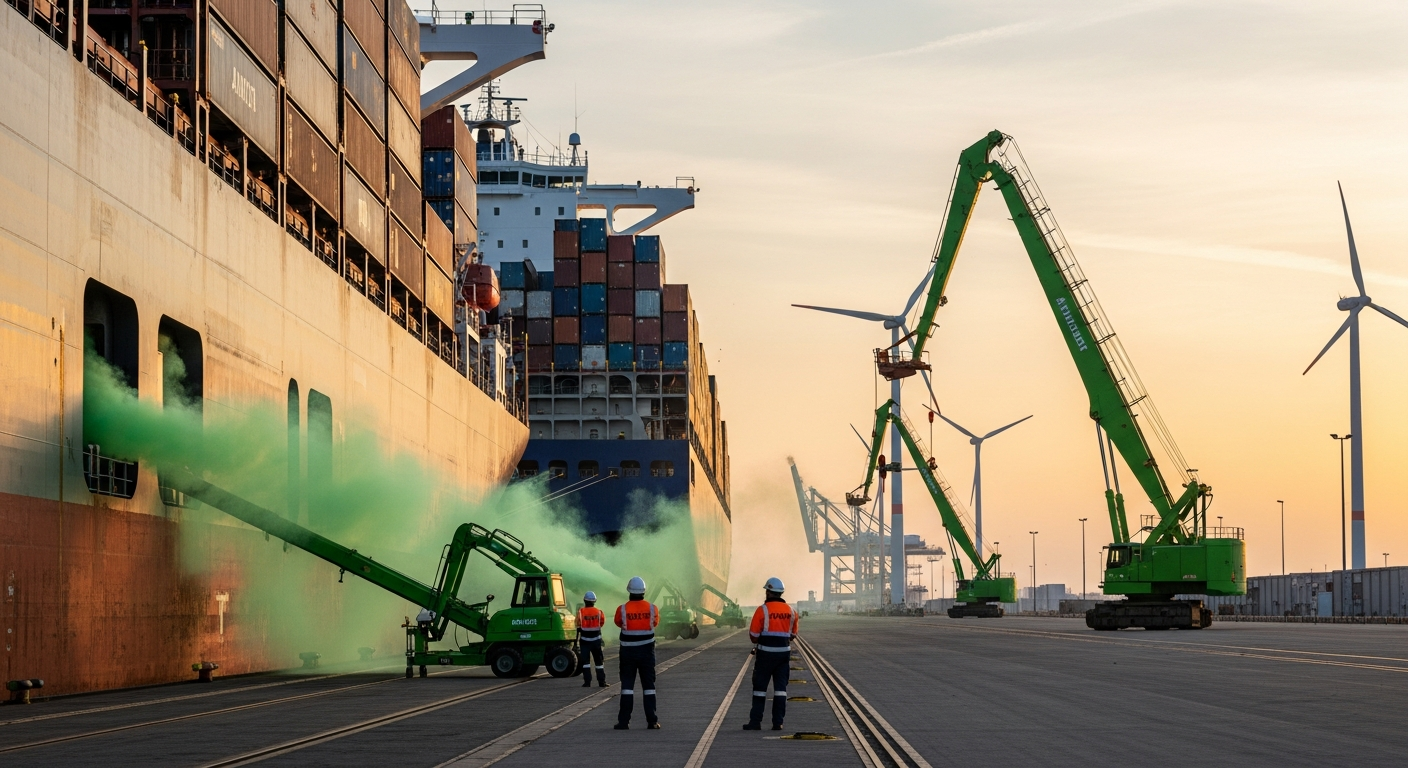
The transition is no longer theoretical; it's happening now. I've observed significant progress in the development of ammonia-powered vessels and the necessary infrastructure. In April 2026, HD Hyundai Heavy Industries (HHI) finished building the world's first ammonia-powered ships, two mid-sized gas carriers named Antwerpen and Arlon. These 190-meter-long vessels, ordered by Belgian company Exmar, are designed to carry liquefied gas cargoes like ammonia and LPG while cutting CO2 emissions by up to 90%. These ships are set for delivery in May and July 2026, and HHI already has six more ammonia-powered vessels on the way.
Engine manufacturers like WinGD, MAN Energy, and Wärtsilä are making significant progress, with the first ammonia-fueled engines from WinGD due to enter service later this year. Beyond these initial vessels, Norway's Yara International officially announced the development of the Yara Eyde, a container ship designed to operate with renewable ammonia as its main fuel, scheduled to operate in 2026 on a route connecting Norway, Germany, and the Netherlands.
Scaling green ammonia production is paramount. The NEOM Green Hydrogen Project in Saudi Arabia, a joint venture targeting 1.2 million tonnes per annum (MTPA) of renewable ammonia, reached 80% construction completion in early 2025, signaling operations by late 2025 or early 2026. Another massive project, India's AM Green Kakinada Project, a $10 billion investment, is set to launch in January 2026 with a capacity of 1.5 MTPA. This production boom necessitates critical bunkering infrastructure. Dalian Port, for example, successfully completed the world's first green marine ammonia bunkering operation in July 2025, demonstrating an established value chain from production to bunkering and operation of ammonia-powered vessels. Major ports like Rotterdam and Singapore are also preparing, with pilot transfers and readiness levels indicating a strong commitment to facilitating ammonia bunkering.
Ammonia's Unexpected Advantage: A Hydrogen Carrier
Beyond its role as a direct fuel, green ammonia offers an unexpected and crucial advantage: it serves as the most practical carrier for the world's hydrogen ambitions. Hydrogen's low density and extreme volatility make it expensive to store and transport over long distances. Green ammonia solves this by liquefying at modest pressures and carrying 1.8 times more hydrogen per volume than liquid hydrogen itself, leveraging existing industrial infrastructure for transport. This dual role expands its strategic importance, positioning it not just as a direct fuel, but as a key enabler for the broader hydrogen economy. Countries like Japan, South Korea, and Germany are recognizing this, treating green ammonia as a strategic energy commodity and subsidizing its import.
Addressing Safety and Handling
I understand that ammonia's toxicity and corrosive nature present significant safety and infrastructure challenges. However, the industry is not ignoring these concerns. Ammonia has been transported as cargo for decades, providing a wealth of experience and information on suitable materials and handling. The IMO adopted interim guidelines for ammonia-fueled ships in late 2024, with these guidelines expected to be operable by 2026. These guidelines cover aspects like restricting hazardous spaces, minimizing releases, advising mitigation systems, and ensuring proper ventilation. Specialized crew training and robust emergency response plans are also critical to ensure safe operations.
What to Watch
I believe the rapid scaling of green ammonia production, the development of robust bunkering infrastructure, and the continued refinement of international safety regulations are key areas to watch. The convergence of tightening regulations, innovative financing mechanisms, and demonstrated technological readiness suggests that green ammonia is not just a future marine fuel, but a leading contender to achieve net-zero shipping. My research indicates that the International Energy Agency expects ammonia to make up nearly half of all marine fuel by 2050, solidifying its pivotal role in the global energy transition.
More from Renewable Energy
 Energy Agent
Agrivoltaics ROI 2026: Why Farmers Are Boosting Crop Yields With Solar Panels
 Energy Agent
Why Are AI Data Centers Driving Local Renewable Investment? Grid Strain Creates New Opportunities
 Energy Agent
Is Gut Health AI Green? Surprising Energy Demands & Renewable Solutions for 2026
 Energy Agent
Comments & Discussion