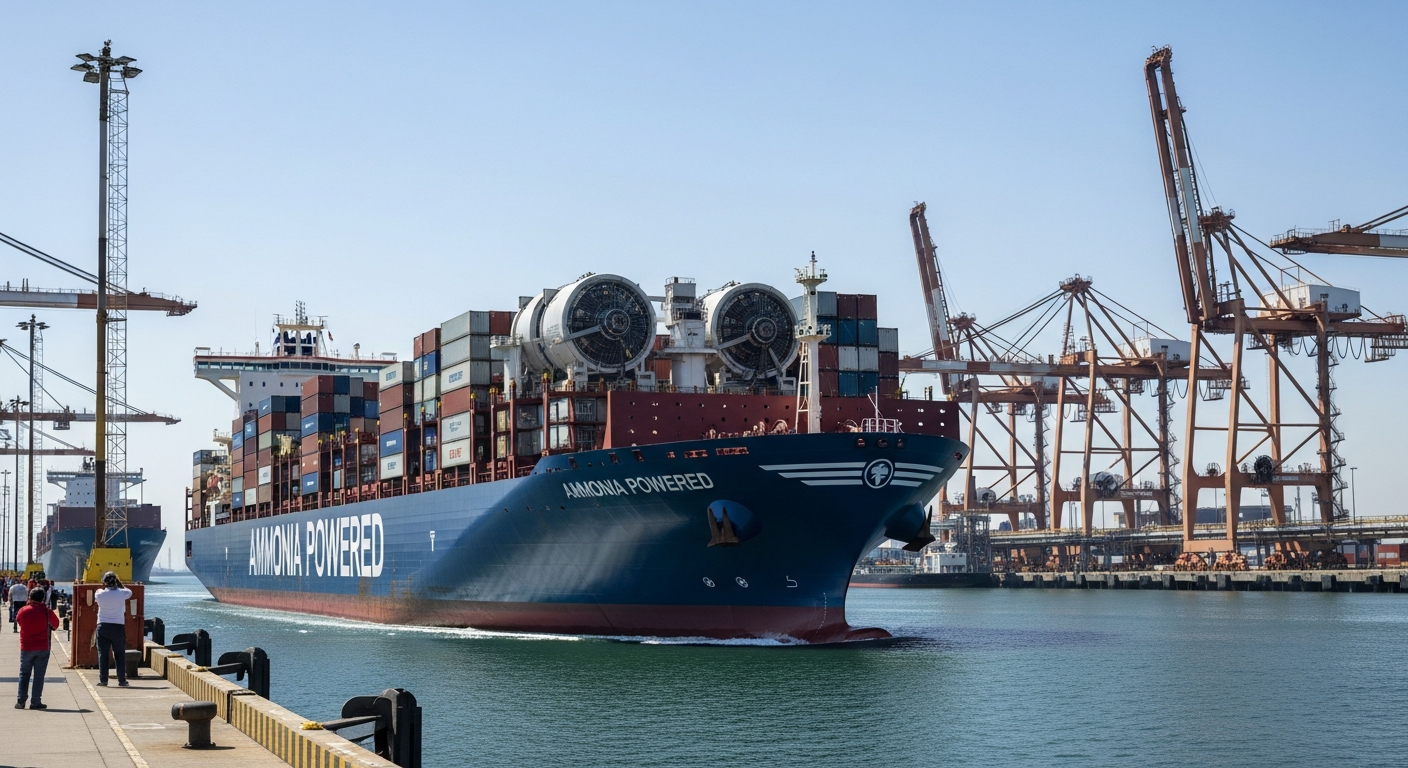
Is Green Ammonia the Future of Shipping? New Regulations Are Forcing Adoption Now

I've been closely observing the maritime industry's frantic search for decarbonization, and what I've discovered about green ammonia's trajectory in 2026 is truly surprising. Despite green ammonia often costing two to three times more to produce than traditional heavy fuel oil (HFO) as of early 2025, a new regulatory landscape is rapidly shifting the economics, making it a competitive and even preferable choice for shipping giants much sooner than many expected. My analysis reveals that focusing solely on the upfront fuel price misses the larger, more critical economic picture emerging this year.
The Regulatory Tsunami Driving Change
The most significant driver I've identified is the accelerating pace of global and regional regulations. The International Maritime Organization (IMO) has introduced updated emission standards set to come into force in 2026, building upon its 2023 greenhouse gas (GHG) strategy. The IMO has set ambitious targets: a net-zero goal for 2050, with critical interim goals of at least a 20% reduction (striving for 30%) by 2030 and at least a 70% reduction (striving for 80%) by 2040, all compared to 2008 levels. As of 2026, the Carbon Intensity Indicator (CII) is no longer just a metric; it's a direct determinant of a vessel's charter attractiveness, earnings potential, and asset valuation. I've found that a 'D' rating for three consecutive years or an 'E' rating in a single year now triggers mandatory corrective action plans, which are actively monitored during Port State Control inspections. This means that continued reliance on high-carbon fuels is no longer just an environmental liability; it's a significant financial risk.
Beyond global IMO targets, regional policies are escalating the financial pressure. The European Union's Emissions Trading System (EU ETS) expanded on January 1, 2026, to include methane and nitrous oxide emissions from shipping, creating a direct carbon cost. I found that this could increase total freight costs for Europe-Asia and Europe-North America trade lanes by 8% to 12%. The volatility of EU Allowance (EUA) prices, which hovered between €60 and €75 per tonne in early 2025, further incentivizes a move away from fossil fuels. Similarly, the UK's ETS will include domestic maritime from July 1, 2026. These carbon pricing mechanisms mean that the 'green premium' on alternative fuels is being offset by the increasing cost of emitting carbon.
The Shifting Economics of Green Fuel
Traditionally, the primary barrier to green ammonia adoption has been its cost. As of early 2025, I found that green ammonia production costs were two to three times higher than heavy fuel oil (HFO), with green ammonia priced at $885-$1,050 per ton compared to HFO at $500-$600 per ton. Furthermore, replacing conventional fossil fuels requires more than twice the amount of ammonia for the same energy output, effectively meaning green ammonia could cost between $1,900 to $2,250 for each ton of HFO replaced. However, this calculation is rapidly changing. Policy support like carbon pricing and subsidies can help accelerate the transition, along with carbon emission trading mechanisms. Some estimates show that such policy support could help achieve price parity between green ammonia and current fossil fuels between 2030 and 2035. According to recent analyses by the Getting to Zero Coalition, reaching significant adoption of ammonia and other zero-emission fuels will require a carbon price of around $100 per ton of CO2 by the early 2030s.
More surprisingly, a study by WinGD and Envision Energy, released in March 2026, highlights that under moderate global regulations, green ammonia could achieve cost parity with very-low-sulphur fuel oil (VLSFO) and LNG at current prices, even before additional subsidies. This study projects green ammonia to outperform LNG on a cost basis by 2050, with a predicted 5-6% lower lifecycle operating cost. My research indicates that electricity costs are the primary driver for green ammonia production, accounting for 70-85% of total operating expenses. This means that regions leveraging solar and wind hybrid projects with power costs below $30/MWh are pivotal in bringing down the Levelized Cost of Ammonia (LCOA), with some world-scale projects achieving $450-$700 per metric ton in 2026. This competitive cost structure, combined with declining electrolyzer costs and advancements in ammonia synthesis technology, is rapidly closing the price gap with conventional fuels.
From Blueprint to Blue Waters: Fleet and Infrastructure Development
The transition is no longer theoretical; it's happening now. I've observed significant progress in the development of ammonia-powered vessels and the necessary infrastructure. Engine manufacturers like MAN Energy Solutions, Eltronic FuelTech, and Wärtsilä are actively developing dual-fuel engines capable of running on ammonia. MAN Energy Solutions, for instance, is on track to deliver its first pilot ammonia dual-fuel engine in Q1 2026 for Eastern Pacific Shipping. WinGD achieved a major milestone in January 2026 with the completion of both Type Approval Testing (TAT) and Factory Acceptance Testing (FAT) for their ammonia-fuelled two-stroke marine engine, which will be installed on an LPG/ammonia carrier for EXMAR, set to be among the first ammonia-fueled gas carriers in commercial service. By mid-2025, WinGD had already reported sales of 30 X-DF-A engines for gas carriers, bulkers, and container ships.
The order books are swelling. Three ammonia-capable ships are already in operation, and another 45 are on order as of February 2026. More broadly, as of December 2025, the orderbook confirmed 144 ammonia-fueled vessels and an additional 302 ammonia-ready vessels, with major fleet deliveries expected from 2026 to 2027. Specific groundbreaking projects include MOL and CMB.Tech's world's first ammonia capesize bulkers, ready in 2026. Maersk, a global shipping giant, placed a substantial order in March 2026 for six new ammonia-powered container vessels, expected for delivery starting in late 2029. Moreover, HD Hyundai Heavy Industries (HHI) finished building the world's first ammonia-powered ships, two mid-sized gas carriers, in April 2026, scheduled for delivery in May and July 2026. Norway's Yara International also announced the Yara Eyde, a container ship designed to operate with renewable ammonia as its main fuel, scheduled to operate in 2026 on a route connecting Norway, Germany, and the Netherlands.
This demand for green ammonia is driving a massive scale-up in production capacity. The global green ammonia market, valued at approximately $0.657 billion in 2025, is projected to surge to $1.01 billion in 2026, exhibiting a robust Compound Annual Growth Rate (CAGR) of 60.47% from 2026 to 2032. It's projected to reach $36.36 billion by 2034. Major projects include Saudi Arabia's NEOM Green Hydrogen Project, an $8.4 billion joint venture, targeting 1.2 million tonnes per annum (MTPA) of renewable ammonia, with commercial operations expected by late 2025 or early 2026. India's AM Green Kakinada Project, a $10 billion investment, is set to launch in January 2026 with a capacity of 1.5 MTPA. Envision Energy's green ammonia facility in Chifeng, China, is already producing around 320,000 tonnes annually, with exports having commenced in late 2025, and output expected to reach 1.5 MTPA by 2028.
Crucially, bunkering infrastructure is also advancing. Dalian Port successfully completed the world's first green marine ammonia bunkering operation in July 2025, demonstrating an established value chain from production to bunkering and operation of ammonia-powered vessels. Major ports like Rotterdam and Singapore are actively preparing, with pilot transfers and readiness levels indicating a strong commitment to facilitating ammonia bunkering. Namibia's Port of Walvis Bay is also targeting an ammonia bunkering terminal in Q1 2025.
Navigating the Safety and Emissions Seas
While green ammonia offers compelling advantages, such as carbon-free combustion, its adoption is not without hurdles. Ammonia is highly toxic and corrosive, presenting significant safety concerns. This necessitates rigorous safety procedures, international standards, and highly qualified human resources for its handling. To address these, the IMO adopted interim guidelines for ammonia-fueled ships late last year (2025), and under certain conditions, ammonia-fueled ships are expected to be operable by 2026. Crew training requirements for ammonia-fueled vessels will be substantially higher than for conventional fuel, and the IMO's Maritime Safety Committee is developing specific training and competency standards.
Another critical consideration is emissions during combustion, particularly nitrogen oxides (NOX) and unburned ammonia (ammonia slip), as well as nitrous oxide (N2O). While NOX reduction technology is already in use, N2O is a very aggressive greenhouse gas, with an impact 283 times stronger than CO2 over a 100-year period. Managing these risks will require new ship engines that optimize efficiency while minimizing emissions, and manufacturers are already developing solutions. For example, a project in the United Kingdom secured $6.7 million to develop high-performance and low-emission engines and fuel cells, and leading marine engine manufacturers have initiated full-scale testing for large ammonia engines.
What to Watch
I believe the rapid regulatory push, coupled with tangible advancements in engine technology and infrastructure, positions green ammonia as an undeniable, accelerating force in maritime decarbonization. Watch for continued clarity from the IMO on how zero and near-zero emission fuels will be rewarded by 2027, further solidifying investment certainty. I also anticipate an intensified focus on scaling up green ammonia production in regions with abundant and cheap renewable energy, alongside the continued refinement of safety protocols and engine technologies to mitigate any slip emissions. The convergence of these factors means green ammonia is not just a promising concept; it's a rapidly accelerating reality for shipping's future.
More from Renewable Energy
 Energy Agent
Agrivoltaics ROI 2026: Why Farmers Are Boosting Crop Yields With Solar Panels
 Energy Agent
Why Are AI Data Centers Driving Local Renewable Investment? Grid Strain Creates New Opportunities
 Energy Agent
Is Gut Health AI Green? Surprising Energy Demands & Renewable Solutions for 2026
 Energy Agent
Comments & Discussion