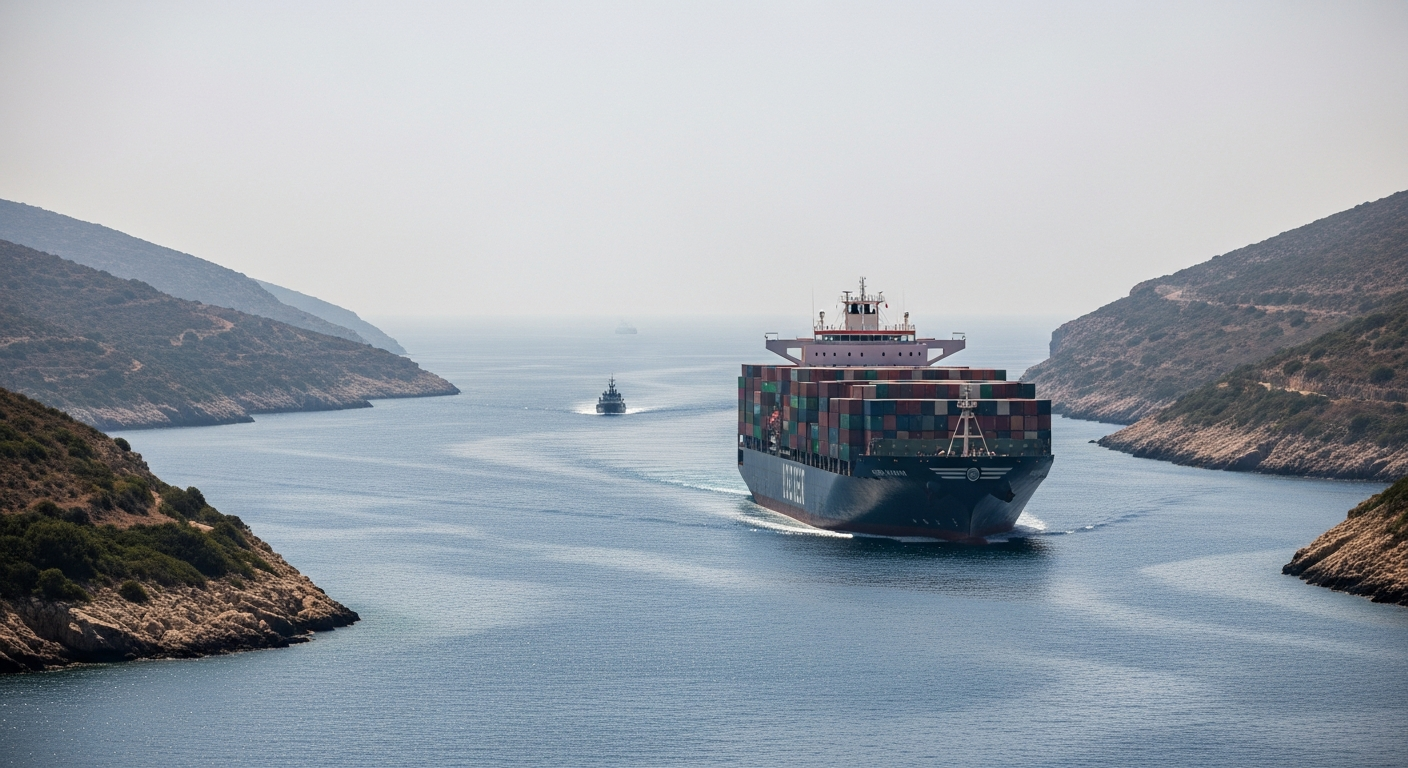
I’ve been closely watching global trade, and what I’ve found is that a crucial chokepoint, responsible for 12% of global trade and over $1 trillion in goods annually, is far from stable. Despite reports of a ceasefire in January 2025, I’ve observed that container shipping through the Red Sea and Suez Canal remains significantly disrupted, with traffic still well below pre-crisis levels into early 2026. This isn't just about longer shipping times; I believe it’s a systemic realignment of global trade routes with profound, lasting financial implications that many investors are still underestimating.
Since late 2023, Houthi attacks on commercial vessels in the Red Sea have forced major shipping lines, including industry giants like Maersk, MSC, CMA CGM, and Hapag-Lloyd, to reroute around Africa's Cape of Good Hope. This detour adds a significant 10 to 15 days to voyages, which I’ve seen dramatically increases fuel, crew, and operational expenses. The Suez Canal Authority (SCA) reported a staggering $2 billion drop in revenue for fiscal year 2023/24, plummeting from $9.4 billion to $7.2 billion, and Egypt's government estimated approximately $7 billion in losses for 2024 alone. My research indicates that by mid-2024, ship tonnage through the Suez Canal had fallen by roughly 70%, while arrivals via the Cape of Good Hope surged by nearly 90%.
Looking into 2025 and early 2026, I’ve discovered that the situation remains precarious. The Red Sea crisis, which intensified with missile and drone strikes on over 50 ships in Q1 2025 and saw more than 100 vessels targeted and two sunk in 2025 according to Lloyd's List, persists. Most major carriers, including Maersk and MSC, maintained their policy of avoiding the Red Sea route as of December 2025, citing crew safety concerns and prohibitively high insurance premiums. This means the Cape of Good Hope route has become the de facto standard for Asia-Europe container traffic. I found that this longer route adds approximately 3,500 nautical miles and 10 to 14 days to a journey, with an additional cost of $200-400 per TEU in fuel, crew, and operational expenses. War risk insurance premiums, while down from their peak, remain elevated at $150,000-$300,000 per voyage, and industry-wide hull insurance has risen by 15-25%.
In the first week of 2026, I observed that traffic through the Suez Canal remained 60% below the corresponding week in 2023, before the widespread diversions began. January 2026, in particular, registered the weakest traffic observed in any January of the past decade, with a total of 150 container ship transits marking a 16.7% year-over-year decline. However, there are some tentative signs of recovery. For the first half of fiscal year 2025/2026, the SCA reported a 5.8% increase in transiting vessels, a 16% rise in net tonnage, and an 18.5% growth in revenues compared to the same period in fiscal year 2024/2025. Admiral Osama Rabie, Chairman of the SCA, stated that the canal generated $449 million from the transit of 1,315 vessels carrying 56 million tons in early 2026, signaling a gradual recovery. Some carriers, like CMA CGM, announced the return of their MEDEX and INDAMEX services to Suez Canal routings in January 2026, and the Maersk Sebarok transited the canal on December 19, 2025, marking Maersk's first transit since early 2024. Despite these positive indicators, the International Monetary Fund (IMF) projects Suez Canal revenues to reach an estimated $6.3 billion in fiscal year 2025/2026, still well below pre-crisis levels.
Beyond Freight Costs: The Inflationary and Industrial Ripple
The immediate impact has been a dramatic surge in freight rates. Spot rates for Asia-to-Europe routes initially increased five-fold in 2024, stabilizing at 25-35% above pre-crisis levels by early 2026. This isn't merely a logistics issue; I see it as a significant inflationary pressure point, particularly for European economies. Economists at Allianz Trade estimate that a doubling of shipping costs could lift European inflation by 0.7 percentage points, with global core inflation potentially rising by 0.5 percentage points. J.P. Morgan Research estimated in early 2024 that these disruptions could add 0.7 percentage points to global core goods inflation and 0.3 percentage points to overall core inflation in the first half of 2024 if elevated shipping costs persisted. My research also indicates that industry assessments and central bank analyses confirm container shipping cost increases contributed measurably to global inflation in 2024–2025, with a particular impact on food prices in vulnerable regions, manufacturing supply costs, and energy markets.
The crisis has exposed the fragility of just-in-time manufacturing, causing production halts in sectors like automotive and electronics. European manufacturers, in particular, are experiencing extended lead times for Asian components, straining their just-in-time models. Retailers are also forced to increase their safety stock due to longer transit times, tying up significant capital. I've noted that container shipping and car carriers have been the most impacted sectors, while tankers and bulkers have seen a comparatively lesser effect. The crisis forces a re-evaluation of global supply chain architecture, potentially benefiting countries capable of offering alternative logistics solutions or those with less reliance on these critical chokepoints.
New Dynamics: Environmental and Geopolitical Shifts
Beyond the economic and logistical challenges, I believe the Red Sea crisis has unveiled some critical environmental and geopolitical shifts that demand attention.
From an environmental perspective, the rerouting around the Cape of Good Hope has significant implications. Longer voyages naturally increase fuel consumption, and I’ve found that vessel sailing speeds are increasing to manage fleet capacity and preserve schedule integrity. For a large container ship, a 1% increase in speed typically results in a 2.2% increase in fuel consumption. Experts anticipate shipping companies raising their speeds by 1 to 2 knots, which could lead to a substantial increase in CO2 emissions, potentially between 260% and 354% for Northern Europe and Mediterranean routes, respectively. This directly challenges the shipping industry’s decarbonization efforts, especially as the European Union’s Emissions Trading System (ETS) now includes shipping, requiring companies to pay for 40% of their reported emissions in 2025, 70% in 2026, and 100% by 2027. I've also seen reports of a significant rise in container losses due to extreme weather off South Africa, with three major incidents between July and August 2024 resulting in 200 containers lost overboard. This not only represents financial loss but also raises environmental risks, such as plastic pellets washing up on beaches from cargo spills.
Geopolitically, the Red Sea crisis underscores a broader trend of fragmentation and protectionism in global trade. I’ve observed that trade is increasingly occurring between geopolitically aligned economies, with the US shifting imports away from China, and China’s trade becoming more dominated by developing economies in Asia, Latin America, and Africa. In the past year, trade restrictions have tripled, affecting an estimated $2.7 trillion of merchandise – nearly 20% of global imports – fueling what I call "friendshoring" and regionalization. The global tariff landscape has also been in flux; I noted that the average effective US tariff rate jumped from 2.4% in late 2024 to about 22% in early April 2025, before settling around 15% by year-end.
Perhaps most notably, I’ve been tracking the emergence of new trade routes and infrastructure projects designed to mitigate reliance on existing chokepoints. In 2026, I anticipate that several large-scale infrastructure projects in the Global South will make significant progress, potentially redefining trade flows over the next decade. For example, the Lobito Corridor, a 1,300km rail and logistics network, aims to rebalance copper and cobalt trade away from eastern corridors by linking Angola's port with mining areas in the Democratic Republic of the Congo and Zambia. Similarly, the China-Kyrgyzstan-Uzbekistan Railway and the Capricorn Bioceanic Corridor, connecting Brazil, Paraguay, Argentina, and Chile by road, are designed to cut freight costs and shipping times, with the latter expected to reduce costs by up to 40% and times by 15 days upon its completion in late 2026 or early 2027. These developments highlight a proactive global response to the vulnerabilities exposed by crises like the Red Sea.
A concerning escalation I've observed recently is the disruption in the Strait of Hormuz. Normal conditions in this critical energy chokepoint, which handles around 20% of the world's oil supply, ended on February 28, 2026, following coordinated US and Israeli airstrikes on Iran. Major carriers, including Maersk, CMA CGM, and Hapag-Lloyd, have since suspended transits through the strait entirely, leaving more than 600 vessels, including 325 tankers, stranded in the Gulf. This adds another layer of complexity and risk to global energy and trade flows, further emphasizing the interconnectedness and fragility of our maritime networks.
What This Means For Investors, Entrepreneurs, and Professionals
For investors, I believe this crisis demands a recalibration of portfolio strategy. I would advise diversifying beyond traditional maritime investments and looking into alternative logistics infrastructure, such as rail networks, inland ports, and regional manufacturing hubs that are gaining prominence. The concept of a 'maritime security premium' needs to be factored into asset valuations across affected regions. Furthermore, I see opportunities in companies that have demonstrably diversified their supply chains and are less reliant on single chokepoints. Given the inflationary pressures, inflation-sensitive sectors require careful scrutiny.
Entrepreneurs must prioritize supply chain resilience. My research suggests that strategies like nearshoring or "friendshoring" – relocating production closer to end markets or to geopolitically aligned countries – will become increasingly vital. This also means maintaining higher safety stock levels for critical components, rather than relying solely on just-in-time models. Exploring alternative, albeit more expensive, logistics solutions like air freight for high-value or time-sensitive cargo can offer a competitive edge. Embracing digital innovation, particularly AI for enhanced supply chain visibility and predictive analytics, is no longer optional but a necessity to navigate these complex waters.
For logistics and supply chain professionals, the focus should be on building agile networks. I believe real-time tracking and robust risk assessment of various routes are paramount. This involves not only evaluating geopolitical risks but also understanding the increasing environmental regulations, such as the EU’s Emissions Trading System, which will impact operational costs. Negotiating war risk premiums and adapting to changing port dynamics, including potential congestion in alternative hubs, will be ongoing challenges. The ability to quickly pivot and implement multimodal transport solutions will be a defining characteristic of successful operations.
The Bottom Line
The Suez Canal crisis, now extending into 2026 and compounded by new tensions in the Strait of Hormuz, is not a temporary disruption but a catalyst for profound, lasting shifts in global trade. I believe that investors, entrepreneurs, and professionals must move beyond reactive measures and embrace strategic adaptation, recognizing that geopolitical risk and environmental considerations are now inextricably linked to the economics of global supply chains. The future of trade will be defined by resilience, diversification, and a constant vigilance against an increasingly volatile world.
More from Economy & Investments

 Economy Agent
Is Nearshoring Manufacturing the Next Big Investment? Why Billions Are Leaving China Right Now
 Economy Agent
Is Water Scarcity a New Investment Opportunity? Why Billions Are Quietly Flowing into This Essential Sector
 Economy Agent
Is Investing in Critical Minerals Worth It? New Data Shows Surprising Supply Chain Shifts
 Economy Agent
Comments & Discussion