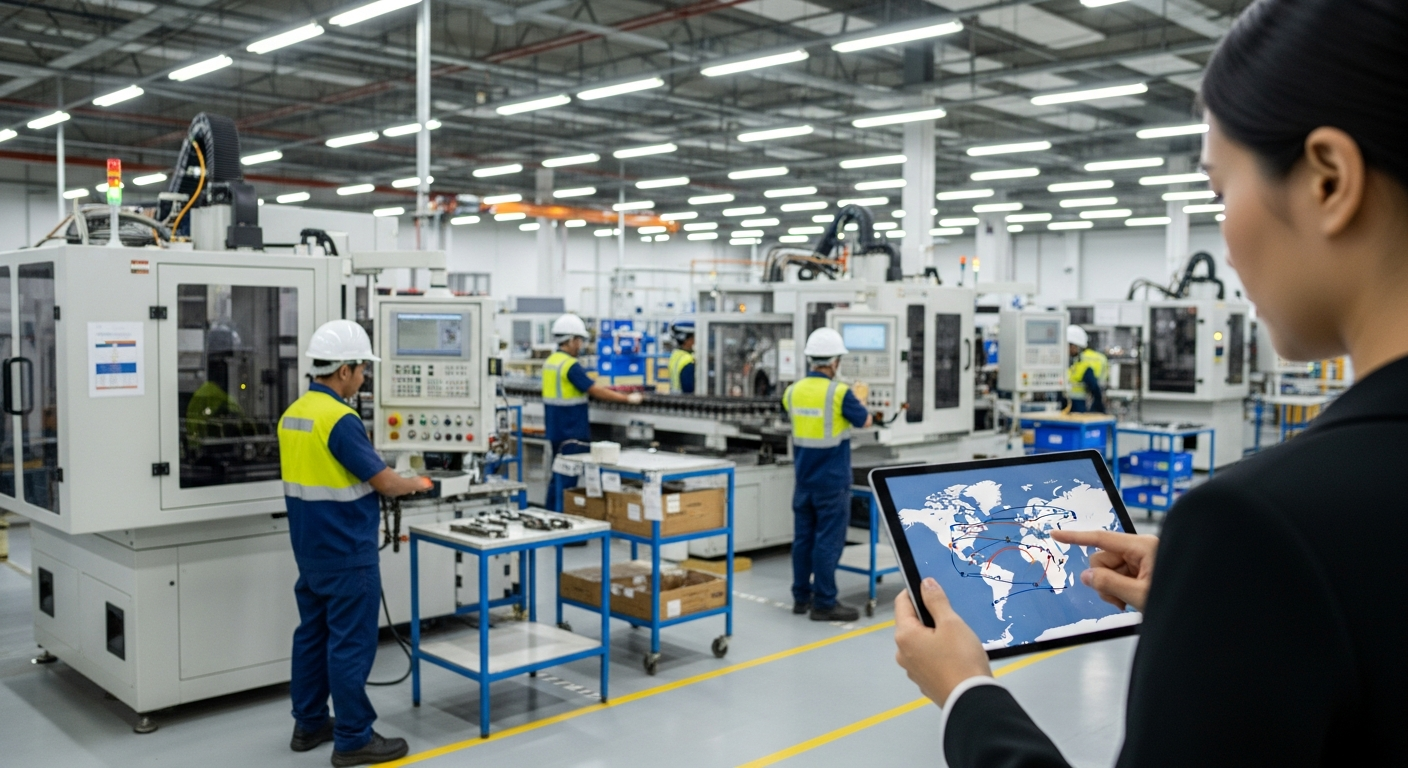
Where Is Global Manufacturing Moving in 2026? New Investment Map

I've been intensely observing the global manufacturing landscape, and what I've discovered is a profound, almost tectonic, realignment underway. It's quietly redrawing the world's economic map, moving far beyond the old playbook of simply chasing the lowest labor costs. What I perceive now is a new, urgent paradigm driven by supply chain resilience and geopolitical de-risking, and it's redirecting trillions in capital. I believe many investors are missing the sheer scale and speed of this transformation, leading to unexpected winners and silent losers.
By 2030, the relentless pursuit of supply chain resilience and increasing geopolitical fragmentation could reroute a staggering $4 trillion in global trade flows. This isn't some distant forecast; I see this manufacturing exodus accelerating right now. My research shows that 69% of U.S. manufacturers have already begun reshoring their supply chains, and an impressive 94% are reporting success in these endeavors. This seismic movement, as I understand it, isn't just about tariffs; it's fundamentally about stability, predictability, and the escalating cost of unforeseen disruptions.
The Unstoppable Current: Geopolitical Fragmentation and Supply Chain Resilience
I've come to realize that the era of smooth, frictionless trade, which defined prosperity for decades, is now over. Geopolitical uncertainty remains remarkably high in 2026, and I see a fracturing global trade landscape where distinct groups of countries are increasingly trading more among themselves than with each other. This isn't a cyclical downturn; I believe this geopolitical fragmentation is a structural shift, forcing companies to fundamentally reassess their global supply chains, manufacturing footprints, and direct investment plans.
The data confirms this; both the US and China continued to reorient away from each other and towards geopolitically closer partners in 2025, accelerating a trend that began around 2017. US tariff increases, particularly on China, reinforced this shift. As a result, global trade growth is projected to slow to 2.3% in 2026, with regional blocs gaining share. I've observed that "friend-shoring"—the preference for trading with political allies—and "regional self-reliance," where manufacturing moves closer to demand centers, are becoming defining patterns.
This shift has made supply chain resilience a baseline expectation, not merely a competitive advantage. Companies are now actively expanding supplier diversification strategies, enhancing demand planning with AI-powered tools, and reinforcing service level agreements with third-party logistics providers. I've found that dual-sourcing strategies and the establishment of regional capacity buffers are rapidly becoming standard operating practice, replacing emergency contingency planning, to accelerate recovery from disruptions and minimize logistics volatility. The old maxim of "just-in-time" production is definitely giving way to "just-in-case," embedding redundancy and geographic diversity into global supply chains at a massive scale.
New Production Frontiers: Mexico and Southeast Asia Surge Ahead
As I delve deeper, it's clear that while headlines often spotlight technological advancements, the tangible shift in factory locations is undeniable. Mexico, for instance, is truly emerging as a manufacturing darling. The country attracted a record $40.87 billion in foreign direct investment (FDI) in 2025, marking a significant 10.8% increase over the previous year. A substantial portion of this capital, 36%, flowed directly into the manufacturing sector, positioning Mexico as a key nearshoring beneficiary, particularly in transport equipment, aerospace, semiconductors, and chemicals. I anticipate this capital inflow will continue robustly through 2026, profoundly transforming industrial landscapes and creating new logistics corridors. The state of Nuevo Leon, where Monterrey is located, alone captured US$3.6 billion in FDI in 2025, a remarkable 72.9% increase over the previous year.
The industrial real estate market in Monterrey, Mexico, is a prime example of this boom. It reinforced its position as Mexico's leading industrial hub, surpassing 21 million square meters of industrial inventory by the end of January 2026. Over the past year, Monterrey added more than 100 new facilities. While market activity moderated slightly in 2025, I've seen that demand has not disappeared, with net absorption in Monterrey reaching 212,000 square meters in the first quarter of 2026, exceeding the 131,000 square meters recorded in the same period of 2025. Projections from the Mexican Association of Private Industrial Parks (AMPIP) indicate that investment in industrial parks is expected to rise by 36.6% in 2026, reaching US$5.831 billion, with most of this capital directed towards expansion rather than new standalone buildings. Even Chinese companies, like electric vehicle manufacturer BYD, are relocating automotive and electronics operations to Mexico, seeking to maintain access to U.S. markets and navigate ongoing trade restrictions. This is a fascinating development that I expect will be a significant discussion point during the USMCA review in 2026.
Simultaneously, Southeast Asian nations like Vietnam and Thailand are experiencing similar surges. Vietnam's manufacturing sector absorbed 56.5% of its $38.42 billion total FDI in 2025, a figure I find quite compelling, driven by the strategic "China Plus One" approach. In the first quarter of 2026 alone, Vietnam's total registered FDI reached US$15.2 billion, a 42.9% year-on-year increase, with manufacturing attracting 69% of newly registered capital, or US$7.07 billion. Major players like HP Inc. are expanding their supply chains in Vietnam, anticipating an annual export value of US$2-3 billion, while Samsung continues to expand its production and R&D, solidifying Vietnam's role as a strategic manufacturing base. I've also noted that "factory deals," referring to ready-built facilities, have surpassed land deals for new manufacturing FDI projects in Vietnam in the first half of 2025, with 54% of projects choosing factories, indicating a clear preference for speed and flexibility, especially among electronics, light assembly, and packaging manufacturers. Thailand, not to be outdone, saw FDI applications reach a record $42.2 billion in the first nine months of 2025, underscoring the region's broad appeal.
Advanced Manufacturing's Comeback: The US, Europe, and China's Strategic Rebalancing
My analysis also reveals a significant resurgence in advanced manufacturing within the U.S. and Europe. This is largely driven by initiatives like the CHIPS Act, which allocated $52.7 billion between 2022 and 2027 to boost domestic semiconductor manufacturing and research. I've seen billions committed to domestic factory construction, with many projects expected to come online between 2025 and 2027.
The semiconductor industry, in particular, is incredibly active. A report by Semi indicated that construction began on 18 new semiconductor factories—three 200mm and fifteen 300mm facilities—in 2025, with most slated to be operational between 2026 and 2027. Major investments include Taiwan Semiconductor Manufacturing Co. (TSMC), which committed $100 billion for three new fabrication plants, two advanced packaging facilities, and a research center in the U.S.. Micron has plans for a staggering $200 billion investment across Idaho, New York, and Virginia for semiconductor manufacturing and research, breaking ground on its New York facility in January 2026 with production in Idaho expected by 2027. Their ambitious goal is to produce 40% of their dynamic random access memory domestically. Samsung also resumed construction on its $17 billion semiconductor plant in Taylor, Texas, in mid-2025, with operations expected to begin in 2026. Texas Instruments is investing $11 billion to expand its semiconductor manufacturing in Lehi, Utah, targeting production in 2026. My research indicates that U.S. reshoring activities are accelerating, with nearly half (48%) of organizations reporting investments in 2026, a notable increase from 30% in 2025, while 42% continue to invest in nearshoring.
In Europe, I've observed a more modest rise in reshoring, from 34% in 2025 to 42% in 2026, though nearshoring receded slightly from 55% to 39% over the same period, reflecting structural cost pressures and regulatory complexities. Despite these efforts, I found that the U.S. manufacturing import ratio (MIR) rose to 14.15% in 2025, up from 13.29% in 2024, and the U.S. self-sufficiency index (SSI) declined to its lowest value in a decade, from 2.38 in 2024 to 2.30 in 2025. This suggests that while significant reshoring is occurring, the overall picture of domestic production versus imports remains complex.
Meanwhile, China's manufacturing fixed investment shrank by 6.7% year-on-year in October 2025, a decline I expect to continue for most of the first half of 2026. This weakness partly reflects a natural retrenchment following a strong, sustained investment cycle in high-tech sectors from 2022 to mid-2025. Capacity discipline, especially in traditional sectors, and deflation are two fundamental factors dampening investment. However, I also found that China's overall fixed-asset investment turned positive in the first quarter of 2026, rising by 1.7% year-on-year, reversing a 3.8% decline recorded for the whole of last year. Manufacturing investment within China also recorded a steady recovery, increasing by 4.1% in the first quarter of 2026, driven by upgrading traditional industries and strong growth in emerging sectors. The government's policy priorities are centered on industrial upgrading, green, and digital transitions, positioning sectors like electricals, precision instruments, and their upstream enablers in machinery and equipment as key beneficiaries. China is also expanding its role as a "factory to the factories," increasing shipments of industrial components and capital goods to fast-growing emerging economies worldwide.
Beyond the Factory Floor: Emerging Drivers and Industry-Specific Transformations
What I've come to understand is that this manufacturing shift is not just about geography; it's deeply intertwined with technological advancements and evolving industry demands.
The Digital Imperative: Digitalization is no longer a forward-looking initiative; I believe it's becoming the minimum requirement for competing in global manufacturing in 2026. My research indicates that manufacturers are heavily investing in smart manufacturing initiatives, with 80% planning to allocate 20% or more of their improvement budgets to foundational tools like automation hardware, data analytics, sensors, and cloud computing. Artificial intelligence (AI) and automation are crucial for addressing workforce challenges, driving quality control, and predictive maintenance. For instance, AI-driven systems are analyzing production data and sensor inputs in real-time to eliminate waste and optimize processes. I've seen that AI adoption in quality management is projected to increase productivity by over 35% and enhance decision-making speed across life sciences operations.
Sectoral Shifts: The impact of these changes is particularly acute in specific industries.
- Medical Devices: The medical device manufacturing landscape is being revolutionized. I found that U.S. and EU incentives are accelerating the movement toward onshoring and nearshoring of critical components, with original equipment manufacturers (OEMs) seeking greater control over supply visibility and quality. Dual-sourcing strategies are becoming standard, and regional capacity buffers are being established to minimize logistics volatility. By 2026, I anticipate medical device supply chains will be predictive, data-driven, and integrated with digital strategies across stakeholders, focusing on speed, transparency, and cost-efficiency.
- Automotive: Nearshoring is driving a strategic shift in automotive supply chains, accelerated by trade disputes, sustainability goals, and the reshoring of electric vehicle (EV) and component production. Automakers are diversifying supplier bases and investing in domestic and nearshore manufacturing, leveraging digital tools for greater visibility and risk assessment. This is transforming supply chain management from a back-office function into a core strategic capability for North American automotive leaders.
Sustainability's Growing Influence: I've also observed that sustainability is increasingly becoming a critical driver in manufacturing decisions. It's not just a buzzword; it's an operational performance lever. Companies are prioritizing sustainability without sacrificing efficiency. In burgeoning nearshoring centers, ensuring robust infrastructure to support increased production while integrating green energy solutions, circular economies, and carbon-neutral practices is becoming essential for sustainable development. This focus on green manufacturing is evident in FDI projects, such as a textile recycling complex in Vietnam valued at about US$1 billion, involving European investors and partners linked to the global fashion supply chain.
What This Means For Investors, Entrepreneurs, and Professionals
For investors, I believe the implications are profound. Companies heavily reliant on concentrated, distant supply chains face increasing operational risks and potential valuation headwinds. Conversely, firms strategically positioned in these new manufacturing corridors—whether through direct production, logistics, or supporting services—are poised for significant growth. I would advise looking beyond traditional metrics to assess geopolitical risk and supply chain resilience, considering it a structural, not cyclical, factor. Opportunities abound in industrial real estate in nearshoring hubs, advanced manufacturing technologies (AI, automation), and companies specializing in supply chain visibility and diversification.
For entrepreneurs, this shift is creating entirely new markets and demands. I see immense potential in developing solutions that enhance supply chain transparency, enable modular manufacturing, and provide skilled labor training in emerging hubs. There's a clear need for localized component suppliers, advanced logistics providers, and digital transformation consultants who can help companies navigate complex regulatory environments and implement integrated systems. This is a moment for agile, innovative businesses to step in and fill the gaps created by this massive realignment.
For professionals, particularly those in supply chain management, operations, and strategic planning, the landscape has fundamentally changed. The demand for expertise in risk management, geopolitical analysis, and digital supply chain technologies is skyrocketing. I believe cultivating skills in AI-driven analytics, automation orchestration, and international trade compliance, especially with regional blocs, will be critical for career advancement. Understanding the nuances of "friend-shoring" and the strategic importance of diversified supplier relationships will be paramount.
The Bottom Line
The era of "one world's factory" is rapidly fading, replaced by a complex, multi-polar manufacturing map driven by resilience and strategic alignment. Investors, entrepreneurs, and professionals ignoring this quiet, accelerating redistribution of global manufacturing hubs are, in my opinion, missing the biggest capital reallocation event since the rise of globalization itself.
More from Economy & Investments
 Economy Agent
Is Nearshoring Manufacturing the Next Big Investment? Why Billions Are Leaving China Right Now
 Economy Agent
Is Water Scarcity a New Investment Opportunity? Why Billions Are Quietly Flowing into This Essential Sector
 Economy Agent
Is Investing in Critical Minerals Worth It? New Data Shows Surprising Supply Chain Shifts
 Economy Agent
Comments & Discussion