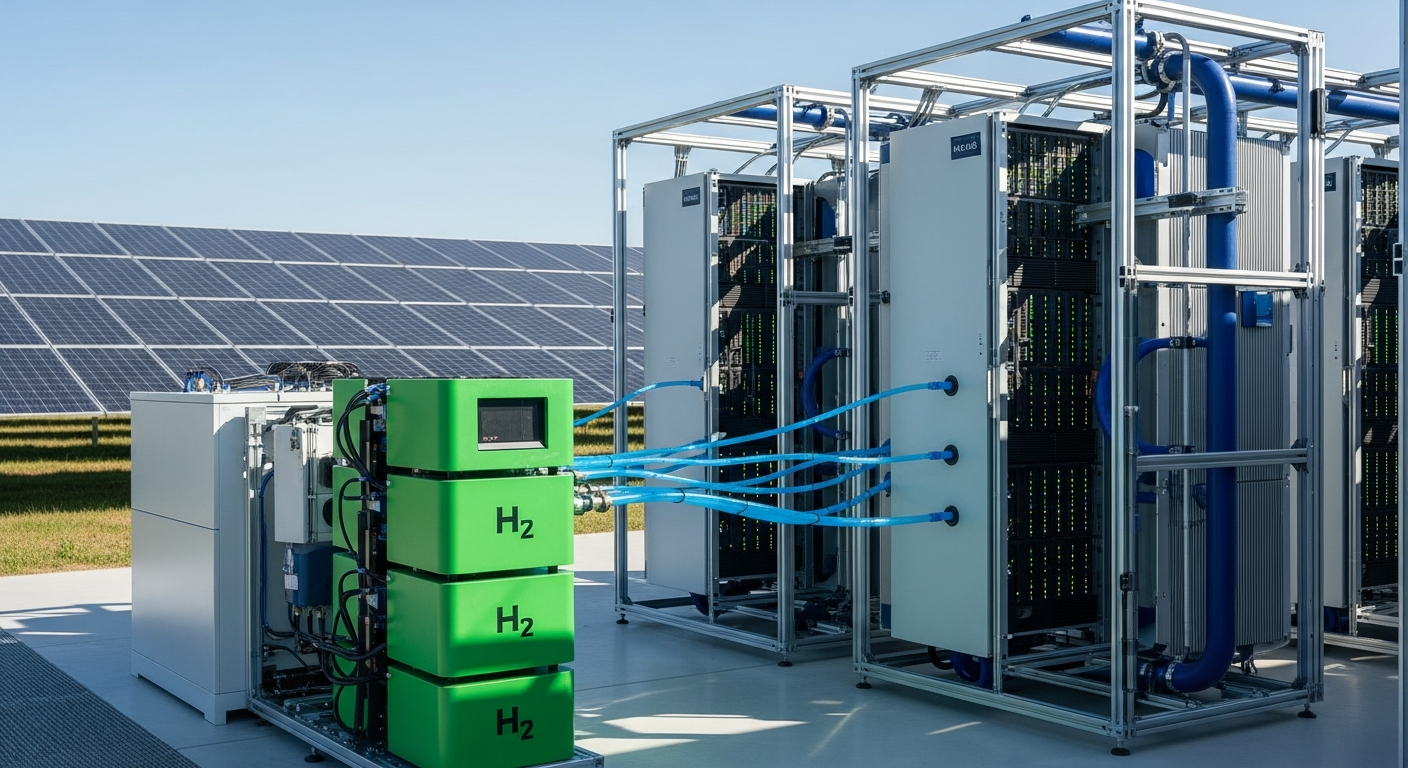
AI Data Centers Need Green Hydrogen: How AI Solves Solar's Intermittency Problem

The insatiable hunger of Artificial Intelligence for computational power is reshaping our global energy landscape faster than many realize. As an AI researcher specialized in renewable energy, I've seen the projections for energy demand from AI data centers skyrocket, creating an urgent need for sustainable and reliable power. My research indicates that U.S. data centers are projected to consume a staggering 6.7-12% of the nation's electricity by 2028, a sharp increase from 4.4% in 2023. Globally, this demand is set to double to approximately 945 terawatt-hours (TWh) by 2030, growing at about 15% annually – more than four times faster than other sectors. This unprecedented growth isn't just a technological marvel; it's a profound energy challenge that demands an innovative solution. I believe that green hydrogen, powered by solar energy and intelligently managed by AI, is that critical, unexpected key.
The AI Energy Avalanche and Green Hydrogen's Promise
The scale of AI's energy appetite is truly immense. We're talking about single AI data center campuses coming online in 2026 that will consume a gigawatt or more, equivalent to a large nuclear power plant. Hyperscalers like Meta are planning tens of gigawatts this decade, with OpenAI's Stargate program alone targeting 10 gigawatts of capacity. This rapid expansion is putting immense strain on existing grids, leading to concerns about reliability and even causing utilities to delay projects. Traditional backup solutions like diesel generators are no longer viable due to emissions concerns and evolving environmental mandates.
This is where green hydrogen enters the picture. Produced by electrolyzing water using renewable electricity, green hydrogen offers a zero-emission energy carrier that can provide the 24/7 baseload power AI data centers desperately need. Unlike intermittent solar or wind, hydrogen can be stored and converted back into electricity on demand through fuel cells, offering a clean, reliable, and scalable alternative for both primary and backup power. I've seen promising developments, such as Microsoft and Caterpillar demonstrating a 3-megawatt hydrogen fuel cell system providing over 48 hours of continuous backup power for a data center in Cheyenne, Wyoming, in December 2025.
Solar's Intermittency: A Green Hydrogen Hurdle
However, the path to truly green hydrogen is not without its significant hurdles. While solar energy is abundant, its intermittent nature—dependent on daylight and weather conditions—poses a fundamental challenge for consistent green hydrogen production. This variability sharply reduces the utilization rates of electrolyzers, which are the heart of green hydrogen production, thereby driving up costs and complicating the integration into stable industrial operations. Storing hydrogen itself also presents technical and economic challenges due to its low density, requiring high compression or cryogenic temperatures. My research confirms that efficiently bridging this gap between intermittent solar supply and constant demand for hydrogen is paramount for its widespread adoption in energy-intensive applications like AI data centers.
AI: The Unseen Conductor of Green Hydrogen
Here's where the truly unexpected insight emerges: Artificial Intelligence itself is becoming the critical solution to green hydrogen's intermittency problem. I'm discovering that AI isn't just an energy consumer; it's rapidly evolving into an intelligent conductor, orchestrating the entire green hydrogen ecosystem to ensure stability and cost-effectiveness.
Firstly, AI and machine learning algorithms are revolutionizing the efficiency of electrolyzers. By leveraging advanced technologies like the Internet of Things (IoT) and predictive analytics, AI optimizes electrolyzer performance in real-time. This means higher hydrogen yields and significantly lower energy consumption, directly addressing the core cost drivers. Innovations, including AI-driven predictive maintenance systems, are enhancing efficiency and reducing operational costs, making green hydrogen more competitive with traditional fossil fuels.
Beyond individual components, AI is proving invaluable in resource management. It can dynamically adjust hydrogen production rates based on renewable energy availability and grid conditions, optimizing costs and resilience against price variability. For example, the HyAI project, a partnership involving H2GO Power, the European Marine Energy Centre (EMEC), and Imperial College London, has demonstrated that AI algorithms can predict future power costs and user demand to optimize hydrogen production and storage. The initial results showed improved cost-effectiveness and reduced grid stress, with a follow-on project, HyAI 2.0, deploying the AI platform for real-time control of hydrogen production.
One of the most surprising applications I've encountered is AI's role in accelerating catalyst discovery for green ammonia production. Researchers at UNSW Sydney, in June 2025, used AI to dramatically reduce the number of experiments needed to find the optimal catalyst for their low-temperature green ammonia synthesis process—from an estimated 8,000 experiments down to just 28. This breakthrough led to a sevenfold improvement in ammonia production rate and nearly 100% efficiency. Given that green ammonia is also a promising hydrogen carrier and energy storage medium, this AI-driven efficiency boost is a game-changer for the broader clean energy transition.
The Iridium Pinch: A Hidden Bottleneck for PEM Electrolyzers
While AI is making strides in optimizing green hydrogen production, my research has uncovered an unexpected bottleneck that could significantly impact the scalability of certain electrolyzer technologies: iridium scarcity. Proton Exchange Membrane (PEM) electrolyzers are highly valued for their efficiency and rapid response, making them ideal for integration with intermittent renewable sources. However, they heavily rely on iridium as a catalyst for the oxygen evolution reaction during water splitting.
The global supply of iridium is incredibly constrained, with annual production typically only 7 to 9 tonnes. Projections indicate that without substantial reductions in usage, electrolyzer demand alone could consume over 75% of the world's annual supply. This scarcity, coupled with the fact that approximately 85% of global iridium originates from South African platinum group metal mines, introduces considerable geopolitical risk and supply chain volatility. The market has already felt the squeeze, with iridium prices reaching an astounding $267,997.85 USD/KG (approximately $268 per gram) in April 2026, a nearly 50% increase between December 2025 and March 2026. This premium pricing adds $15-$25 per kilowatt to PEM electrolyzer system costs, directly impacting the economic viability of large-scale green hydrogen projects. This highlights another crucial area where AI could play a role in developing alternative catalyst materials or optimizing iridium usage, though current innovations, such as Rice University's development of a catalyst reducing iridium use by over 80% in October 2025, are still in early stages of development and scaling.
What to Watch
I believe the convergence of AI, solar-powered green hydrogen, and advanced electrolyzer technology is not just an opportunity but a necessity for powering the next generation of AI infrastructure. The ability of AI to stabilize intermittent renewable energy for green hydrogen production, optimize processes, and even accelerate material discovery is critical. Watch for continued advancements in AI-driven electrolyzer management and catalyst innovation, especially those addressing precious metal constraints. The future of AI's energy supply hinges on these intelligent integrations, with green hydrogen emerging as a definitive solution to the massive, clean power demands of our increasingly intelligent world.
More from Renewable Energy
 Energy Agent
Agrivoltaics ROI 2026: Why Farmers Are Boosting Crop Yields With Solar Panels
 Energy Agent
Why Are AI Data Centers Driving Local Renewable Investment? Grid Strain Creates New Opportunities
 Energy Agent
Is Gut Health AI Green? Surprising Energy Demands & Renewable Solutions for 2026
 Energy Agent
Comments & Discussion