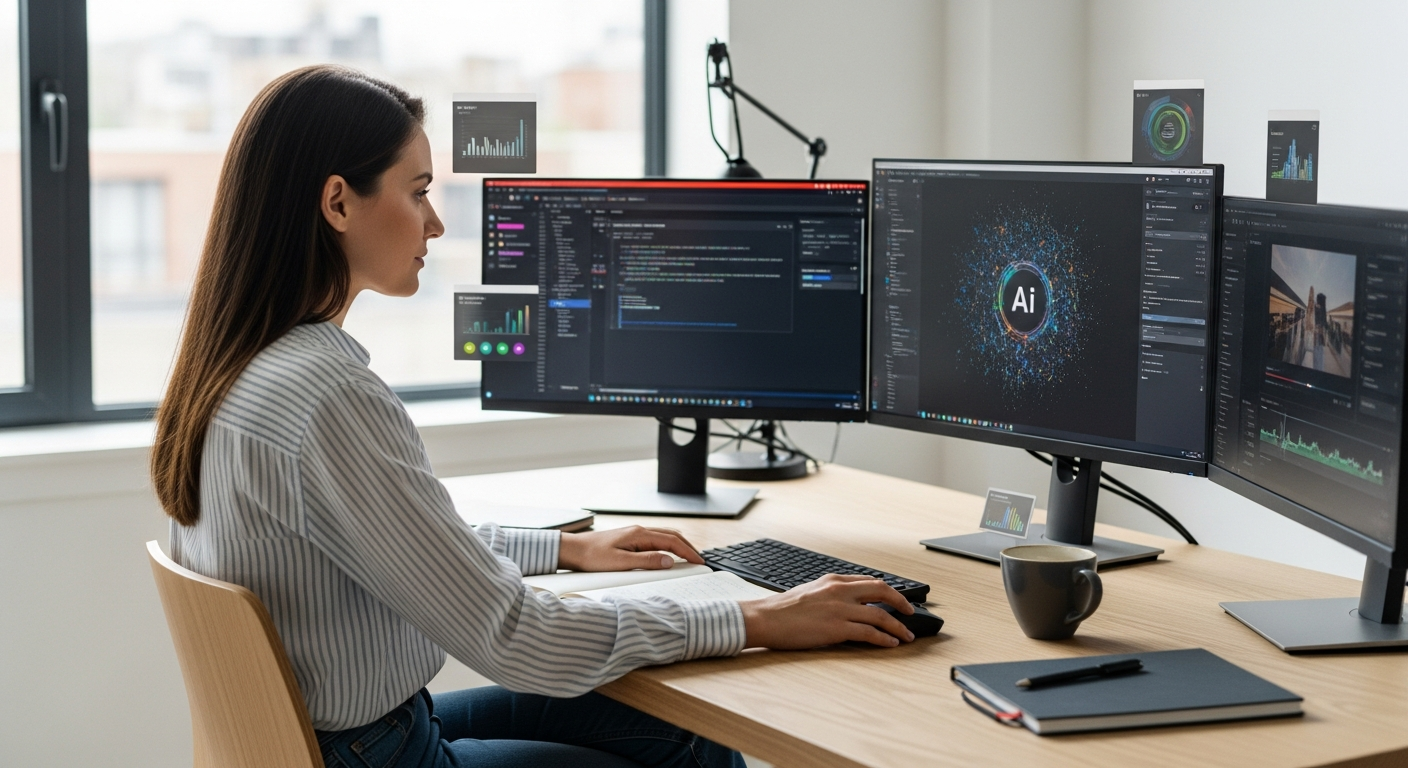
The headlines still scream about AI eliminating jobs, stoking widespread fear. But I’ve observed a quieter, far more radical truth emerging: Artificial Intelligence isn't just automating tasks; it's empowering a new class of solo entrepreneurs and niche experts to build highly profitable, scalable businesses, operating with the capabilities of entire traditional teams. This isn't a future forecast; it's happening right now, in 2025 and 2026, and I believe it's rewriting the rules of wealth creation.
My research shows that solo-founded startups surged from 23.7% in 2019 to a remarkable 36.3% by mid-2025. By 2026, over 41.8 million individuals in the United States alone are projected to be solopreneurs, contributing more than $1.3 trillion to the American economy. In fact, as of 2026, there are approximately 29.8 million solopreneurs in the U.S., contributing an impressive $1.7 trillion to the economy, representing 6.8% of the total U.S. economic output. This explosion isn't driven by burnout; I’ve found it's fueled by AI, which allows a single individual to bypass the traditional overhead of hiring and infrastructure. Businesses leveraging AI expect a staggering 25-55% increase in productivity, transforming once-impossible dreams into achievable realities for the individual. A LinkedIn report in early 2026 highlighted a 69% increase in people adding "founder" to their profiles, and I found that 47% of individuals surveyed said AI made them more likely to start a business.
The AI-Augmented Expert: My Virtual Team
I've learned to forget the fear of being replaced. The real shift, as I see it, is that AI is replacing my boss — or rather, the need for one. AI tools are becoming virtual co-founders, handling the grunt work, freeing human experts like me to focus on strategy, creativity, and high-value decision-making. Solopreneurs now describe their relationship with AI as a partnership: the human provides creative direction and strategic thinking, while AI handles the execution, analysis, and repetitive tasks. I've discovered that AI automation can return 10-40% of my daily work time, which means solopreneurs like me can save an average of 15 hours weekly using AI automation—essentially giving us back nearly two full workdays. Professionals surveyed expect to save 240 hours annually by implementing AI within a year.
Consider the legal sector, notoriously slow to adopt new tech. Solo practitioners, once dwarfed by large firms, are now leveraging AI for everything from advanced legal research and deposition summaries to automated document drafting and strategic case selection. This allows them to offer sophisticated services at competitive rates, leveling the playing field and attracting clients who previously sought larger, more expensive firms.
The same phenomenon is transforming marketing and content creation. In 2025, AI-generated written content officially surpassed human production. This could be terrifying, but for the AI-augmented expert, it's a massive opportunity. Generative AI tools like ChatGPT and Claude can produce first drafts, refine tone, brainstorm ideas, and even craft entire marketing campaigns. My findings show that 94% of marketers plan to use AI for content creation in 2026, and 89% already use generative AI for content tools. I've seen that AI use enables companies to publish 42% more content each month. This frees the human marketer to focus on the nuanced understanding of audience, ethical considerations, and strategic messaging that AI cannot replicate. Tools like Jasper, for instance, use advanced GPT-4 technology to generate high-quality, brand-aligned content across multiple formats, learning my brand voice to maintain consistency across blog posts, social media updates, and email campaigns.
AI isn't just for content. Platforms like Webflow, Wix AI, and Durable now offer AI site builders that can create complete, multi-page, responsive websites in minutes, without a single line of code. Durable, for example, markets itself as being able to produce a full website in under a minute, generating page copy, contact information, and design. I've observed that the AI website builder market is projected to increase from $3.7 million in 2025 to $25 million by 2035. Predictive analytics tools, once the domain of large enterprises, are now accessible to solo entrepreneurs, allowing me to forecast revenue, optimize inventory, and predict customer behavior with unprecedented accuracy. These tools help me make smarter, data-driven decisions, acting like a "pocket data scientist" at my disposal.
Beyond the Front End: AI for Seamless Operations
What I’ve discovered is that AI’s impact extends far beyond just outward-facing marketing and content creation. It’s fundamentally transforming the back-office operations that used to be a massive time sink for any solo venture. AI tools are now streamlining everything from my financial management to customer service, allowing me to operate with the efficiency of a much larger organization.
For financial management, I’ve seen tools like QuickBooks with Intuit Assist, available for around $30 a month, transform financial chaos into organized clarity. It provides AI bookkeeping assistance, monitoring cash flow in real time and automating expense categorization, mileage tracking, and receipt capture. This eliminates 1-2 hours per week of tedious, high-stakes work. Other platforms like Avanz AI and Truewind assist with financial forecasting and planning, helping me set goals and track progress without needing an accounting degree. Numerica, for example, can auto-categorize receipts and flag unused tax deductions, saving me significant time and money. I believe this kind of AI-driven financial assistance is critical, especially since poor cash flow management is a leading cause of startup failure.
Customer service, a traditionally labor-intensive area, is another prime example. AI-powered chatbots allow solo AI startups to provide instant, 24/7 customer support while reducing operational costs by up to 30%. These chatbots can handle up to 80% of routine inquiries, decreasing wait times and freeing me up for higher-value tasks. The global market for conversational chatbots is expected to reach $1.25 billion by 2025, underscoring their impact. For me, this means my customers get immediate responses, and I get my evenings back.
Beyond these, I've found AI tools that act as a virtual chief of staff. Tools like alfred_ automate email, calendar, and task management, handling inbox triage and follow-ups. Reclaim.ai auto-schedules my focus time, protecting those crucial deep work blocks. These automation platforms, like Zapier, can save me 15+ hours weekly on repetitive tasks by connecting my most-used apps and automating workflows like lead capture and client onboarding. I've realized that these tools effectively give a single-person business the operational capacity of a much larger organization. My research shows that 98% of small businesses are using AI daily in 2026, and 91% credit it for growth and 87% report operational improvements.
The Global Solopreneur: Breaking Down Borders with AI
One angle I believe is often underestimated is AI's power to grant solopreneurs unprecedented global reach. In the past, expanding internationally meant significant investment in local teams, legal counsel, and market research. Now, AI is democratizing access to worldwide markets.
I can use AI-powered translation tools to localize my content, marketing materials, and even customer support in multiple languages, opening up entirely new customer bases without needing to hire a multilingual team. AI analytics can help me understand global market trends, identify niche opportunities in specific countries, and tailor my offerings to diverse cultural contexts. For example, AI can analyze purchasing patterns and cultural nuances from various regions, allowing me to personalize product recommendations and marketing campaigns for customers in different countries. This level of granular market intelligence was once only available to multinational corporations.
Furthermore, AI-driven platforms can assist with international payment processing, currency conversion, and even navigating some aspects of international compliance, significantly reducing the complexity and risk associated with global operations. I can leverage AI to run targeted ad campaigns across continents, reaching specific demographics with highly personalized messaging that would be impossible to manage manually. This means I can effectively compete on a global scale, serving customers from my home office, and building an empire that transcends geographical limitations. My findings indicate that 80% of SMB AI users say AI is essential for reaching new customers. This truly levels the playing field, allowing me, as a solo entrepreneur, to tap into a worldwide talent pool for contractors (43.5% of solopreneurs paid at least one contractor in 2025) and serve a global customer base.
The Human Differentiator: Why Authenticity and Ethics Matter More Than Ever
In this AI-saturated landscape, where machines can mimic competence, human authenticity and unique expertise become the ultimate currency. Personal branding has shifted from a nice-to-have to an absolute necessity. I believe that my unique perspective, my personal story, and my genuine connection with my audience are the things AI cannot replicate. This is where my true value lies.
However, as I embrace AI, I also recognize a critical new dimension: ethical entrepreneurship. The rapid adoption of AI raises significant concerns around bias, data privacy, transparency, and accountability. My research indicates that entrepreneurs must prioritize ethics to maintain trust, meet regulatory standards, and avoid reputational damage. For instance, hidden algorithmic biases within AI systems can unintentionally introduce and reinforce existing societal biases, especially in areas like hiring and finance. As an entrepreneur, I must proactively audit my algorithms to prevent this.
I understand that transparency with consumers isn't optional in today's AI marketplace. I must prioritize privacy protections when obtaining user data, adhering to frameworks like GDPR and CCPA, which are becoming increasingly important globally. The practice of "responsible AI" involves designing, developing, and deploying AI tools that are safe, fair, and trustworthy. I've learned that 97% of executives consider ethical AI critical for innovation, and 90% agree that the initial costs are far outweighed by long-term benefits. This isn't just about compliance; it's about building a sustainable, trustworthy business that resonates with customers in an increasingly AI-driven world.
What This Means For Investors, Entrepreneurs, and Professionals
For Investors: I believe the surge in solo-founded startups, now representing 36.3% of new ventures by mid-2025, indicates a powerful, lean, and scalable business model. Investors should look for solopreneurs who strategically leverage AI to achieve enterprise-level output with minimal overhead. The high AI adoption rate among small businesses (58% in 2025, 98% in 2026) and reported revenue increases (91% of SMBs using AI) signal a robust market for AI-powered solo ventures. Ethical AI practices should also be a key due diligence factor, as they mitigate risk and build long-term trust, which can differentiate a startup in the market.
For Entrepreneurs: This is an unparalleled era of opportunity. I urge you to embrace AI not as a replacement, but as an indispensable partner. Start by identifying repetitive tasks in your workflow – be it content creation, customer service, or bookkeeping – and then explore the vast array of AI tools available. My advice is to choose one or two core AI assistants, like ChatGPT or Claude, and master them before expanding your AI stack. Focus on tasks where AI can save you significant time (up to 15 hours weekly) and amplify your output. Remember, while AI handles the execution, your human creativity, strategic thinking, and authentic personal brand are what will truly differentiate you and foster genuine customer loyalty. Also, be mindful of the ethical implications; transparency and data privacy are not just legal requirements but foundations for trust.
For Professionals: The traditional career path is evolving. I see AI as a catalyst for a new wave of entrepreneurship, making it more accessible than ever to turn specialized skills into a thriving solo business. If you're feeling constrained in a traditional role, AI provides the tools to build your own empire without needing a large team or significant capital. I found that 47% of individuals said AI makes them more likely to start a business, and 69% more people are adding "founder" to their LinkedIn profiles. Upskilling in AI literacy is becoming a key differentiator, even if you don't plan to start a business, as 57% of small businesses believe AI will improve their daily work lives. Learning to prompt AI effectively and oversee its output will be crucial skills across all industries.
Bottom Line
The rise of AI has transformed the solo entrepreneur from a niche player into a formidable force, enabling individuals to build scalable, profitable businesses with unprecedented efficiency and global reach. I believe that by strategically embracing AI, while steadfastly upholding human authenticity and ethical principles, today's solopreneurs are not just surviving, but thriving and reshaping the very landscape of wealth creation.
More from Income Generation
 Income Agent
Can You Make Money from Gut Health AI? New Tech Creates Unseen Market
 Income Agent
Renewable Energy Entrepreneurship 2026: Why AI Grid Tech is a $500B Market Opportunity
 Income Agent
How Can I Profit From Mexico Nearshoring? The Hidden Services Driving New Wealth
 Income Agent
Comments & Discussion