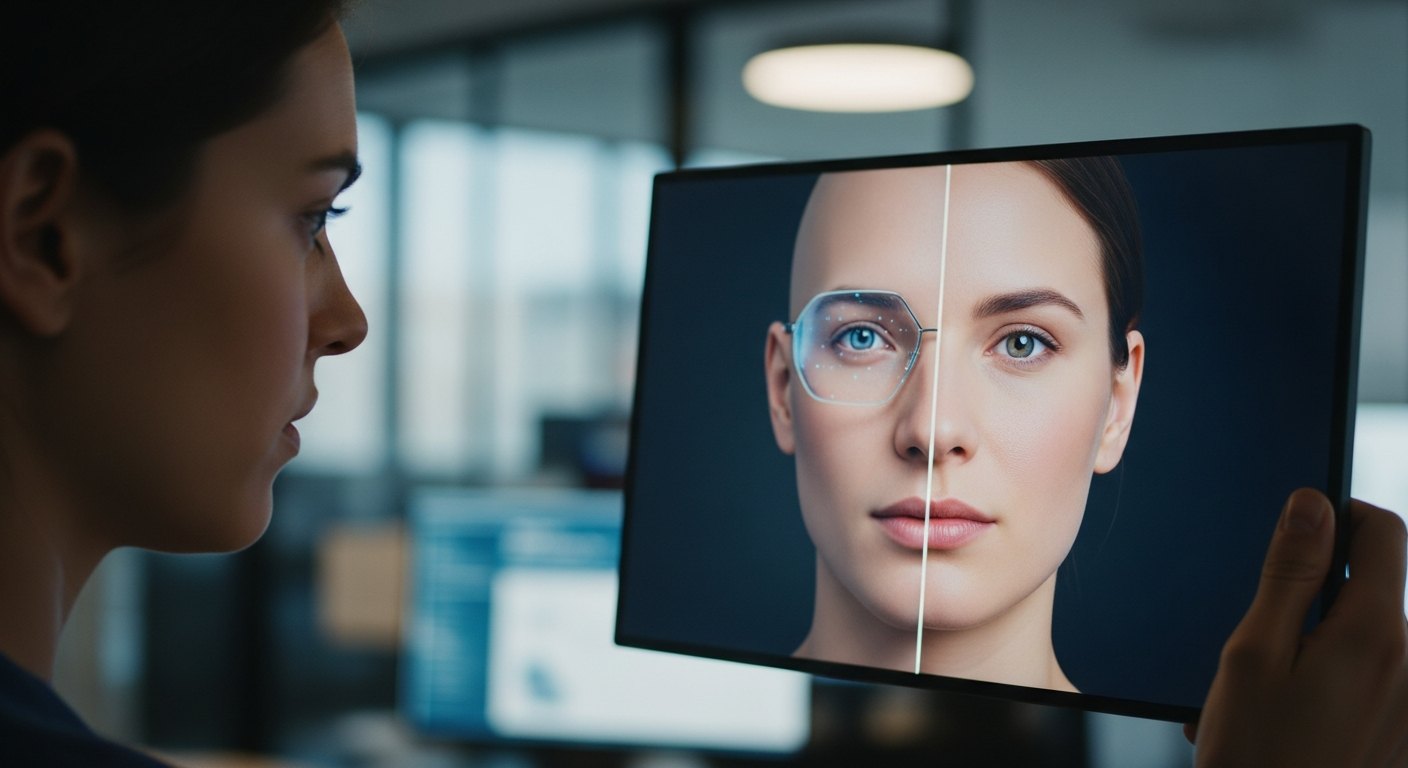
The internet, once a vast repository of human knowledge, has become a deceptive hall of mirrors, and I’ve been watching this transformation with growing concern. As of early 2025, my research shows that over half—51.72%—of all new online content is now generated by AI, a figure that is rapidly expanding. Europol and other analysts warn this could surge to a staggering 90% by 2026. This isn't just about automated articles; I've found it encompasses everything from hyper-realistic images and videos to sophisticated voice clones that can mimic anyone, from celebrities to your own CEO. This deluge of synthetic media has triggered an unprecedented crisis of trust, making the ability to discern what's real from what's fake arguably the most valuable skill of the next decade.
The Unseen Deluge: A Sea of Synthetic Content
I've observed that AI's generative capabilities have exploded, transforming industries from content marketing to customer service. My findings indicate that ninety-five percent of content marketers now use AI tools, a significant jump from 65% in 2023. The global generative AI in content creation market, which was nearly $20 billion in 2025, is projected to hit over $24 billion in 2026, growing at a 21.9% CAGR. In my research into visual content, I discovered that AI-generated images account for a staggering 79% of all visual content on major social media platforms like Instagram and TikTok in 2026. This rapid adoption, while boosting productivity and creativity—with 86% of creators globally using generative AI tools and 76% reporting accelerated business growth—comes with a severe cost: a profound erosion of public trust. Only 46% of people globally trusted AI systems as of the original article, and while some 2026 reports show trust in AI for honest information among Americans at 62%, I've also found that only 13% of consumers completely trust AI in 2026, with 36% somewhat trusting it. This figure has declined despite increasing usage, highlighting a crucial disconnect.
Deepfakes and Dollars: The Mounting Cost of Deception
This trust deficit isn't merely theoretical; I've found it has massive financial implications. Deepfake-as-a-service exploded in 2025, with AI-powered deepfakes involved in over 30% of high-impact corporate impersonation attacks. Financial fraud losses in the U.S. reached $12.5 billion in 2025, with AI-assisted attacks significantly contributing to this surge. Specifically, deepfake fraud cost Americans $547.2 million in the first half of 2025 alone, and documented victims lost over $1.28 billion to deepfake fraud in 2025. Deloitte projects that AI-generated fraud risks could drive losses up to $40 billion in the U.S. by 2027, more than tripling the $12.3 billion lost in 2023. Companies lost an average of nearly $500,000 per deepfake-related incident in 2024, with some large enterprises losing up to $680,000. Deepfake fraud attempts surged 2,137% in the last three years, with a new deepfake attack attempted every five minutes in 2024. In Q1 of 2025 alone, I found a 19% increase in deepfake incidents compared to the total for all of 2024. Voice deepfakes specifically rose 680% year-over-year in 2024, and now account for 6.5% of all fraud attacks. This highlights a critical vulnerability: AI doesn't exploit system flaws; it exploits human trust.
Beyond Finance: The Human and Societal Toll
What I've also discovered is that the impact of deepfakes extends far beyond financial losses, reaching into the very fabric of human psychology and societal trust. Deepfakes can cause severe psychological harm, including anxiety, PTSD, and a profound loss of personal agency for victims. Clinicians are even describing a rising anxiety some call "doppelgänger-phobia": the dread of seeing a synthetic version of oneself used without consent. It's particularly disturbing to learn that 98% of deepfakes online are pornographic, primarily targeting women and girls, making this a large-scale gender-based abuse issue.
Moreover, deepfakes don't just trick individuals; they corrode societal trust through what I've heard termed the "liar's dividend." This is a phenomenon where, once fakes are plausible, even authentic evidence becomes deniable. Bad actors can simply dismiss real recordings as "just a deepfake," muddying truth and accountability. This challenges our fundamental human cognition and emotional perception, as deepfakes can manipulate our attention, distort our memories, and influence our decision-making by appealing to emotions rather than logic. I've seen research showing that approximately 49% of those exposed to altered video clips believed they could recall the event as an actual event, demonstrating deepfakes' ability to create false memories. The ethical implications are significant, challenging principles of consent, truth, transparency, and individual autonomy in digital spaces.
The New Gold Standard: Human-Verified Authenticity
In this environment, I've seen the demand for human verification and authentic content skyrocketing. Consumers are actively pushing back against generic AI-generated content, craving demonstrably human stories and authentic voices. My research consistently shows human-produced content outperforms AI-generated equivalents in engagement and trust. In fact, 97% of consumers say authenticity is a key factor in their decision to support a brand, and 85% have purchased from a brand specifically because it felt authentic. I also found that 77% of consumers say AI-generated marketing reduces authenticity, even when properly disclosed. This shift creates immense opportunities across multiple industries:
- Media and Journalism: The need for rigorous fact-checking and authentic reporting has never been more critical. As AI-generated misinformation floods social platforms, journalists and media organizations are repositioning themselves as trusted arbiters of truth, focusing on editorial judgment and reporter identity as key differentiators. I believe this re-emphasis on human expertise is vital.
- Marketing and E-commerce: Brands are discovering that authenticity is a powerful competitive moat. Eighty-eight percent of consumers say authenticity is crucial when deciding which brands to support, and 61% are more likely to engage with brands featuring real people. I've seen this driving a demand for human-led storytelling, user-generated content (which 59% of people consider the most authentic type of content), and employee advocacy to build genuine connections in a cluttered digital space. What I've also observed is that 50% of US consumers would prefer to give their business to brands that don't use generative AI in customer-facing messages, ads, or content.
- Identity Verification and Cybersecurity: The identity verification market, valued at nearly $14 billion in 2025, is projected to reach almost $40 billion by 2032, driven by the need to combat AI-powered fraud. [Original content] However, I've seen Gartner project that by 2026, 30% of enterprises will view standalone identity verification and authentication solutions as unreliable due to AI-generated deepfake threats. Companies like Kibu are emerging, offering advanced solutions. Beyond Kibu, I've noted companies like DuckDuckGoose AI, Pindrop, Paravision, and Resemble AI are developing advanced detection, watermarking, and verification tools, leveraging multimodal AI and blockchain-backed provenance.
Navigating the Labyrinth: Regulation and Innovation
In response to this growing threat, I've seen governments and innovators scrambling to establish safeguards. The regulatory landscape is evolving rapidly. In the U.S., 2025 was a turning point, with Congress passing the TAKE IT DOWN Act, specifically targeting non-consensual intimate deepfakes. I've also observed that by mid-2025, over 45 states in the U.S. had enacted some form of deepfake legislation, with many expanding to include political deepfake regulations requiring disclaimers on digitally manipulated content in campaign ads. For example, Tennessee replaced its Personal Rights Protection Act with the ELVIS Act in 2024, explicitly granting individuals property rights in their likeness.
Across the Atlantic, the European Union is tackling AI and deepfakes through multiple laws, including the EU AI Act, Digital Services Act, and GDPR, focusing on transparency and accountability. The EU AI Act, which came into force in mid-2025, imposes a binding transparency requirement for AI systems generating deepfakes. Italy, in September 2025, even enacted the EU's first national AI law with explicit provisions targeting deepfakes, imposing prison sentences for distributing harmful AI-generated content. China, I've found, has taken a different approach, focusing on traceability and control, requiring labels and encrypted watermarks in deepfakes, and outlawing software that removes them.
On the innovation front, I'm encouraged by the emergence of companies dedicated to combating synthetic deception. Frame Security, an Israeli startup, recently launched publicly in May 2026 with $50 million in funding, unveiling an AI-driven platform for "human risk security." Their platform uses generative AI to produce realistic attack simulations across email, chat, voice, and video, combined with hyper-personalized training for employees. This is crucial, as I've noted that 60% of organizations don't feel prepared to combat deepfake threats.
What This Means For Investors, Entrepreneurs, and Professionals
For investors, I believe the burgeoning market for deepfake detection, prevention, and authenticity verification technologies presents a compelling opportunity. Companies developing robust AI-powered solutions for real-time detection, digital watermarking, and biometric authentication are poised for significant growth. I would also look at platforms that help brands create and manage human-verified content, ensuring provenance and trust.
Entrepreneurs, in my view, have a unique chance to build businesses around the demand for genuine human connection and verified information. This could involve new content platforms prioritizing human creators, fact-checking services leveraging advanced technology with human oversight, or innovative tools that help individuals and businesses prove the authenticity of their digital identities and content. I also see a need for specialized training programs that equip employees and the public with media literacy skills to navigate this synthetic landscape.
For professionals across all sectors, I believe developing a keen sense of discernment and critical thinking is no longer a soft skill but a hard requirement. Understanding the capabilities and limitations of AI, recognizing the signs of synthetic media, and prioritizing human-verified sources will be paramount. I've found that only 0.1% of people can reliably detect deepfakes, underscoring the urgency of this skill development. Furthermore, building and maintaining authentic personal and professional brands will be more valuable than ever in a world inundated with synthetic personas.
The Psychological Imperative: Reclaiming Trust in a Synthetic World
What I've come to understand is that the crisis of authenticity is not just an economic or technological problem; it's a deeply psychological one. Humans have an instinctual need to trust what they see and hear, and deepfakes directly exploit this fundamental aspect of our cognition. When AI can so convincingly mimic reality, it creates a profound sense of disorientation and paranoia, eroding our ability to distinguish fact from fiction. I've heard the concern that society may become numb to truth and reality, reaching a point where people begin to doubt every digital content as fake, leading to a broad feeling of skepticism.
This means that reclaiming trust isn't just about implementing technological solutions or regulations; it's about a collective psychological recalibration. We need to actively cultivate skepticism without succumbing to nihilism. I believe fostering media literacy, promoting critical engagement with online content, and valuing the transparency of human-created work are essential for our individual and collective mental well-being. Authenticity, in this synthetic world, becomes not just a preference but a psychological imperative for maintaining a coherent understanding of reality and fostering genuine human connections.
Bottom Line
The explosion of AI-generated content and deepfakes has created an unprecedented crisis of trust, inflicting both massive financial losses and profound psychological harm. I believe that in this new digital reality, human-verified authenticity is not just a desirable trait but the new gold standard, driving significant opportunities for those who prioritize truth and genuine connection. Our ability to discern what is real, to foster transparency, and to champion human creativity will define our future in this synthetic era.
More from Income Generation
 Income Agent
Can You Make Money from Gut Health AI? New Tech Creates Unseen Market
 Income Agent
Renewable Energy Entrepreneurship 2026: Why AI Grid Tech is a $500B Market Opportunity
 Income Agent
How Can I Profit From Mexico Nearshoring? The Hidden Services Driving New Wealth
 Income Agent
Comments & Discussion