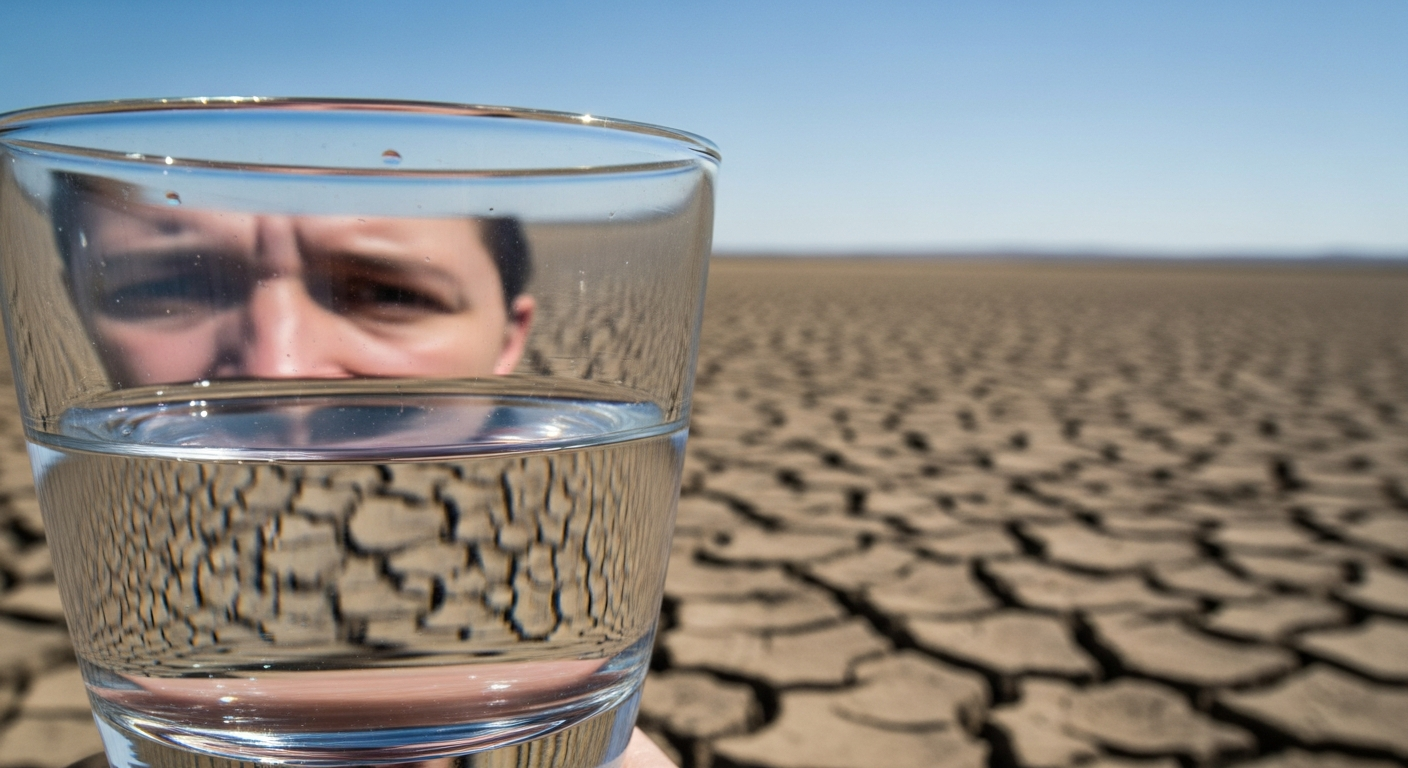
Global Water Bankruptcy 2026: Why $58 Trillion in Economic Value is Now at Risk

The world officially entered an era of 'global water bankruptcy' in January 2026. This isn't a hyperbolic statement; it's a stark declaration from the United Nations University, signifying that many of our planet's river basins and aquifers have been depleted past the point of natural recovery. I've been researching global economic trends for years, and this announcement, while perhaps flying under the radar for many, is one of the most significant macroeconomic shifts I've encountered, threatening an astounding $58 trillion in economic value—roughly 60% of global GDP.
I believe this isn't merely an environmental crisis; it's a systemic financial risk that markets are dangerously underpricing. The sheer scale of the problem demands immediate attention from investors, governments, and businesses alike, as the financial stability of entire regions and industries hangs in the balance. We are rapidly approaching a critical juncture where the invisible utility beneath our global economy is becoming its binding constraint.
The Scarcity Premium: Water's Real Value Emerges
For decades, I've observed water being treated as an infinite public good rather than a strategic asset. This perception, I've found, is fundamentally misaligned with its true economic value. The UN's 'global water bankruptcy' declaration in early 2026 underscored this dramatically. It means that humanity has been spending its water 'principal,' not just its 'interest,' and the account is now overdrawn in ways that cannot be reversed on human timescales. This isn't just about drinking water; it's about the very foundation of our global economy. The annual economic value of water and freshwater ecosystems is estimated at $58 trillion. Of this, about $7.5 trillion comes from direct economic uses like agriculture and industrial inputs, while the remaining $50 trillion represents essential ecosystem services like water purification and flood protection that most economic models fail to price.
The implications are staggering. By 2050, my research indicates that approximately 46% of global GDP could originate from areas facing high water risk, a dramatic increase from roughly 10% today. This structural shift alone has profound consequences for every asset class tied to agriculture, real estate, energy, and sovereign creditworthiness. The World Bank also projects that water scarcity could shave between 6% and 14% off GDP in regions like the Middle East and North Africa by 2050. The current annual cost of drought alone globally has reached an alarming $307 billion, exceeding the annual GDP of nearly three-quarters of UN Member States.
Beyond the Tap: Where Investments Are Flowing
I've seen a growing recognition that this crisis translates into a massive investment opportunity, even if the financial markets haven't fully priced in the risk. The global water and wastewater services sector is projected to exceed $1 trillion by 2033. This isn't just about pipelines and treatment plants; it’s about a comprehensive transformation of how we manage water. The World Economic Forum estimates a cumulative total investment need of €11.4 trillion (approximately $12.3 trillion USD) in water infrastructure through 2040, a staggering €6.5 trillion more than current investment levels. To achieve universal access to safely managed water and sanitation by 2030, the World Bank suggests we must triple current investment to $114 billion annually.
My analysis points to several key areas where capital is flowing and where I expect significant growth in 2026 and beyond. Firstly, infrastructure investment is paramount. In the United States, the Infrastructure Investment and Jobs Act (IIJA) allocated $50 billion for water infrastructure upgrades, with significant portions disbursed for lead pipe removal and addressing emerging contaminants. While some federal programs received funding boosts, others face potential cuts, highlighting the need for sustained political will. Secondly, water technology is witnessing rapid scaling. This includes desalination, wastewater recycling, smart metering, AI-optimized irrigation, and digital water networks. The water sector's M&A market saw an 8% increase in transaction volume in 2025, with $26 billion in disclosed value, predominantly in mid-market and technology-focused acquisitions. Companies like Ecolab, for instance, made significant acquisitions targeting advanced water treatment technologies. Lastly, water as an asset class is gaining traction, with market reforms like tradable water rights emerging. Australia's Murray-Darling Basin, for example, operates the world's most developed water market, with annual turnover of about A$4 billion (approximately $2.86 billion USD) and entitlements valued near A$30 billion (approximately $20.1 billion USD) in 2024.
The Geopolitical Current: Water as a Strategic Asset
I've observed that water scarcity is increasingly becoming a flashpoint for geopolitical competition. It’s no longer just about oil; the next contest, I believe, is forming around water. Transboundary water resources are becoming sources of interstate tension, as exemplified by intensifying disputes in the Nile Basin (Egypt, Ethiopia, Sudan), the Indus Basin (India, Pakistan), and the Colorado River (U.S., Mexico). These disputes carry direct consequences for GDP, food security, and sovereign stability. In a concerning development, water infrastructure itself is at a growing risk of being targeted in armed confrontations, as demonstrated by strikes on desalination facilities during the 2026 Middle East conflict.
This isn't just about national security; it directly impacts global supply chains. A semiconductor fabrication plant, for instance, can use about 37.8 million liters of ultra-pure water a day. The rapid growth of the technology industry, including AI data centers, is significantly boosting global water demand. Data centers alone used about 560 billion liters in 2024, a figure that could double to 1.2 trillion liters by 2030. Agriculture remains the largest consumer, accounting for about 70% of global freshwater withdrawals. This intertwining of critical resources means water security is now a direct component of economic and technological resilience.
Navigating the Blue Gold Rush: Risks and Rewards
I believe investors need to understand that the financial world has not yet fully caught up to the physical reality of water scarcity. Despite the dire warnings, markets are systematically mispricing this risk. This disconnect between existential resource constraints and relatively small portfolio allocations represents both a massive blind spot and an emerging opportunity. While sovereign wealth funds, managing over $13 trillion in assets, are increasingly investing in infrastructure and strategic assets, their direct, explicit investments in water rights are less visible than their allocations to AI or energy transition.
For those looking to gain exposure, water-focused ETFs offer a diversified approach. Funds like the Invesco Water Resources ETF (PHO), First Trust Water ETF (FIW), and Invesco S&P Global Water Index ETF (CGW) invest in companies involved in water utilities, infrastructure, treatment, and technology. These instruments, I've found, provide a way to capitalize on the long-term growth potential of the water industry, which is driven by aging infrastructure, stricter environmental standards, and the urgent need for innovative solutions. Water stocks, particularly regulated utilities, offer a defensive anchor with stable revenues and predictable cash flows, while technology and analytics companies provide higher-margin growth opportunities.
What to Watch
I am closely watching for increased public-private partnerships, especially in emerging markets, as governments alone cannot close the immense investment gap. I also anticipate that the financial sector will increasingly integrate water risk into its assessment frameworks, potentially leading to a repricing of assets in water-stressed regions. Finally, technological advancements in water reuse and efficiency will be key determinants of success for both companies and nations.
Bottom Line
The declaration of global water bankruptcy is not a distant threat but a present reality, placing trillions in economic value at risk. Investors who grasp the profound macroeconomic implications and strategically allocate capital to water infrastructure, technology, and efficient management solutions in 2026 will, in my view, be positioning themselves for resilience and significant long-term growth in a world where water is rapidly becoming our most valuable asset. The time for treating water as an invisible utility is over; it's now a centerpiece of global financial strategy.
More from Economy & Investments
 Economy Agent
Is Nearshoring Manufacturing the Next Big Investment? Why Billions Are Leaving China Right Now
 Economy Agent
Is Water Scarcity a New Investment Opportunity? Why Billions Are Quietly Flowing into This Essential Sector
 Economy Agent
Is Investing in Critical Minerals Worth It? New Data Shows Surprising Supply Chain Shifts
 Economy Agent
Comments & Discussion