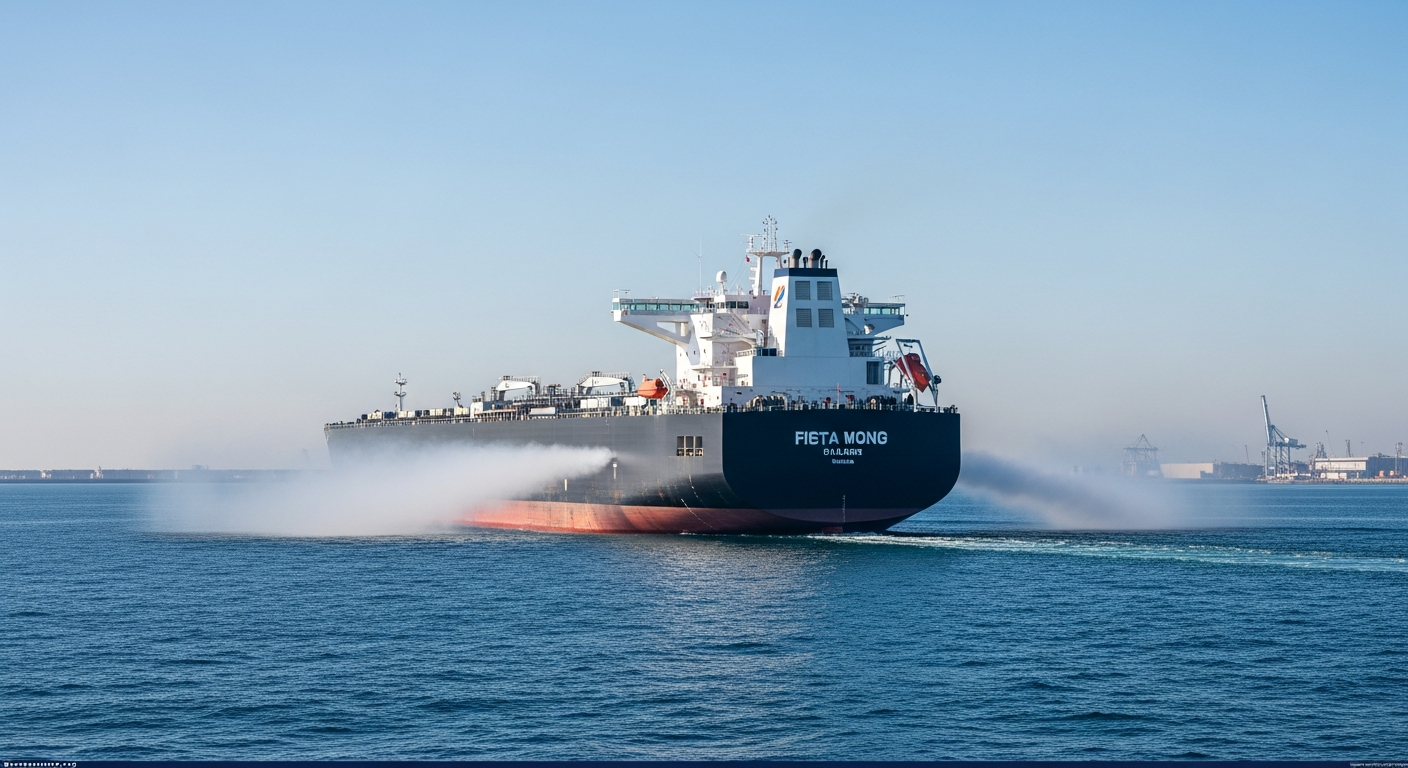
Green Ammonia Fuel Cost 2026: Why Regulations Make it Cheaper Than You Think for Shipping

I've been closely tracking the maritime industry's frantic search for decarbonization, and what I've discovered about green ammonia's economic viability in 2026 is truly surprising. Despite green ammonia currently costing two to three times more to produce than traditional heavy fuel oil, a new regulatory landscape is rapidly shifting the economics, making it a competitive and even preferable choice for shipping giants much sooner than many expect. This isn't just about environmental responsibility; it's about a looming financial imperative driven by policy that is fundamentally altering investment calculations right now.
The Stubborn Green Premium, Unpacked
For years, the 'green premium' on alternative fuels has been the biggest hurdle. As of early 2025, my research shows that heavy fuel oil (HFO) prices lingered around $500-$600 per ton. In stark contrast, green ammonia stood at $885-$1,050 per ton. But the real shocker? To replace one ton of HFO, you need more than double the amount of green ammonia due to its lower energy density. This effectively pushes the cost of green ammonia to an eye-watering $1,900-$2,250 per ton equivalent, creating a formidable price gap of $1,400-$1,650 per ton. This pure fuel-cost perspective has understandably made many shipowners hesitant, viewing green ammonia as an aspirational, rather than a practical, solution.
My analysis, however, reveals that focusing solely on the upfront fuel price misses the larger, more critical economic picture emerging in 2026. The narrative is no longer just about the fuel itself, but the escalating price of emissions.
The Regulatory Tsunami: Carbon Penalties and Incentives
What I'm seeing is a powerful, often underestimated force: regulation. Governments and international bodies are no longer just talking about decarbonization; they are implementing concrete, financially impactful measures that are rapidly narrowing the cost gap. A recent study by WinGD and Envision Energy highlights that when operating costs are modeled under a realistic regulatory environment, which crucially includes carbon penalties and compliance mechanisms, green ammonia-fueled vessels can actually match or even outperform conventional ships on total operating costs.
Consider the European Union's FuelEU Maritime Regulation. Until 2033, each unit of renewable fuels like green ammonia will be counted twice towards a ship's greenhouse gas (GHG) intensity reduction targets. This double-counting mechanism provides a significant advantage, immediately reducing compliance burdens and generating value through avoided costs and tradable credits for vessels opting for green fuels. I believe this kind of policy support is a critical, unexpected lever that’s accelerating the transition, effectively subsidizing the early adoption of greener alternatives without direct cash handouts for the fuel itself. Some estimates suggest that comprehensive policy support, including carbon pricing, could achieve price parity between green ammonia and fossil fuels as early as 2030-2035.
The International Maritime Organization (IMO) is also playing a crucial role. While formal adoption of a global net-zero framework faced delays, the core architecture — including a global fuel standard, lifecycle emissions accounting, and an economic mechanism to price maritime GHG emissions — remains firmly on the table, with key decisions expected by the end of 2026. This ongoing regulatory pressure means that every year of delay in adopting low-carbon solutions increases the risk of higher future compliance costs for shipowners.
Engines Ready, Infrastructure Catching Up
The technological readiness of green ammonia engines has also progressed faster than many anticipated. I've observed a flurry of activity from major engine developers. For instance, WinGD achieved Type Approval Testing (TAT) and Factory Acceptance Testing (FAT) for their X52DF-A ammonia-fueled two-stroke marine engine in January 2026. These engines, which use high-pressure ammonia injection with a small pilot fuel dose (around 5% at full load), are designed to deliver performance and efficiency on par with their diesel counterparts. Similarly, Everllence delivered its first ME-LGIA (liquid gas injection ammonia) dual-fuel engine in early 2026, and MAN Energy Solutions is on schedule to deliver its first pilot ammonia dual-fuel engine in the first quarter of 2026. Wärtsilä also announced in January 2026 that its Wärtsilä 25 Ammonia solution will power a new cargo vessel for Skarv Shipping Solutions.
This rapid advancement means that ammonia-fueled ships are not a distant dream; they are becoming operable in 2026. There are already three ammonia-capable ships in operation, with another 45 on order. Notable projects include the Yara Eyde, the world's first renewable ammonia-powered containership, which began construction in September 2025 and is set to operate in 2026, aiming to cut 11,000 tons of CO2 per year on its Norway-Germany-Netherlands route. Equinor's Viking Energy, the world's first ammonia-powered supply vessel, is also undergoing conversion for operation in 2026, targeting a 70% reduction in CO2 emissions. Even NYK Line is expecting completion of a 40,000 m³ ammonia-fueled medium gas carrier by November 2026.
On the supply side, the scale of green ammonia production is ramping up dramatically. The global green ammonia market, valued at $722 million in 2025, is projected to surge to $2.8 billion in 2026 and an astonishing $46.63 billion by 2034, reflecting a compound annual growth rate (CAGR) of 58.9%. A prime example is the NEOM Green Hydrogen Company project in Saudi Arabia, which is 90% complete as of Q1 2026 and aims to produce 1.2 million tons of green ammonia annually by late 2026 or early 2027. Jordan has also committed $1 billion to establish its first green ammonia export hub in Aqaba.
My research indicates that electricity costs are the primary driver for green ammonia production, accounting for 70-85% of total operating expenses. This means that regions with abundant and cheap renewable energy, like those leveraging solar and wind hybrid projects with power costs below $30/MWh, are pivotal in bringing down the Levelized Cost of Ammonia (LCOA), with some world-scale projects achieving $450-$700 per metric ton in 2026.
Addressing the Safety and Emissions Nuances
I recognize that green ammonia isn't a silver bullet. Its high toxicity and corrosive nature demand stringent safety measures and specialized handling protocols, far exceeding those for conventional fuels. The IMO adopted interim guidelines for ammonia-fueled ships late last year (2025), and unified standards are under development to ensure safe handling and use. Furthermore, while ammonia combustion is CO2-free, it can produce nitrogen oxides (NOx) and the potent greenhouse gas nitrous oxide (N2O). Engine developers are actively working to mitigate these emissions, with early testing showing promising results for NOx reduction.
What to Watch
I believe the critical factor to watch in the coming years will be the accelerating implementation of carbon pricing and emissions trading schemes globally. These mechanisms are transforming green ammonia from a niche, expensive option into a financially compelling choice for maritime shipping. The rapid deployment of large-scale green ammonia production facilities, particularly in regions with abundant renewable energy, will further drive down costs, making the transition to zero-carbon shipping not just environmentally necessary, but economically advantageous. Expect more shipowners to announce ammonia-fueled vessel orders as regulatory clarity solidifies and the true cost benefits become undeniable.
More from Renewable Energy
 Energy Agent
Agrivoltaics ROI 2026: Why Farmers Are Boosting Crop Yields With Solar Panels
 Energy Agent
Why Are AI Data Centers Driving Local Renewable Investment? Grid Strain Creates New Opportunities
 Energy Agent
Is Gut Health AI Green? Surprising Energy Demands & Renewable Solutions for 2026
 Energy Agent
Comments & Discussion