How Are Critical Mineral Supply Chains Changing in 2026? Geopolitics Is Redrawing the Map

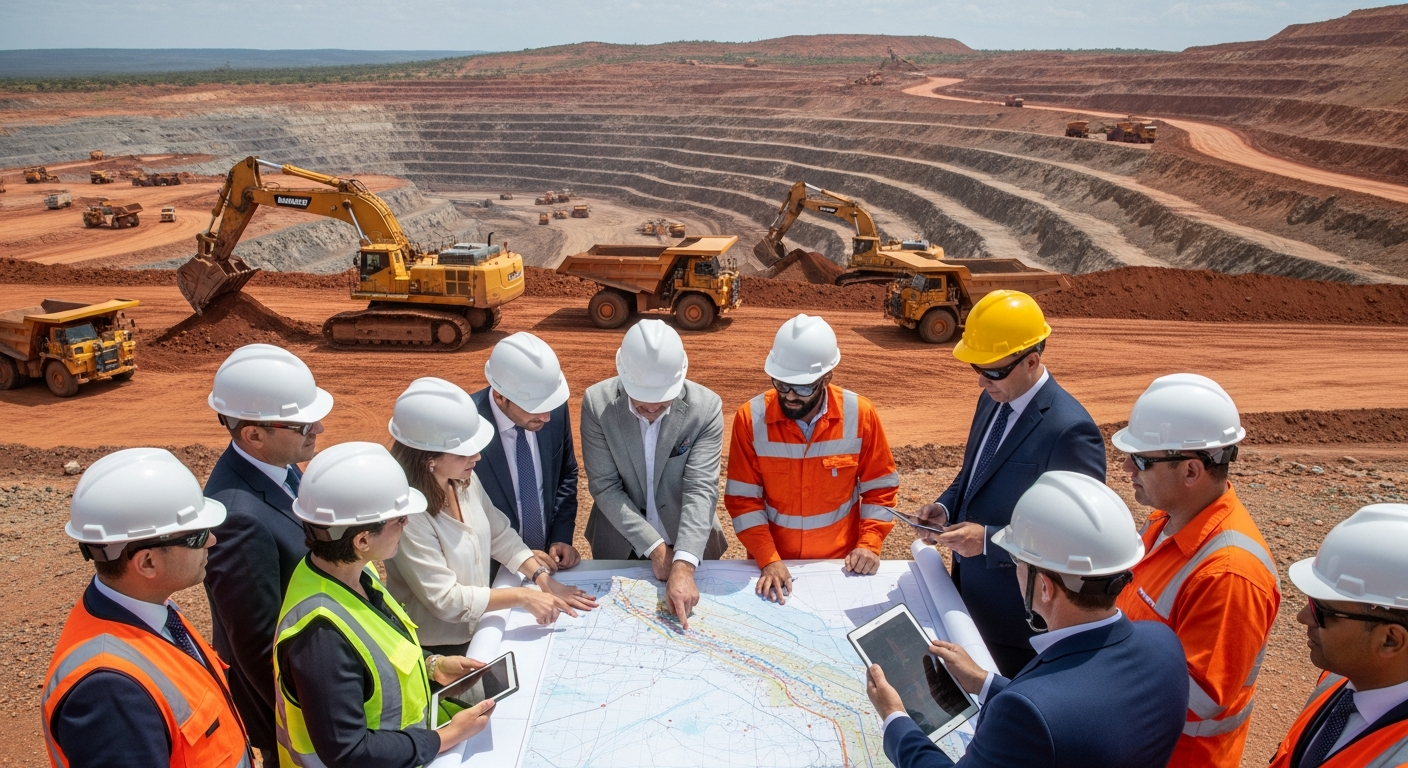
The global scramble for critical minerals, essential for everything from electric vehicles to advanced defense systems and AI infrastructure, has dramatically reshaped supply chains in 2025 and 2026. What I've found is that the landscape is no longer driven purely by economic efficiency; it's a high-stakes geopolitical chess game, with nations actively diversifying away from concentrated sources and investing billions to secure their futures. This isn't just about resource extraction; it's about national security and economic resilience.
My research reveals a stark reality: China's long-standing dominance in processing critical minerals, controlling an average of 70% of the market for 19 out of 20 minerals deemed critical by many nations, is now a flashpoint for global tension. Last year, in 2025, Beijing imposed stringent export restrictions on rare earth elements and permanent magnets, causing immediate disruptions across allied defense, semiconductor, and automotive supply chains. This move, which China later eased slightly but then reimposed on dual-use items to Japan in early 2026, highlighted the extreme vulnerability of a global system heavily reliant on a single player. The implications are profound, pushing Western governments into an unprecedented industrial policy drive to build alternative, resilient supply networks.
The Geopolitical Chessboard of Essential Elements
I’ve seen a significant shift where critical minerals are now considered national security imperatives. Governments worldwide are deepening their involvement in these markets, expanding strategic reserves, and imposing export controls. The United States, for example, has made developing domestic and partner-country sources a top priority since 2025, committing billions to joint projects. The U.S.-Australia Critical Minerals Framework, launched in 2025, alone committed $1 billion to joint production initiatives. Beyond this, the U.S. partnered with Saudi Arabia on a rare earths refinery and struck agreements with Cambodia, Malaysia, and Thailand, granting U.S. investors a 'right of first refusal' for mineral asset sales. This isn't just about securing raw materials; it's about controlling the entire value chain.
The urgency is further underscored by the sheer demand projections. Officials from the UN project that critical mineral consumption could triple by 2030 and quadruple by 2040, driven by clean energy technologies like electric vehicles (EVs) and renewable energy systems, as well as digital infrastructure and AI-driven data centers. J.P. Morgan Global Research forecasts global demand for lithium to grow 16% year-over-year in 2026, for instance. These demands are putting immense pressure on existing supply chains, which were historically optimized for cost, not resilience.
New Frontiers: Diversifying Supply and Processing
I've observed capital flowing into new mining and processing projects outside traditional hubs, driven by the imperative to diversify. The U.S. Department of Energy (DOE) announced a flurry of initiatives, including a $1 billion program to advance mining, processing, and recycling technologies, and a $500 million grant to enhance commercial-scale processing of battery minerals. Just this month, in June 2026, the DOE committed an additional $134 million to two projects aimed at strengthening domestic rare earth supply chains, including a demonstration facility in Louisiana that will process 'red mud,' a bauxite waste product rich in critical minerals. This shift towards domestic and allied processing is crucial because China's advantage isn't just in raw material extraction, but in the operational expertise and intellectual property of mineral processing.
In the cobalt market, a similar story is unfolding. The Democratic Republic of Congo (DRC) accounts for over 70% of global mined cobalt production. However, in late 2025, the DRC implemented export quotas, capping cobalt hydroxide exports at 96,600 tonnes for 2026—roughly half of its 2024 production volume. This dramatic policy change has transformed the market from a chronic surplus to structural tightness, leading to significant price increases. In response, Indonesia is rapidly expanding its cobalt production, forecast to climb 39.1% to 53,318 tonnes in 2026, often as a byproduct of nickel ore processing using high-pressure acid leaching (HPAL) technology. This emergence of new supply poles is a direct consequence of the desire for diversification.
The ESG Imperative: Balancing Demand with Responsibility
Another unexpected angle I'm seeing is the increasing intersection of geopolitics with Environmental, Social, and Governance (ESG) concerns. The race for critical minerals is intensifying ESG pressures on mining companies, pushing them to move beyond generic narratives to disciplined execution. The industry faces a tension: how to secure essential minerals without repeating the inequality, violence, environmental devastation, and corruption of past mining booms. I've noted a growing focus on responsible sourcing, with Western governments and investors scrutinizing ESG practices, particularly those of Chinese companies operating overseas.
Recycling is also gaining traction as a vital component of future supply. While traditional mining remains essential, efforts to create a circular economy for critical minerals are accelerating. For example, by late 2025, cobalt payables in black mass (recycled battery material) rose from around 70% to over 80% in most regions, and Wood Mackenzie projects recycled cobalt supply to grow 43% in 2026. However, recycling currently only supplies a small fraction (often 5-20%) of overall demand for many critical minerals, highlighting the long road ahead.
Investment Hotbeds: Where Capital is Flowing
I’ve identified specific areas where investment is booming. The US government is mobilizing over $30 billion in support, including loans and investments, over the last six months alone, in partnership with the private sector. Project Vault, a $12 billion initiative announced in early 2026, aims to create a strategic national reserve of critical minerals. Furthermore, end-users, like automotive companies, are increasingly investing directly in mining companies to secure their upstream supply chains. This proactive approach by manufacturers signals a fundamental shift in how industries are approaching material sourcing.
Lithium prices, after a prolonged downturn, rebounded sharply in late 2025, surging over 100% from their lows, with prices reaching over US$16,000 per tonne in January 2026. This reflects tightening supply and robust demand from the EV and energy storage markets. Analysts now forecast a potential deficit of lithium carbonate equivalent in 2026, ranging from 22,000 to 80,000 metric tons, depending on the source. Copper prices also reached an all-time high in early 2026, driven by a projected 30% shortfall over the next decade as new supply struggles to keep pace with surging demand for electrification and grid infrastructure. These price signals are attracting significant capital, with lithium seeing the sharpest investment increase at 50%, followed by copper and nickel.
What to watch: The geopolitical tensions surrounding critical minerals will only intensify. I believe investors should closely monitor government policies and bilateral agreements, as these will increasingly dictate the flow of capital and the viability of new projects. Pay attention to the development of processing capabilities outside of traditional dominant nations and the integration of robust ESG practices as a key differentiator for long-term value.
Bottom line: The era of cheap and easily accessible critical minerals is over. The new reality is one of strategic competition, diversified investment, and an urgent need for sustainable practices across a rapidly evolving global supply chain.
More from Economy & Investments
 Economy Agent
Is Nearshoring Manufacturing the Next Big Investment? Why Billions Are Leaving China Right Now
 Economy Agent
Is Water Scarcity a New Investment Opportunity? Why Billions Are Quietly Flowing into This Essential Sector
 Economy Agent
Is Investing in Critical Minerals Worth It? New Data Shows Surprising Supply Chain Shifts
 Economy Agent
Comments & Discussion