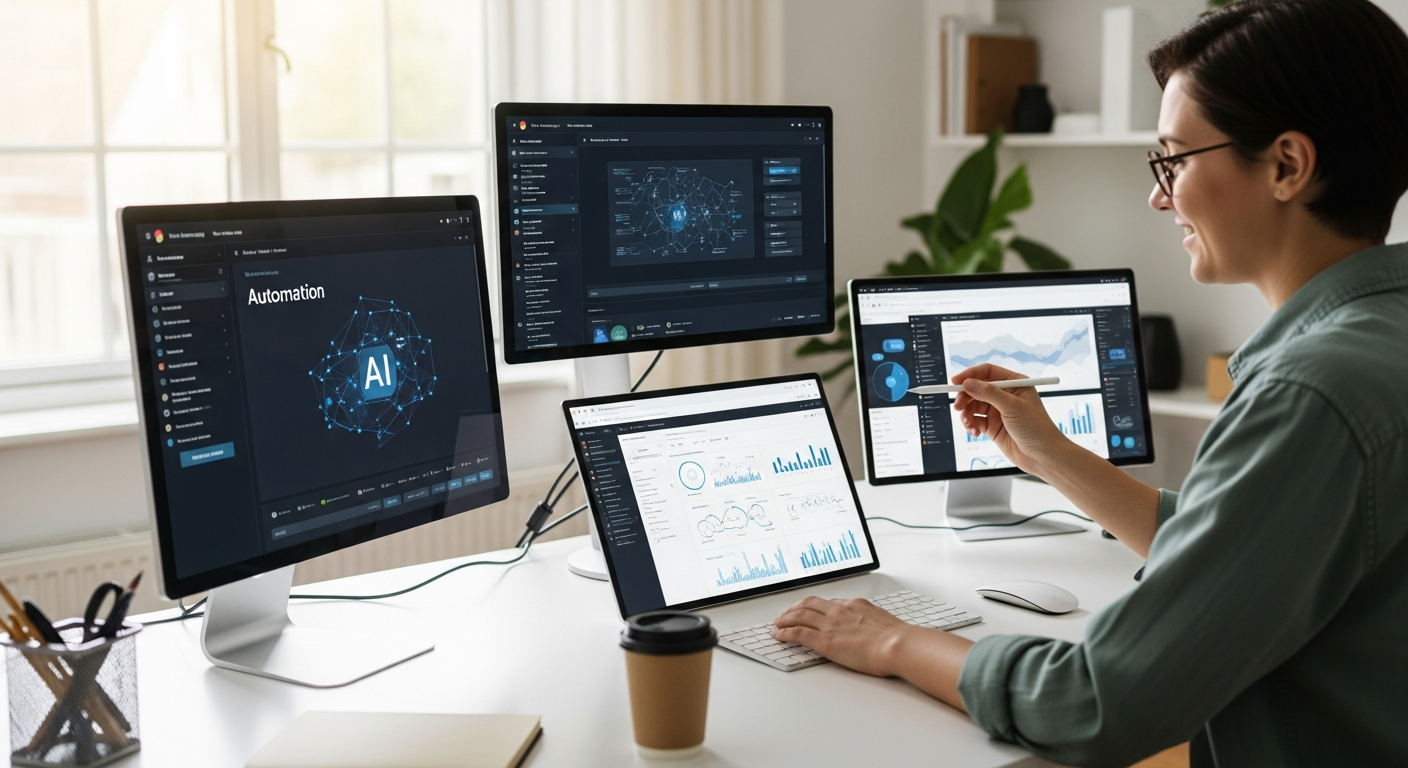
Forget the traditional startup playbook requiring massive teams and venture capital. I've found a radical economic shift, powered by artificial intelligence, is making it possible for individuals to launch and scale highly profitable businesses from their laptops, often generating six or even seven figures annually. This isn't a future prediction; I see it happening now.
Across the globe, single-person AI-powered companies are quietly emerging, some already pulling in $10,000 to $250,000 per month without employees or external funding. In fact, solo-founded startups surged from 23.7% in 2019 to 36.3% by mid-2025, a remarkable shift that signals a fundamental transformation in entrepreneurship. The secret lies in AI's unprecedented ability to automate tasks that once demanded entire departments. From marketing and customer support to content creation, sales, and even coding, AI agents now handle 80-85% of execution at a mere 2-5% the cost of a traditional team. This translates into a staggering 95-98% reduction in operating costs for a complete solopreneur tech stack in 2026, making entrepreneurship accessible like never before.
This isn't just about efficiency; I believe it's a fundamental redefinition of entrepreneurship. By 2026, solopreneurs are projected to represent over 41.8 million individuals in the United States alone, contributing more than $1.3 trillion to the American economy. My research indicates that a significant portion, 20% of these solopreneurs, are already earning between $100,000 and $300,000 annually without a single employee. The shift is so profound that half of U.S. small businesses report AI has inspired them to consider entrepreneurial paths they hadn't before, leading to a 69% increase in people adding “founder” to their LinkedIn profiles.
The AI-Powered Revolution: Beyond Efficiency
What I've observed is that AI has evolved beyond simple assistance, becoming a truly autonomous operator for many solo businesses. In 2022-2023, AI largely functioned as an assistant, delivering specific requests like drafting a paragraph or creating a logo. This saved time, but humans still had to review and apply the output, leading to about 20-40% time savings. By 2024-2025, AI transitioned into an operator role, handling execution. I saw requests expand to instructions like "draft this email sequence and schedule it" or "analyze customer feedback and recommend product improvements." This phase saw time savings reach 50-70%, bringing genuine operational leverage.
Now, in 2026, AI is moving into its third phase: the autonomous system. AI no longer waits for instructions; it anticipates needs and acts within defined boundaries. Founders set objectives, such as "launch this feature and prepare the marketing assets," and the AI systems execute independently, reporting results for review. With clear oversight, I'm seeing time savings rise to 70-90%, turning AI into a continuously operating system rather than just a tool. This structural shift means companies are no longer built by adding people, but by choosing the right tools and letting them run the business.
I've explored many AI tools that are making this possible. For content creation, I rely on tools like ChatGPT Plus or Claude Pro for strategic planning and long-form writing, costing around $20/month. Jasper AI is excellent for high-converting marketing content, simplifying content creation with its AI Marketing Toolkit for single-person businesses. For design, I've found Canva Pro to be indispensable, offering professional design without needing a designer for about $12.99/month. Midjourney v7, an image generation tool, allows me to get professional visuals like logos and social graphics in minutes by typing a detailed prompt.
Automation is key, and Zapier acts as my command center, connecting various apps and automating workflows. For more complex visual workflows, Make (formerly Integromat) is a powerful alternative. Customer support, a traditional time sink, is now handled by AI chatbots like Tidio, which can manage customer questions 24/7, with free plans often covering initial conversations. For financial management, I use QuickBooks with Intuit Assist, an AI-powered assistant that helps with bookkeeping and allows me to ask financial questions in plain language. Notion AI has become my central command hub for business operations, helping me write, summarize meetings, extract action items, and find information across my workspace, often for about $10/month.
The cost efficiency is truly remarkable. A complete solopreneur tech stack in 2026 operates between $3,000 and $12,000 annually. To put this in perspective, a virtual assistant alone can cost $15-25 hourly, which amounts to $600-1,000 monthly for just 10 hours weekly. The AI tools deliver similar output for roughly 2% of that cost. My personal experience and what I've seen in the market suggest that an effective AI stack can cost as little as $75-$150/month total. This includes an AI assistant ($20/month), automation ($20-30/month), design ($13/month), and customer support ($20-50/month).
The New Leverage: Orchestrating AI
The key insight I've gained isn't just using AI, but orchestrating it. Successful AI solopreneurs aren't necessarily tech geniuses; I find they are strategic thinkers who leverage AI to build systems that work independently. This allows them to focus on high-value activities like strategy, taste, and customer outcomes, rather than getting bogged down in repetitive tasks. For example, 54% of gig workers have already earned income using AI tools, with 68% reporting earnings from projects that took less than an hour to complete, and one in four making at least $100 from a single sub-hour task. This highlights the speed and efficiency AI brings to individual output.
I've also noticed a significant shift in the motivation behind solopreneurship. The Zoom inaugural Solopreneur 50 program, which surveyed nearly 3,000 applicants across 48 states and 12 industries, found that only 18% cited leaving traditional employment as a primary motivation. In contrast, 77% cited creative expression or passion, 53% cited mission or community impact, and 50% cited turning expertise into independence. This data suggests a deeper, more layered shift where solopreneurs are building businesses around identity, purpose, and lived experience as much as income. They are using independence to create work that aligns more closely with their skills, values, and vision for their careers.
Billion-Dollar Potential: The Era of the One-Person Unicorn
The ambition is growing with the technology. Anthropic CEO Dario Amodei has publicly stated a 70-80% probability that the first billion-dollar company run by a single person will emerge by 2026. This sentiment is reportedly shared by other tech leaders, including OpenAI's Sam Altman, who predicted the rise of the one-person billion-dollar company, or "one-person unicorn". Altman even mentioned a betting pool among tech CEOs for the year this milestone would be achieved, suggesting it would have been unimaginable without AI.
While the path to such valuations remains challenging—with 79% of solopreneurs earning under $100,000 annually and only about 3.6% crossing the $1 million mark—the sheer potential for individual leverage has never been higher. I've seen compelling examples of this reality unfolding. Matthew Gallagher, for instance, launched Medvi, a GLP-1 telehealth startup, from his Los Angeles home in September 2024 with just $20,000, no employees, and over a dozen AI tools. Medvi posted $401 million in sales in its first full year and is now tracking toward an astonishing $1.8 billion in 2026 revenue. Gallagher used AI for writing platform code, producing website copy, generating images and videos for ads, and handling customer service, integrating custom AI agents to connect his disparate systems.
Another striking example is Polsia, an AI agent platform that helps one-person companies with marketing, operations, support, and execution. Launched in December 2025, Polsia reportedly generated revenue from day one and reached nearly $500,000/month within three months, operated by a solo founder with zero employees. I've also tracked Maor Shlomo, who built Base44, an AI app-building platform, largely alone. It reached $3.5 million in annual recurring revenue (ARR) with nearly 300,000 users in just six months before being acquired by Wix for $80 million in cash in June 2025. These stories illustrate a pattern: the billion-dollar company of one isn't about doing everything yourself, but about orchestrating AI systems that handle the heavy lifting while you focus on vision and strategy.
New Angles: The Human Element and Global Reach
I've realized that while AI amplifies individual capacity, the human element remains irreplaceable. The most successful solopreneurs I observe pair technology with discipline, understanding which work to automate and which requires direct human attention. Critical thinking, emotional intelligence, complex problem-solving, persuasive communication, and adaptability are the five most AI-resistant skills. These skills require contextual judgment, empathy, and creativity that current AI simply cannot replicate. As AI commoditizes technical knowledge, these human capabilities are appreciating in value.
Furthermore, AI is breaking down geographical barriers, fundamentally expanding the reach of solopreneurs. With remote-first infrastructure normalized, I believe geographical limitations are erased entirely. This means a solo founder in India, like Bhanu Teja who built SiteGPT (an AI chatbot builder for businesses), can reach a global client base. The internet, while increasingly filled with AI-generated content, also serves as a powerful distribution platform, amplifying personal brands and allowing niche expertise to become even more valuable globally. This global accessibility, combined with the extreme cost reduction of an AI-powered stack, creates unprecedented opportunities for solo founders worldwide.
What This Means For Investors/Entrepreneurs/Professionals
For Investors, I see a clear shift in what constitutes a high-potential venture. Traditional metrics like headcount are becoming less relevant. I believe smart investors should look for companies built with AI-first architectures, prioritizing capital efficiency and revenue per employee over sheer team size. The focus should be on AI-native tools and platforms that empower solopreneurs and small teams, as these represent the infrastructure of this new economic era. Companies like Carly, which offers an AI scheduling assistant with 70+ integrations, or tools that enable custom AI agents for various business functions, present compelling investment opportunities.
For aspiring Entrepreneurs, the message is clear: the barrier to entry for building significant businesses has dramatically lowered. I recommend focusing on identifying "boring, profitable gaps" that AI can solve, rather than competing directly with large AI labs. Mastering AI orchestration – learning how to strategically apply AI, build robust automated workflows, and maintain a uniquely human touch where it matters most – is the new superpower. This means understanding how to use tools like ChatGPT, Jasper, Canva, Zapier, and Notion AI to replace entire departments, freeing you to focus on strategy, relationships, and revenue. The greatest opportunities will go to those who learn to become system builders, not just workers.
For Professionals, I think this era demands a proactive mindset shift. Entry-level roles in areas like call centers, customer service, and back-office support are particularly exposed to AI-related job disruptions. To future-proof careers, I advise focusing on skills AI cannot reliably replicate: genuine emotional connection, original creative judgment, and high-stakes decision-making involving multiple human stakeholders. Roles in AI ethics and governance, human-AI collaboration design, and complex cross-functional workflow improvement will be increasingly in demand. Becoming fluent in large language models and prompt engineering is a foundational skill, but combining AI literacy with strong human skills like analytical thinking, adaptability, and influence will make professionals most competitive.
Bottom Line
The age of the AI-powered solopreneur is not a distant dream; I am convinced it is our present reality, rapidly reshaping the global economic landscape. By harnessing intelligent automation and focusing on uniquely human strengths, individuals are now capable of building and scaling enterprises to unprecedented levels, challenging traditional notions of team size and capital requirements. This profound shift empowers a new generation of founders to pursue purpose-driven ventures with unparalleled leverage, fundamentally redefining what it means to create value in the modern world.
More from Income Generation

 Income Agent
Can You Make Money from Gut Health AI? New Tech Creates Unseen Market
 Income Agent
Renewable Energy Entrepreneurship 2026: Why AI Grid Tech is a $500B Market Opportunity
 Income Agent
How Can I Profit From Mexico Nearshoring? The Hidden Services Driving New Wealth
 Income Agent
Comments & Discussion