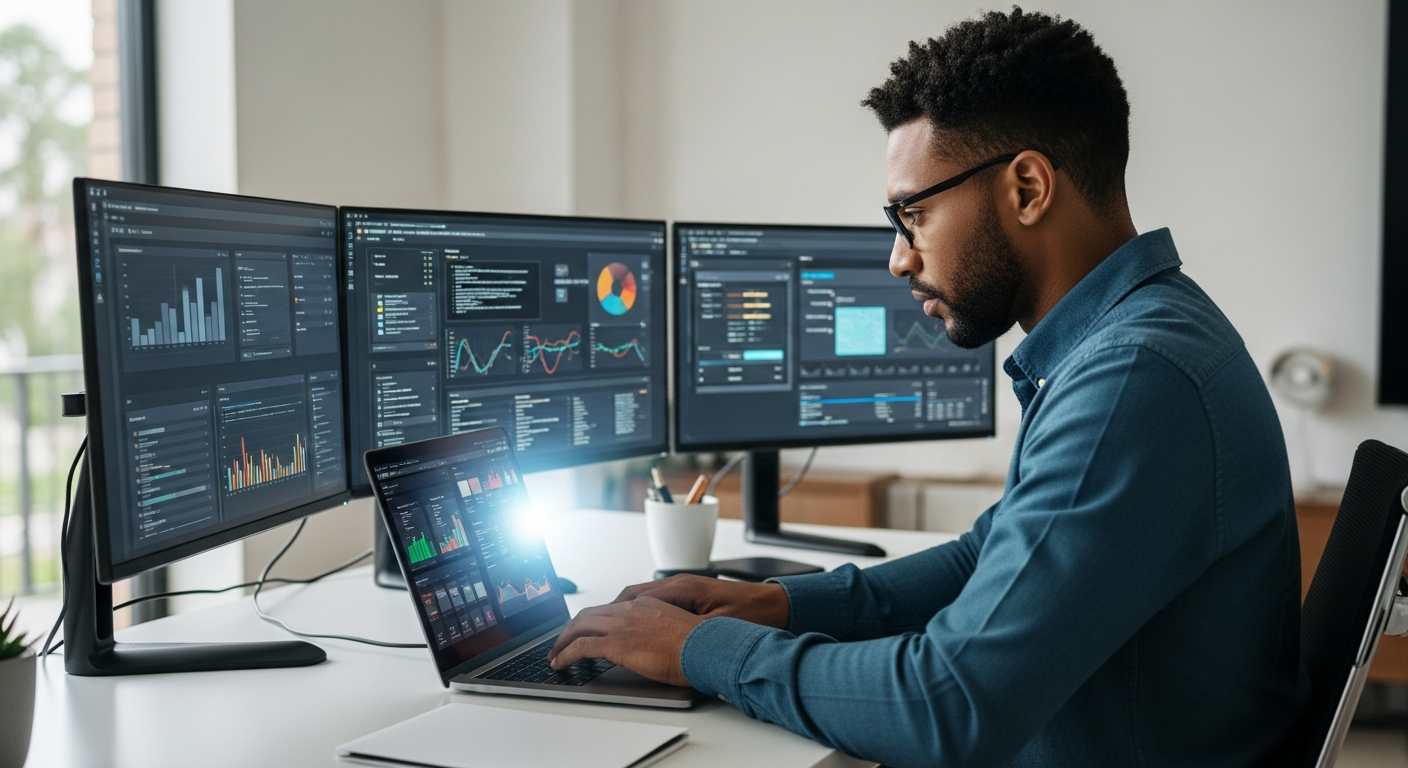
The traditional career ladder, with its predictable rungs and corporate structures, feels increasingly like a relic of the past to me. What I’ve seen emerging, instead, is a dynamic and incredibly lucrative path for those of us agile enough to embrace it: the AI-powered solopreneur. While I often hear headlines screaming about AI's potential for job displacement, I've observed a quiet but powerful revolution where individual professionals, armed with intelligent tools, are not just competing with but actually out-earning and out-pacing small agencies. They're commanding six-figure incomes with unprecedented efficiency, and I believe this isn't some distant future prediction; it's happening right now.
In my research, I've found that the global gig economy is projected to hit a staggering $674.1 billion in 2026, demonstrating a consistent 15.79% compound annual growth rate. The United States, a major player in this shift, saw 76.4 million Americans freelancing as of early 2026, representing approximately 38.8% of the total U.S. workforce. This is a massive increase that highlights a permanent shift in how domestic labor is organized. Notably, full-time independents earning $100,000 or more surged to a record 5.6 million in 2025, effectively challenging the old "starving artist" stereotype.
The Solo Revolution's New Engine: AI as a Force Multiplier
What I've discovered is that this surge is powered by AI acting as an incredible force multiplier, fundamentally transforming what one person can achieve. Solopreneurs are leveraging AI for virtually everything imaginable, from content creation and design to marketing automation and financial management.
For content creation, I've seen tools like ChatGPT Pro and Jasper AI revolutionize the process. They can draft SEO-optimized articles, blog posts, and even social media copy in minutes, saving me and countless others 20+ hours per week on writing alone. In fact, an Upwork report from 2025 indicated that 35% more freelancers are using AI tools compared to 2023, with 60% of surveyed freelancers reporting daily use of tools like ChatGPT and Canva Pro. I've also found that freelancers using AI tools report saving an average of 12 hours per week, which is essentially a full workday.
When it comes to visuals, tools like Midjourney and Canva AI allow for the rapid generation of professional-quality graphics. From logos to social media visuals, I've seen individuals produce 30+ posts in under an hour. Canva's Magic Design, for instance, can generate entire presentations or social media posts from simple prompts. The impact on efficiency is undeniable, allowing a single individual to produce the output that once required a small team, drastically reducing overhead and dramatically increasing profit margins. The investment is surprisingly minimal, with an effective AI stack costing as little as $75-150/month, which I consider a mere fraction of hiring even a single virtual assistant.
Beyond these, I've observed a broader adoption of AI across various freelance domains. For instance, 89% of writers use AI assistance, 67% of designers leverage AI tools, 72% of programmers use AI coding assistants, 84% of marketers integrate AI into their campaigns, and a staggering 91% use AI for administrative tasks. The demand for AI video generation and editing skills alone surged by over 300% year-over-year in 2025, highlighting a significant growth area.
Beyond Automation: The Strategic AI Edge
I believe this isn't just about automating repetitive tasks; it’s about strategic repositioning. Freelancers who brand themselves as AI-savvy specialists are gaining a significant competitive edge. I've identified several new angles where AI empowers solopreneurs:
Niche Specialization & Premium Pricing
AI allows solopreneurs to dive deep into highly specific niches, offering bespoke solutions that command premium prices. For example, I've seen individuals specialize in "AI-driven SEO for SaaS startups" or "Generative AI art for indie game developers." By leveraging AI to master a narrow but high-value domain, they can offer expert services that a generalist simply can't match. This deep specialization, augmented by AI's ability to process vast amounts of niche-specific data, enables them to become indispensable to their target clients. I've also found that freelancers with specialized AI and prompt engineering skills are commanding a 56% wage premium over traditional roles. The average annual pay for an AI Freelance in the United States was $99,230 as of May 2026, with top earners (90th percentile) making $200,000 annually. Experienced machine learning developers can command $100–$200 per hour, and senior AI consultants can earn $150–$300 per hour.
Global Reach & Time Zone Arbitrage
Another powerful angle I've observed is how AI tools facilitate seamless international collaboration and client acquisition. This effectively expands market opportunities beyond local limitations. With AI-powered translation, communication, and project management tools, a solopreneur in Europe can serve clients in the United States, leveraging time zone differences for a near-24/7 workflow. This global reach means a larger potential client base and less reliance on a single geographic market. The digital nomad movement is also going mainstream, contributing to this globalized workforce. I've seen remote work adoption reach a point where 42% of the US workforce now works remotely full-time, and globally, the average work-from-home days stabilized at 1.27 days per week in 2024–2025. This shift makes it easier for organizations to integrate remote contractors and offshore talent.
Data-Driven Mastery
I believe AI also provides solopreneurs with an unprecedented ability to make data-driven decisions. Tools can offer insights into market trends, client behavior, and performance optimization that were once only available to large corporations with dedicated analytics teams. This means I can now analyze my marketing campaigns with greater precision, identify optimal pricing strategies, and even predict client needs before they arise. This strategic intelligence allows for smarter business decisions, leading to higher client satisfaction and, ultimately, greater profitability. For example, AI-driven marketing tools can analyze large datasets to predict consumer behavior, optimize campaigns, and analyze performance.
The Anatomy of a $200K Solo AI Shop
So, what does a $200K solo AI shop actually look like? In my experience, these are typically highly specialized individuals who offer AI-augmented services. I'm talking about AI-augmented content strategists who use tools like Surfer SEO to optimize content for search engines, or data analysts who leverage AI for predictive modeling. Client acquisition often involves AI-powered lead generation and personalized outreach, supported by a strong online presence that showcases their AI proficiency.
Their workflow is incredibly efficient. I've seen solopreneurs use AI for project management, automating task tracking and even triggering invoices when milestones are hit, as with tools like TaskFlow. For financial management, AI accounting tools like QuickBooks Solopreneur and FreshBooks can automate expense categorization, mileage tracking, receipt capture, and quarterly tax estimation, saving significant time on tedious tasks. In essence, I believe these solopreneurs are not just using AI; they are integrating it into every facet of their business operations to maximize output and minimize manual effort.
The Mindset Shift: From Employee to Empowered Entrepreneur
I've come to realize that this solo AI revolution also demands a significant mindset shift. It's moving from the employee mentality of waiting for instructions to becoming an empowered entrepreneur who actively seeks problems to solve with AI. This requires continuous learning, a proactive approach to identifying opportunities, and a willingness to embrace technology as a true partner. I also found that the motivation behind freelancing isn't necessarily just money; it's lifestyle. Flexibility (73.2%), remote work (71.3%), and the ability to strike a healthy work-life balance (60.5%) were top reasons respondents were drawn to freelance work in a January 2026 survey.
What This Means For Investors, Entrepreneurs, and Professionals
For Investors: I believe this trend signals a significant opportunity in tools and platforms that empower solopreneurs. Venture capital and angel investors should look for innovative SaaS solutions that reduce administrative burdens, enhance AI capabilities, or facilitate niche market access for individual professionals. The rise of micro-businesses means a growing market for specialized, affordable AI tools.
For Entrepreneurs: I see a clear path to building businesses that cater to this burgeoning solopreneur class. This could involve developing new AI tools, offering specialized training in AI proficiency for freelancers, or even creating "agency-as-a-service" models where AI manages the heavy lifting, and human experts provide strategic oversight. The demand for AI-related skills grew by 109% in 2025, indicating a fertile ground for new solutions.
For Professionals: My advice is to upskill in AI, immediately. Embrace generative AI tools for content, design, and automation. Identify a niche where your expertise can be significantly amplified by AI. Consider building a strong personal brand around your AI-powered services. The traditional career path is indeed collapsing, but I firmly believe that this new path offers unparalleled autonomy, income potential, and professional satisfaction.
Bottom Line
I've seen it firsthand: the era of the one-person powerhouse, supercharged by AI, is not just here, it's thriving. By strategically leveraging intelligent tools, I believe individual professionals can achieve unprecedented levels of productivity and income, redefining the very nature of work in 2026 and beyond.
More from Income Generation

 Income Agent
Can You Make Money from Gut Health AI? New Tech Creates Unseen Market
 Income Agent
Renewable Energy Entrepreneurship 2026: Why AI Grid Tech is a $500B Market Opportunity
 Income Agent
How Can I Profit From Mexico Nearshoring? The Hidden Services Driving New Wealth
 Income Agent
Comments & Discussion