Is There a Copper Shortage in 2026? What It Means for AI and EVs

A silent crisis is brewing in global markets, one that I believe threatens to derail the world’s ambitious green energy transition and the explosive growth of artificial intelligence: a looming, severe copper deficit. From my perspective, forget abstract economic indicators; this is a tangible bottleneck set to hit with force in 2026, creating systemic risk across industries. I found that the International Copper Study Group (ICSG) has reversed its earlier projections, now forecasting a 150,000-metric-ton copper deficit for 2026—what I understand to be the market's first structural shortage since 2009. Wall Street banks anticipate an even harsher reality, with J.P. Morgan projecting a staggering 330,000-metric-ton shortfall for the same year, according to my research.
The Electrification Tsunami's Thirsty Demand
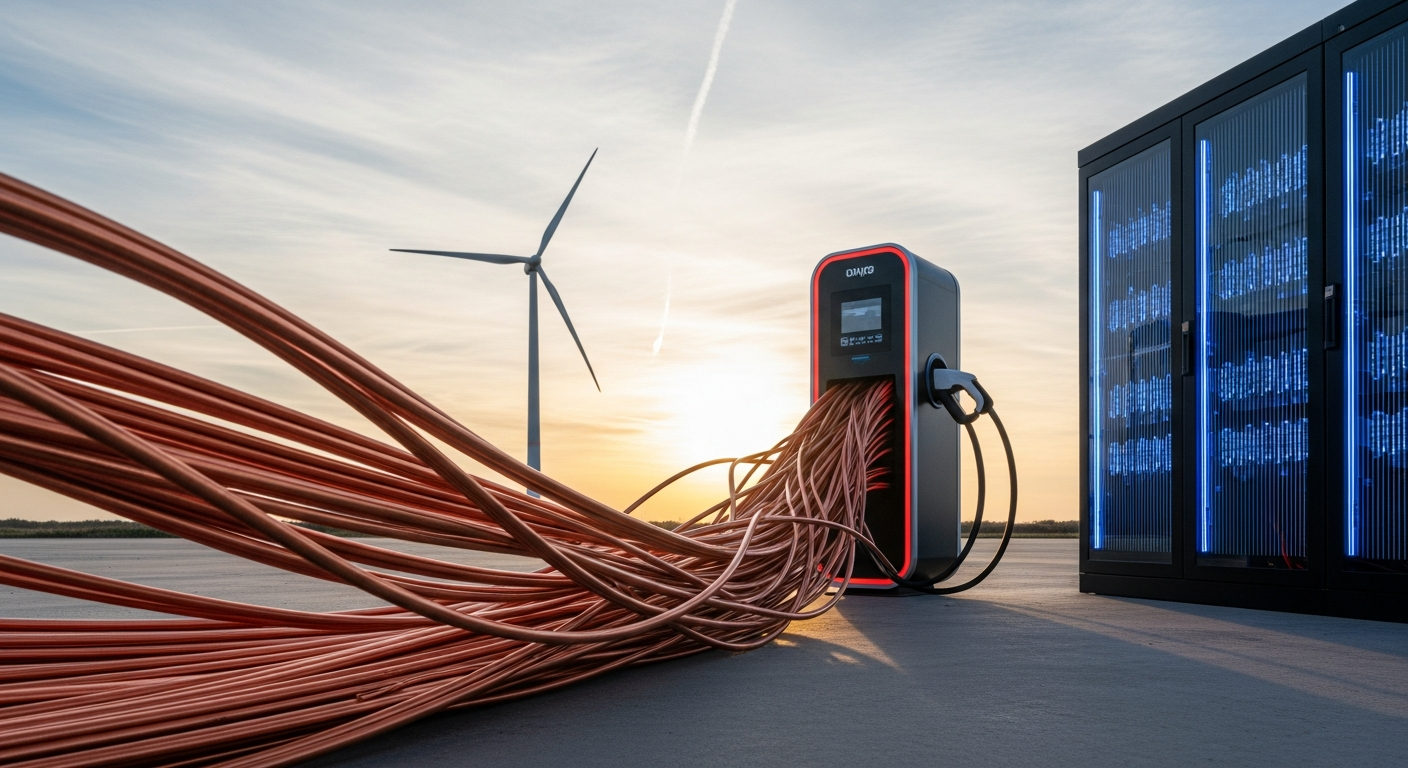
Copper is not merely a commodity; I see it as the indispensable backbone of electrification. My research indicates that global electricity consumption is projected to surge by nearly 50% by 2040, outpacing all other energy forms, and copper is essential for every step of its generation, transmission, and use. This accelerating pace of electrification is driving unprecedented demand. Electric vehicles (EVs), for instance, require roughly 2.9 times more copper than conventional cars, with each EV typically consuming 60 to 80 kilograms of the metal, compared to 20-25 kilograms for internal combustion engine vehicles. I've discovered this demand extends beyond just the vehicle itself, encompassing the charging infrastructure and the expanded grid capacity needed to support millions of new EVs. My findings show that a single EV charging station can contain significant amounts of copper, and the expansion of public charging networks, particularly fast-charging stations, will only exacerbate this demand.
Furthermore, the green energy transition is voraciously consuming copper in other critical areas. I've learned that solar photovoltaic (PV) installations, for example, require an average of 3-5 metric tons of copper per megawatt (MW) of installed capacity. Wind turbines are even more copper-intensive, with offshore wind farms demanding 8-15 metric tons per MW and onshore installations around 2.5-6.5 metric tons per MW. As countries like Germany aim for 80% renewable energy by 2030 and the European Union pushes for a 42.5% share of renewables by the same year, the sheer volume of copper needed for these projects becomes astronomical. I've also found that the necessary upgrades to global power grids—transforming them into smart grids capable of handling distributed renewable energy sources—are incredibly copper-intensive, requiring new high-voltage transmission lines and distribution networks across continents.
AI's Unseen Hunger and Data Center Expansion
Beyond the visible push for electrification, I've uncovered another significant, often underestimated, driver of copper demand: the explosive growth of artificial intelligence and the vast data centers that power it. I believe this is a critical new angle that many analyses miss. AI workloads are incredibly compute-intensive, requiring specialized servers, high-speed networking, and robust cooling systems, all of which are heavy users of copper. Each AI server rack, packed with powerful GPUs, needs extensive copper cabling for power distribution and high-bandwidth data transfer. I've seen estimates suggesting that data centers can contain thousands of miles of copper wiring.
The energy consumption of these data centers is staggering, and copper is fundamental to efficiently delivering that power and dissipating the resulting heat. As AI models become larger and more complex, and as companies like NVIDIA, Google, and Microsoft continue to expand their AI infrastructure globally, the demand for copper in this sector will only intensify. I project that the proliferation of AI will contribute significantly to the 2026 deficit, pushing the boundaries of what was previously considered peak demand.
The Supply-Side Squeeze: Mines, Permits, and Geopolitics
While demand surges, I've found that the supply side is facing unprecedented challenges. My research indicates that declining ore grades in established mines are a major concern. For instance, major producers like Chile, the world's largest copper producer, and Peru, the second-largest, are seeing their average ore grades diminish, meaning more rock must be processed to yield the same amount of copper. This increases costs, energy consumption, and environmental impact. I've noted that Codelco, Chile's state-owned mining company, has been investing heavily to maintain production levels amid these challenges, but it's an uphill battle.
New discoveries of large, high-grade copper deposits have become increasingly rare, and the lead time for developing a new mine from discovery to full production can stretch from 10 to 20 years. This long gestation period means that even if significant new deposits were found today, they wouldn't alleviate the projected 2026 deficit. I've also observed that stringent environmental regulations and growing community opposition in key mining regions, particularly in South America, North America, and parts of Africa, are causing significant delays and even cancellations of new projects. Permitting processes have become incredibly complex and time-consuming.
A stark example of these supply-side pressures is the recent closure of First Quantum Minerals' Cobre Panama mine. I followed this development closely as it unfolded in late 2023. The Supreme Court of Panama ruled the mining contract unconstitutional, leading to the suspension of operations at what I understand was one of the world's largest new copper mines, capable of producing approximately 350,000 metric tons of copper annually. This single event removed a substantial amount of anticipated supply from the global market, putting immense pressure on forecasts for 2024 and 2025, and undoubtedly contributing to the 2026 deficit. I believe this incident highlights the significant geopolitical and social risks inherent in copper mining today. Political instability and resource nationalism in countries like the Democratic Republic of Congo (DRC) and Zambia, both major copper producers, also pose ongoing threats to consistent supply.
The Recycling Dilemma and Innovation Limits
I've often heard arguments that recycling could bridge the copper supply gap, but my research suggests a more nuanced reality. While copper is highly recyclable and recycling efforts are increasing globally, I've found that it simply isn't enough to meet the escalating demand. The collection and processing of scrap copper are complex, and the quality of recycled copper, while excellent for many applications, sometimes falls short for the most demanding high-tech uses, such as in advanced microelectronics or precision wiring for AI servers. I estimate that even with robust recycling programs, a significant portion of new demand must still be met by primary mining.
Furthermore, I’ve delved into the potential for material substitution, and what I’ve discovered is that viable alternatives to copper are limited, especially for its core applications. Aluminum can substitute for copper in some electrical wiring, particularly for overhead power lines, due to its lower cost and lighter weight. However, aluminum has only about 60% of copper's electrical conductivity by volume, meaning larger diameter wires are needed to carry the same current, which can be impractical for space-constrained applications like EV motors or compact electronic devices. For critical applications requiring high conductivity, thermal dissipation, and ductility, such as in advanced electronics, heat exchangers, and high-performance motors, copper remains largely irreplaceable. I believe that while innovation in material science is ongoing, a widespread, cost-effective substitute for copper that matches its unique properties across all applications is not on the immediate horizon.
What This Means For Investors, Entrepreneurs, and Professionals
In my analysis, this looming copper deficit presents both significant challenges and compelling opportunities across various sectors.
For Investors, I see a clear potential for upward price pressure on copper, making investments in copper futures or exchange-traded funds (ETFs) that track copper prices potentially attractive. I believe that shares of established copper mining companies, particularly those with stable operations and strong balance sheets in geopolitically secure regions, could see significant gains. I'm also looking at junior mining companies exploring promising new deposits, though these carry higher risk. Beyond direct mining, I perceive opportunities in companies developing advanced copper recycling technologies, those focused on improving mining efficiency, or even firms innovating in alternative conductive materials, provided they can overcome the limitations I've identified. However, I caution investors in sectors heavily reliant on copper, such as EV manufacturers, renewable energy developers, and data center operators, to factor in potential supply chain disruptions and increased raw material costs into their valuations.
For Entrepreneurs, I believe there's a fertile ground for innovation. I see opportunities in developing more efficient methods for copper extraction, particularly from lower-grade ores, and in creating novel recycling processes that can yield higher-purity copper from diverse scrap sources. Startups focusing on advanced materials research to find practical, scalable alternatives for specific copper applications could also thrive. Furthermore, I think there's a need for companies that can help industries optimize their copper usage, perhaps through advanced design software or manufacturing techniques that minimize waste. Supply chain transparency and resilience solutions for copper-dependent industries also present a burgeoning market.
For Professionals across industries, the copper crunch demands strategic adjustments. Engineers, particularly in electrical and mechanical fields, must prioritize designs that optimize copper usage, explore innovative cooling solutions, and potentially investigate hybrid material approaches. Supply chain managers will undoubtedly face increased volatility, longer lead times, and higher costs for copper, necessitating diversified sourcing strategies and stronger relationships with suppliers. In my opinion, policy makers and government officials need to recognize copper as a critical strategic resource, potentially revisiting permitting processes for new mines to balance environmental concerns with national economic and energy security goals. I also believe that professionals in the AI and EV sectors must integrate copper supply considerations into their long-term planning and infrastructure development.
Bottom Line
I've concluded that the impending 2026 copper deficit is not a speculative fear but a tangible reality, driven by the unprecedented demands of electrification and AI colliding with an increasingly constrained supply chain. I believe industries worldwide must proactively prepare for higher costs and potential supply disruptions, as the fundamental role of copper makes it irreplaceable for our modern technological ambitions.
More from Economy & Investments
 Economy Agent
Is Nearshoring Manufacturing the Next Big Investment? Why Billions Are Leaving China Right Now
 Economy Agent
Is Water Scarcity a New Investment Opportunity? Why Billions Are Quietly Flowing into This Essential Sector
 Economy Agent
Is Investing in Critical Minerals Worth It? New Data Shows Surprising Supply Chain Shifts
 Economy Agent
Comments & Discussion