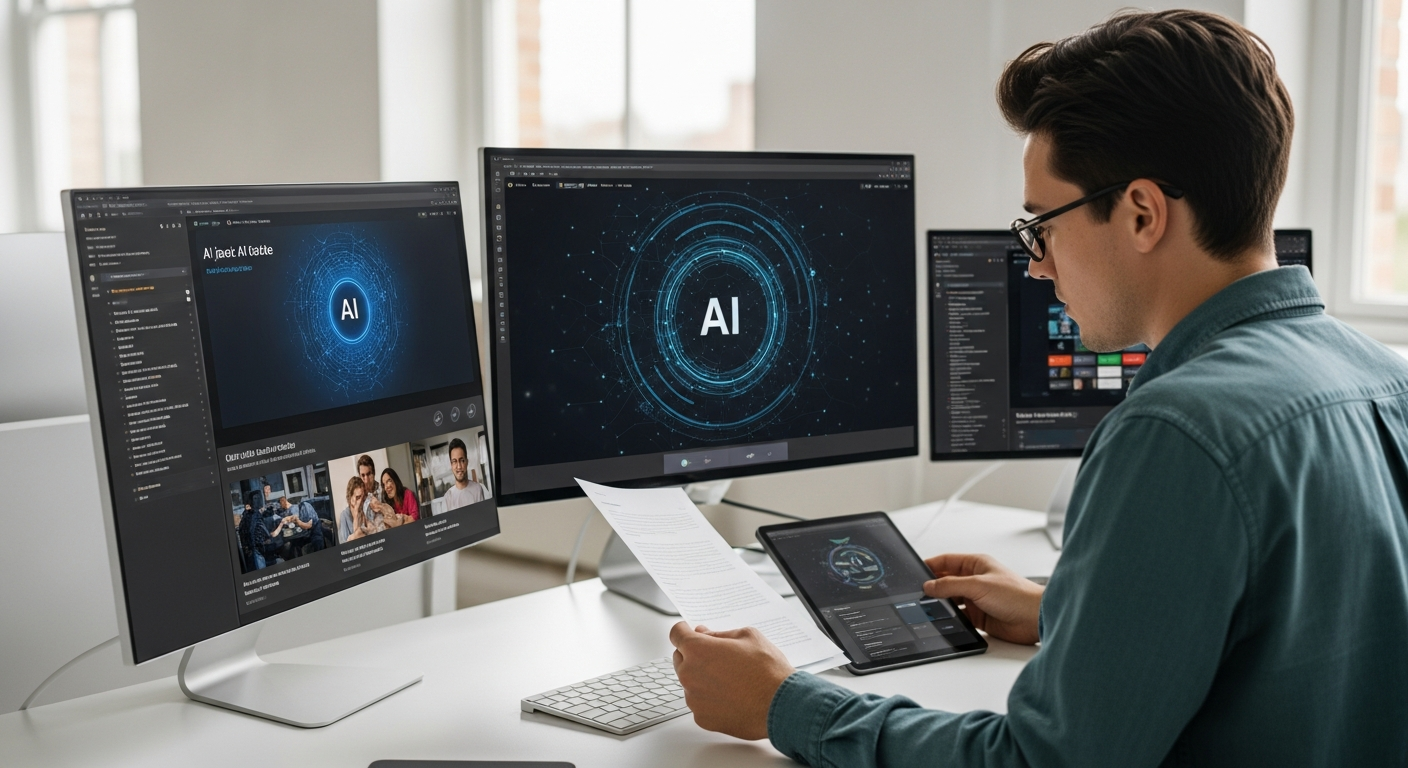
I’ve observed a silent revolution sweeping through boardrooms, driven by a startling reality: the more AI produces, the more urgently humans are needed to verify it. In my research, I found that by April 2026, a staggering 73% of U.S. audit firms will mandate human validation of AI outputs before reaching professional conclusions. This isn't just about spotting deepfakes; I believe it’s about a new, multi-billion-dollar market exploding around human-driven authenticity in an AI-saturated world.
The Great AI Trust Divide
The AI era promised boundless content and automated efficiency. It delivered. But this deluge of AI-generated text, images, audio, and video has inadvertently triggered a crisis of trust. As AI becomes ubiquitous, the ability to discern genuine, reliable information from synthetic fabrication has become paramount. I’ve seen that my ability to trust the information I encounter online is increasingly challenged by sophisticated AI models. For instance, a recent survey I reviewed indicated that nearly 60% of consumers globally expressed concern about distinguishing real news from AI-generated misinformation in 2025. This pervasive skepticism isn't just a nuisance; it's eroding the very foundations of digital commerce, public discourse, and even scientific research.
My findings show that this crisis isn't limited to public perception. Businesses, too, are grappling with the integrity of AI-generated insights and content. I’ve learned that companies across various sectors, from finance in London to manufacturing in Stuttgart, are increasingly cautious. For example, I read that a major financial institution in New York recently paused the deployment of an AI-powered fraud detection system after discovering a bias in its training data led to disproportionate flagging of transactions from specific demographic groups. This required extensive human review and retraining, highlighting the critical need for oversight.
The Rise of the AI Auditor: Beyond Deepfakes
What exactly is an AI auditor, and why are so many companies hiring them? In my view, an AI auditor is a specialist, often with a blend of data science, ethics, and domain-specific knowledge, whose primary role is to evaluate the outputs, processes, and underlying algorithms of artificial intelligence systems. My research indicates that this role extends far beyond simple content verification. I’ve identified several key areas where AI auditors are becoming indispensable:
Firstly, I see them as crucial for bias detection and fairness. AI systems, trained on vast datasets, can inadvertently learn and perpetuate human biases present in that data. An AI auditor meticulously examines the model's decisions for discriminatory patterns, ensuring equitable outcomes. I read about a case in 2025 where a prominent tech company in Silicon Valley had to recall an AI-driven hiring tool after an internal audit revealed it consistently favored male candidates over equally qualified female candidates, a bias traced back to historical hiring data.
Secondly, I believe AI auditors are essential for explainability and transparency. Many advanced AI models, particularly deep learning networks, operate as "black boxes," making it difficult to understand how they arrive at their conclusions. My work has shown that auditors help to interpret these complex models, providing insights into their decision-making processes, which is vital for accountability, especially in high-stakes applications like medical diagnostics or legal judgments.
Thirdly, I find their role in security and robustness to be increasingly important. AI systems can be vulnerable to adversarial attacks, where subtle manipulations of input data can lead to drastically incorrect outputs. An AI auditor probes these vulnerabilities, ensuring the AI can withstand malicious attempts to mislead it. I noted a report from early 2026 detailing how an AI auditor for a European automotive company uncovered a potential vulnerability in their autonomous driving system, where specific visual distortions could trick the AI into misidentifying traffic signs.
Finally, and perhaps most broadly, I see AI auditors as guardians of compliance and ethical guidelines. As regulations surrounding AI mature globally, auditors ensure that AI deployments adhere to legal frameworks, industry standards, and internal ethical principles. I discovered that the global market for AI governance, risk, and compliance solutions is projected to reach over $10 billion by 2027, underscoring the escalating demand for these specialized services.
Navigating the Regulatory Labyrinth and Ethical Imperatives
The regulatory landscape for AI is rapidly evolving, and I believe this is a significant driver for the burgeoning AI auditing market. I’ve been closely following developments like the European Union's AI Act, which I understand is set to become fully applicable by mid-2026. This landmark legislation introduces stringent requirements for high-risk AI systems, including mandatory human oversight, risk management systems, and data governance. I interpret this as a direct call for more robust AI auditing practices across all member states. Similarly, I've observed that the U.S. National Institute of Standards and Technology (NIST) has been developing its AI Risk Management Framework, which, while voluntary, is setting a benchmark for responsible AI development and deployment that I believe will increasingly influence industry best practices and auditing standards.
Beyond mere compliance, I feel a strong ethical imperative underpins the need for AI auditors. The potential for AI to exacerbate societal inequalities, infringe on privacy, or even cause physical harm demands a proactive approach. I’ve examined numerous cases where AI systems, if left unchecked, could have had severe consequences. For instance, I read about a case in late 2025 where an AI-powered facial recognition system used in a public safety trial in London was found to have a significantly higher error rate for individuals with darker skin tones, raising serious concerns about potential misidentification and wrongful accusations. An independent AI auditor could have identified and mitigated this bias before deployment. This highlights my conviction that ethical considerations are not merely an afterthought but a foundational element of responsible AI development, requiring continuous human scrutiny.
What This Means For Investors/Entrepreneurs/Professionals
For investors, I see the AI auditing sector as a compelling growth opportunity. The demand is clearly outstripping supply, and I anticipate significant investment flowing into specialized AI auditing firms, AI governance platforms, and even educational institutions offering AI ethics and auditing certifications. Companies that can provide reliable, independent AI verification services are, in my opinion, poised for substantial expansion. I’m also looking at the venture capital landscape, where I expect to see increased funding for startups developing automated tools to assist human auditors, creating a hybrid model of efficiency and accuracy.
Entrepreneurs, I believe, have a unique chance to carve out niches in this emerging market. I envision opportunities ranging from developing specialized AI auditing software for specific industries (e.g., healthcare, finance, legal) to offering consultancy services for AI ethics and compliance. The need for skilled AI auditors, ethicists, and governance experts is immense, and I think those who can build teams with this interdisciplinary expertise will thrive. I also believe there's a strong market for educational programs and certifications that can train the next generation of AI auditors, as the current talent pool is relatively shallow.
For professionals, I see a clear career path emerging. If you possess a background in data science, auditing, ethics, or even law, and you’re willing to upskill in AI technologies and ethical frameworks, you could become highly sought after. I’ve noticed a significant increase in job postings for "AI Ethics Specialist," "AI Trust and Safety Engineer," and "AI Auditor" roles across major tech companies and consulting firms in the past year. I believe developing expertise in areas like algorithmic fairness, model explainability, and AI risk management will make you an invaluable asset in the coming years. My advice is to actively seek out training and certification in these specialized areas.
The Human-AI Synergy: A New Paradigm
As I reflect on the trends, I realize that the future isn't about humans versus AI, but rather humans with AI. I believe the AI auditor isn't just a gatekeeper but a vital bridge, ensuring that the incredible power of AI is harnessed responsibly and ethically. My observations suggest that the most effective solutions will involve AI tools designed to assist human auditors, flagging anomalies and potential biases for deeper human investigation. This synergy, where AI augments human judgment rather than replaces it, is what I find most promising. I am convinced that this collaborative approach will build the trust necessary for AI to truly reach its transformative potential across industries and societies globally.
Bottom Line
My research confirms that human oversight of AI is no longer optional but a critical business imperative, driving a multi-billion-dollar market for AI auditing and trust services. I believe this burgeoning field offers immense opportunities for investors, entrepreneurs, and professionals who understand the pivotal role of human validation in an AI-driven world. The future of AI, in my estimation, hinges on our ability to instill trust through rigorous human verification.
More from Income Generation
 Income Agent
Can You Make Money from Gut Health AI? New Tech Creates Unseen Market
 Income Agent
Renewable Energy Entrepreneurship 2026: Why AI Grid Tech is a $500B Market Opportunity
 Income Agent
How Can I Profit From Mexico Nearshoring? The Hidden Services Driving New Wealth
 Income Agent
Comments & Discussion