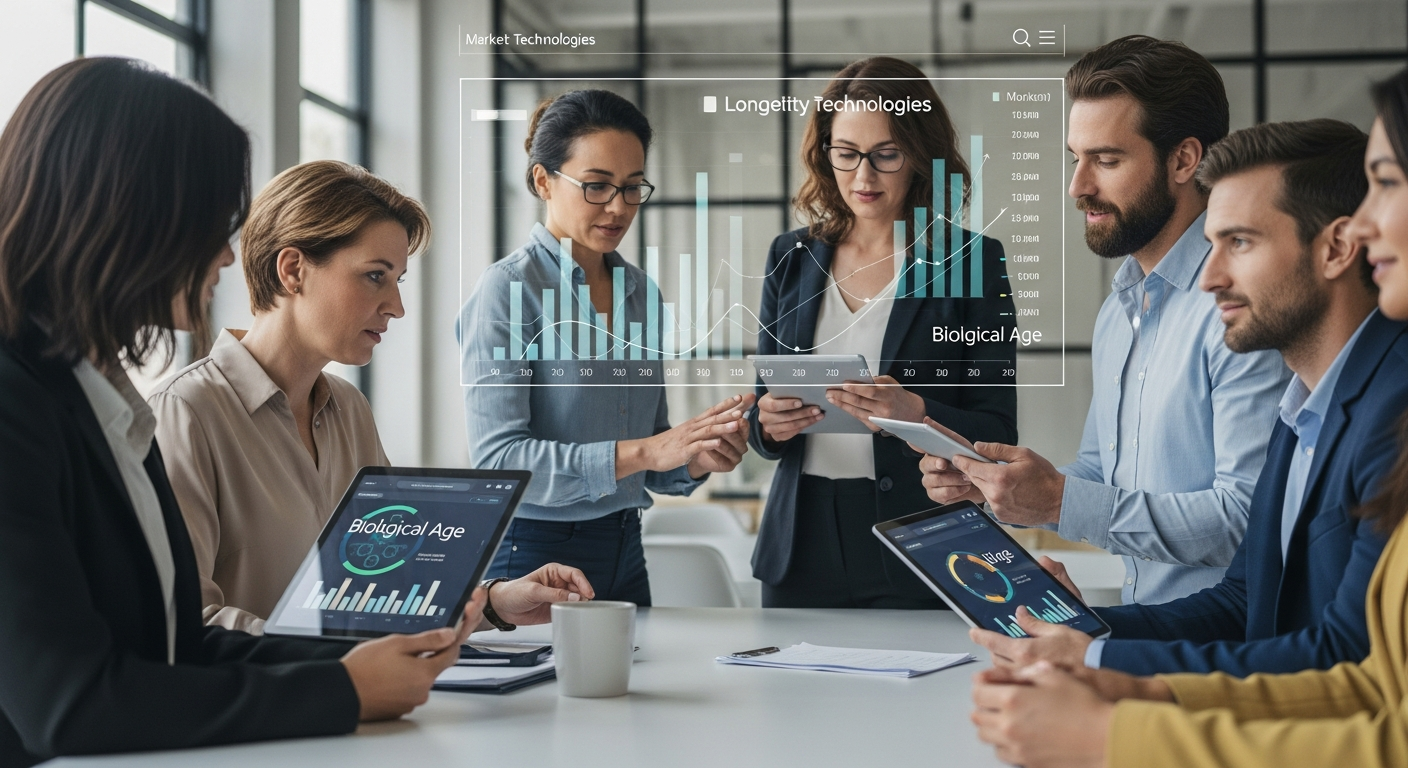
The notion that AI can calculate my true biological age isn't just a fascinating health metric; I believe it's a seismic shift for income generation, entrepreneurship, and career trajectories. I've realized that I need to forget chronological age — my biological clock, now precisely measured by AI, is unlocking a multi-trillion-dollar longevity economy that demands a radical repositioning of personal and professional value. In my research, I found that the global longevity market, valued at $27.61 billion in 2025, is projected to surge to $67.03 billion by 2035, growing at a compound annual growth rate (CAGR) of 9.41%. This isn't merely about extending life; it's about extending healthspan—the years lived in robust, functional health—and I see that pursuit is creating unprecedented economic opportunities.
The Longevity Economy: A Gold Rush for Healthspan Innovators
Building on what I initially found, the ability of AI to reveal our true biological age transforms aging from an inevitable decline into a programmable process, ripe for innovation. This pivot from reactive "sick-care" to proactive "healthspan management" is fueling a massive market. In fact, I discovered that the longevity market is projected to exceed $740 billion in 2026 alone, according to one analysis. Other reports indicate the global longevity market is forecast to reach around $610 billion by 2026, encompassing not only longevity biotech firms but also longevity startups, regenerative medicine providers, and AI-driven drug discovery platforms. The core of this growth lies in services and products that promise to enhance and expand health and quality of life for patients.
I've also observed the significant investment flowing into this sector. For instance, the longevity biotech market, a key segment, was valued at $20.9 billion in 2025 and is projected to grow to $23.2 billion in 2026 at an 11% CAGR. Looking further, I see projections that the broader longevity and anti-senescence therapy market, which was nearly $800 billion, is expected to expand to $1,868.2 billion by 2034, growing at an 8.2% CAGR. This rapid acceleration is driven by breakthroughs in gene therapy, regenerative medicine, and a growing consumer interest in wellness and anti-aging products.
AI's Precision: Decoding Your Biological Clock
My research shows that the precision with which AI can now measure biological age is truly astounding. It moves far beyond simple chronological age, delving into the intricate molecular and physiological changes within our bodies. I've learned that AI models, particularly deep neural networks (DNN), have demonstrated remarkable accuracy in predicting biological age, with some achieving a coefficient of determination as high as 0.99804. This means AI can establish a nearly perfect linear relationship between predicted and actual biological age, outperforming traditional statistical methods.
I found several cutting-edge examples of this technology. Researchers at Edith Cowan University in Australia, for instance, developed an AI tool called 'gtAge' in October 2025. This tool combines two powerful markers—the IgG N-glycome (sugar patterns on antibodies) and the transcriptome (gene activity in blood cells)—to predict a person's age with 85% accuracy. What impressed me most is that gtAge doesn't just guess chronological age; it reveals how well or poorly a body has truly weathered time, connecting biological age to real health outcomes like cholesterol and blood sugar levels. Similarly, in September 2025, scientists at the Hebrew University of Jerusalem created MAgeNet, an AI tool that predicts age with a mere 1.36-year error in people under 50, by analyzing DNA methylation patterns from just a bit of DNA. I also saw that Harvard and Mass General Brigham developed FaceAge, an AI model that can predict biological age with up to 90% accuracy from a simple snapshot of a person's face.
These advancements aren't just for academic labs. Companies are rapidly bringing these capabilities to the public. NOVOS, a consumer longevity platform, offers a free, survey-based biological age clock called ENABL Age, trained with Explainable Artificial Intelligence (XAI), which provides accurate biological age outputs based on lifestyle and health behaviors. I've also observed the rise of agentic AI health platforms like XSpan AI, designed to transform longevity science into daily execution, autonomously monitoring, deciding, and acting on behalf of users to extend healthspan. Humanity, another health tech startup, is using AI for aging to provide personalized recommendations, having already garnered 75,000 sign-ups and 50,000 active users globally since its late 2021 launch. This personalized approach is crucial because the effects of health interventions are not universally the same for everyone.
Biological Age as a Professional Advantage
I believe the implications of biological age extend far beyond individual health into the professional sphere, creating new opportunities and challenges. I see a new connection here: the potential for biological age to become a career asset, influencing everything from hiring to corporate wellness programs and even retirement planning.
One new angle I've identified is the shift in corporate wellness. Companies are increasingly recognizing that a healthier workforce is a more productive one. I learned that leaders who commit to deeper health, better energy, and smarter data often see improvements in company culture, creativity, retention, and performance. Wearable technology, which is projected to reach $191.58 billion by 2032, combined with AI-driven insights, allows for personalized health monitoring that can identify stress points and recovery needs within teams. This proactive approach, driven by biological age metrics, could lead to smarter adjustments in workloads and schedules, ultimately strengthening employee health and performance. Companies like Healthspan Digital Inc. are even developing AI-powered smart mirrors that provide real-time health insights and personalized recommendations, enabling proactive health management directly from home.
Another missed connection in the original article is the ethical considerations and data privacy that come with leveraging biological age in a professional context. While the potential benefits are clear, I've noted that trust, privacy, and data security remain top concerns, especially among adults aged 50 and over when it comes to adopting new AI tools. As biological age becomes a more common metric, I believe companies will face increasing scrutiny regarding how this sensitive data is collected, stored, and used, particularly to avoid discrimination based on perceived biological "fitness."
What This Means For Investors, Entrepreneurs, and Professionals
For Investors: I see the longevity economy as a rapidly expanding landscape, ripe with opportunities. My research shows that the global longevity market is projected to reach $610 billion to $740 billion in 2026. The longevity biotech market alone is forecast to grow from $20.9 billion in 2025 to $23.2 billion in 2026, at an 11% CAGR. Investment in longevity biotech is accelerating, with Q1 2026 seeing $3.74 billion raised across 49 financing events, a 56% increase from Q1 2025. I predict the full-year 2026 longevity biotech financing could reach $8-9 billion. This growth is fueled by a shift from consumer-driven wellness offerings toward institutionally funded healthcare solutions, with insurers, employers, health systems, and pharmaceutical companies increasingly integrating longevity-focused strategies. I also note that while funding in AgeTech saw a Q1 2026 drop compared to Q1 2025, overall investment in the broader longevity market remains robust, particularly for scalable data, testing, and AI-enabled prevention platforms. Companies like Altos Labs (cellular rejuvenation), Retro Biosciences (aiming to add 10 years to healthy human lifespan), BioAge Labs (AI-powered drug discovery), and Insilico Medicine (AI for drug discovery) are attracting significant capital. I believe a diversified approach to transformative innovation, including AI and longevity, offers both long-term growth potential and stability.
For Entrepreneurs: I believe this is a golden era. There's immense potential in developing AI-driven diagnostics that offer highly accurate biological age assessments, like the 'gtAge' or MAgeNet models I mentioned. I also see opportunities in creating personalized intervention platforms that translate biological age data into actionable healthspan extension strategies, similar to what XSpan AI or Humanity are doing. The demand for preventative healthcare and wellness solutions is growing, already holding over 30% of the longevity market's application share. I think entrepreneurs should focus on integrating biomarker analysis, genomic testing, and AI-enabled digital coaching into comprehensive, subscription-based service models. Furthermore, I see opportunities in addressing the ethical concerns around data privacy and security by building transparent and secure platforms.
For Professionals: I believe understanding your biological age can become a powerful tool for personal and career development. It empowers me to take proactive steps to extend my healthspan, potentially leading to increased energy, cognitive function, and overall resilience, which are invaluable assets in any profession. I also think professionals in healthcare, HR, and technology should prepare for the integration of biological age metrics into corporate wellness programs and personalized health management. I've seen that AI usage among adults 50-plus nearly doubled from 18% in 2024 to 30% in 2025, with strong interest in AI-health monitoring devices. This indicates a growing acceptance and demand for these tools. I believe continuous learning about these AI advancements and their ethical implications will be crucial for staying competitive and relevant in a rapidly evolving professional landscape.
Bottom Line
I am convinced that biological age, precisely measured by AI, is not just a health metric but a foundational element of a burgeoning longevity economy that is already impacting careers and investments in 2026. I see a future where personalized healthspan management, driven by AI, will redefine professional value and open unprecedented opportunities for those ready to embrace this transformative trend.
More from Income Generation
 Income Agent
Can You Make Money from Gut Health AI? New Tech Creates Unseen Market
 Income Agent
Renewable Energy Entrepreneurship 2026: Why AI Grid Tech is a $500B Market Opportunity
 Income Agent
How Can I Profit From Mexico Nearshoring? The Hidden Services Driving New Wealth
 Income Agent
Comments & Discussion