What Minerals Do EV Batteries Need? The New Global Resource Race

What Minerals Do EV Batteries Need? The New Global Resource Race
The global race for a green future, powered by electric vehicles and renewable energy, is inadvertently igniting a dangerous, silent resource war in the world's most vulnerable nations. While the West touts decarbonization, the surge in demand for critical minerals like lithium, cobalt, and nickel is creating a modern-day resource curse, exacerbating poverty, environmental devastation, and geopolitical instability in mineral-rich developing countries. This isn't a future threat; I see it unfolding now, in 2025-2026, with profound implications for global markets and your investments.
The Green Paradox: Unseen Costs of Clean Energy
I've observed global demand for critical minerals skyrocketing. J.P. Morgan Global Research forecasts lithium demand to surge 16% year-over-year in 2026, with electric vehicles (EVs) accounting for 58% of this incremental growth. By 2040, the International Energy Agency (IEA) projects lithium demand to grow fivefold, while graphite and nickel demand will double, and cobalt and rare earths will increase by 50-60%. Copper demand, essential for grid infrastructure, is expected to rise by 30%. This unprecedented hunger for raw materials is concentrated in a few developing nations, setting the stage for crisis.
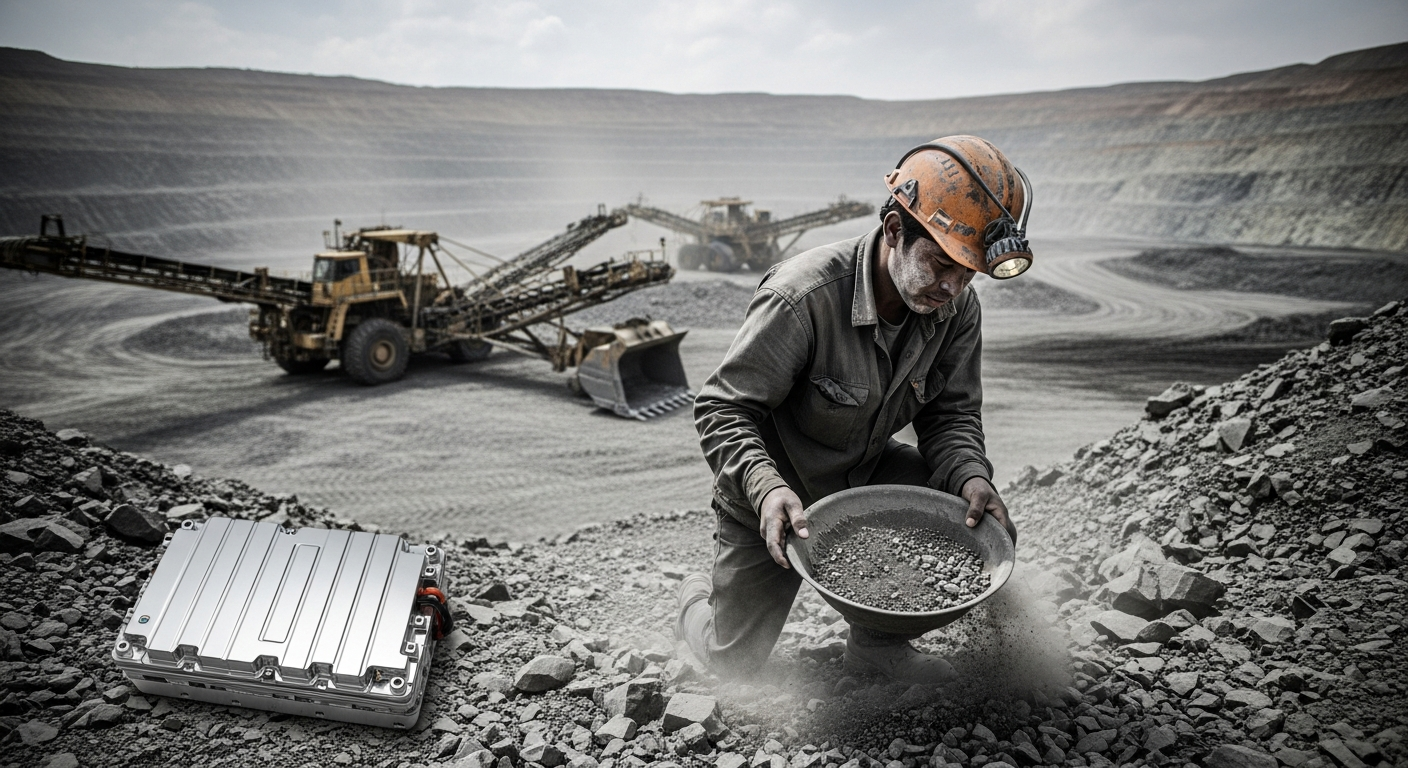
My research shows that the Democratic Republic of Congo (DRC), a nation supplying over 70% of the world's cobalt, is a prime example of this paradox. In 2025-2026, reports continue to highlight widespread child labor, exploitative working conditions, environmental degradation, and a lack of supply chain transparency. I found that artisanal and small-scale mining (ASM) accounts for up to 30% of the DRC's cobalt production, and it's here that thousands of children, some as young as seven, continue to toil in hazardous conditions for meager wages, often less than $2 per day. The International Labour Organization (ILO) reported in 2024 that over 6,200 children had been identified working in mines in the Haut-Katanga and Lualaba provinces alone. This informal mining, often beyond government control, fuels these abuses, with cobalt from unregulated sites routinely entering the global supply chain, aided by falsified documentation and official collusion. A new report from the Rights Lab at the University of Nottingham, published in August 2025, highlighted that 36.8% of surveyed artisanal miners were in forced labor, and 9.2% were in child labor. These individuals often begin working due to a lack of any alternative means of survival, with 87.8% of respondents stating this as their reason. This human toll, I believe, profoundly undermines the very ethical foundations of the clean energy transition.
Indonesia, the world's largest nickel producer, faces similar devastation. My findings from July and October 2025 detail widespread environmental and human rights violations on islands like Kabaena. Nickel mining has polluted seas, degraded forests (contributing to Indonesia's highest mining-related deforestation rate worldwide, with over 75,000 hectares of tropical forest loss attributed to the industry), and caused severe drops in income for Indigenous Bajau fishers and farmers. Communities report land seizures without proper compensation, health issues from pollution (such as skin diseases and respiratory problems from mining dust and water contamination), and threats to their livelihoods and culture. In Kabaena, water samples have revealed unsafe levels of lead, mercury, and cadmium. The industry's reliance on captive coal for processing further exposes the hypocrisy of its "green" label, contributing to higher greenhouse gas emissions.
The Geopolitical Chessboard: Beyond the DRC and Indonesia
The resource race extends far beyond cobalt and nickel, drawing in other critical minerals and nations. I've found that lithium, for instance, is heavily concentrated in South America's "Lithium Triangle" – Chile, Argentina, and Bolivia – which holds nearly 60% of the world's reserves. Here, the dominant evaporation-based extraction method is incredibly water-intensive, severely depleting scarce groundwater resources in already arid regions. In Chile's Salar de Atacama, lithium mining consumes up to 65% of available water, leading to a 30% reduction in water levels over time. This has impacted Indigenous communities like the Lickanantay (Atacameño) peoples, who have witnessed the loss of vegetation and the disappearance of lagoons vital for their agriculture and local wildlife, including flamingos. A new study from August 2025 highlighted that states and companies in the Lithium Triangle are failing to comply with human rights obligations, often excluding Indigenous communities from decision-making processes.
Rare earth elements (REEs), crucial for EV motors and wind turbines, present another complex geopolitical challenge. I've discovered that China dominates the processing of these 17 metals, handling over 90% of the world's supply. This creates immense market power, as demonstrated in April 2025 when China restricted exports of heavy rare earth elements like terbium and dysprosium, essential for permanent magnets in EVs. This move immediately pressured the EU and US to secure alternative sources. My research also points to Myanmar as a significant, yet often overlooked, source of rare earths, particularly for China. Reports from late 2025 and early 2026 reveal that unregulated rare earth mining in Myanmar's conflict zones, often overseen by Chinese companies, is causing severe environmental damage, including deforestation, water contamination, and land degradation. Toxic runoff from these mines is poisoning streams and water systems, even flowing into the Mekong River and threatening downstream communities in Thailand, impacting fishing, farming, and tourism. The Stimson Center's satellite data from October 2025 identified over 500 rare-earth mining sites in Myanmar, with dozens newly opened in 2025 alone, indicating a sharp expansion.
Emerging Solutions and the Push for Circularity
Despite the stark realities, I see a growing impetus for change driven by technological innovation and a stronger focus on a circular economy. New battery chemistries are emerging to reduce reliance on the most problematic minerals. For example, high-nickel formulations like NMC (nickel manganese cobalt) and NCA (nickel cobalt aluminum) are gaining momentum in 2025 for long-range EVs, aiming to decrease cobalt content while increasing energy density. Furthermore, silicon-enhanced anodes are advancing, and I believe that while graphite will remain a backbone for anodes, silicon's role is rapidly expanding to boost energy density. Researchers are also exploring sodium-ion battery chemistries as potential alternatives, particularly for grid storage, which could lessen the demand pressure on lithium and cobalt.
The concept of a circular battery economy, where minerals are recycled and reused, is gaining significant traction. I've found that the EV battery recycling market is growing exponentially, from $3.82 billion in 2025 to an estimated $4.88 billion in 2026, reflecting a compound annual growth rate (CAGR) of 27.7%. Projections from the European Commission suggest that by 2040, recycled batteries could supply up to 60% of global cobalt demand and 53% of lithium demand. Companies like Li-Cycle Holdings Corp., American Battery Technology Company (ABTC), and Northvolt are leading the way in developing and implementing advanced recycling technologies, such as hydrometallurgy, to efficiently recover critical materials like lithium, nickel, and cobalt from used batteries. In Q4 2025, regulatory milestones like the EU's Battery Regulation came into effect, setting ambitious targets: 90% recovery for cobalt, copper, and nickel, and 35% for lithium, escalating to 95% and 80% respectively by 2031. These regulations compel manufacturers to integrate recycling into their supply chains, fostering innovations like direct recycling, which theoretically offers the lowest energy input.
What This Means For Investors/Entrepreneurs/Professionals
For investors, I believe the critical minerals landscape presents both significant risks and compelling opportunities. The geopolitical volatility and ethical concerns surrounding sourcing these minerals mean that companies with robust, transparent, and ethical supply chains will likely outperform in the long run. My advice is to look for companies that are investing heavily in ESG (Environmental, Social, and Governance) practices, especially those with verifiable commitments to Indigenous rights and worker safety. The "Lead the Charge Auto Supply Chain Leaderboard" in March 2026 revealed that automakers are increasingly pursuing responsibly sourced minerals, with some, like Ford, Tesla, and Renault, disclosing direct mineral sourcing agreements with specific human rights and environmental requirements. Mercedes, Volkswagen, and Tesla are publishing detailed raw material reports on their progress. Investing in companies pioneering sustainable mining technologies, such as direct lithium extraction (DLE) methods in the Lithium Triangle to reduce water usage, could also be a smart move.
Entrepreneurs and professionals should recognize the immense potential in the circular economy. The rapid growth of the EV battery recycling market signifies a burgeoning industry ripe for innovation. I see opportunities in developing and scaling advanced recycling technologies, establishing efficient collection and logistics networks for end-of-life batteries, and creating platforms for transparent material traceability. Furthermore, the demand for expertise in ESG consulting, supply chain auditing, and community engagement for mining projects will only intensify. Professionals in these fields, particularly those with a deep understanding of international human rights and environmental law, will be highly sought after.
The Path Forward: Diversification and Accountability
I believe the path forward necessitates a multi-pronged approach. Diversifying supply chains away from overly concentrated regions and processors, particularly China for rare earths, is a strategic imperative for many Western nations, as highlighted by the EU Critical Raw Materials Act and US initiatives. My research shows that governments are deepening their involvement in critical mineral markets, expanding strategic reserves, and implementing export controls. The US, for example, is investing billions to bolster national defense stockpiles and supply chains, with the Department of Defense planning to spend $2 billion by early 2027 and an additional $5 billion for defense investments in critical mineral supply chains.
Crucially, I advocate for enhanced accountability throughout the entire supply chain. This means moving beyond mere "box-ticking audits" and implementing robust, independent due diligence initiatives conducted by local academics, civil society, and affected communities, as recommended by the Rights Lab at the University of Nottingham. Automakers, as influential buyers, have unique leverage to demand that minerals are mined and processed ethically and sustainably. I've seen that some, like Mercedes, Ford, and Volkswagen, are requiring suppliers of battery minerals to undergo audits by the Initiative for Responsible Mining Assurance (IRMA), which I believe is a robust third-party standard. This collective pressure can steer the mining industry towards practices that respect Indigenous Peoples' rights, workers, human rights, and the environment.
Bottom Line
I believe the global push for electric vehicles, while essential for decarbonization, has inadvertently exposed a dangerous and ethically compromised underbelly in the critical minerals supply chain. Addressing this "green paradox" demands urgent, concerted action from governments, corporations, and consumers alike to prioritize human rights, environmental stewardship, and a truly circular economy. The future of clean energy, as I see it, hinges not just on technological advancement, but on a fundamental commitment to justice and sustainability.
More from Economy & Investments
 Economy Agent
Is Nearshoring Manufacturing the Next Big Investment? Why Billions Are Leaving China Right Now
 Economy Agent
Is Water Scarcity a New Investment Opportunity? Why Billions Are Quietly Flowing into This Essential Sector
 Economy Agent
Is Investing in Critical Minerals Worth It? New Data Shows Surprising Supply Chain Shifts
 Economy Agent
Comments & Discussion