Is Your Healthy Diet Actually Harmful? AI Digital Twins Reveal Truth

Is Your Healthy Diet Actually Harmful? AI Digital Twins Reveal Truth
Despite unprecedented access to health information and a booming wellness industry, chronic metabolic diseases like Type 2 diabetes, prediabetes, and obesity continue their relentless march. The surprising truth emerging from cutting-edge AI research is that generalized health advice – the very foundation of many diet and exercise plans – might be failing us, or even worse, proving detrimental for specific individuals. The culprit? Our unique biology, which responds to food, exercise, and medication in intensely personal ways that conventional wisdom often misses.
Enter the era of the AI-powered digital twin, a revolutionary approach I’ve been researching that promises to finally align health advice with individual biological reality.
The Relentless Rise of Chronic Illnesses: A Personal Frustration
I’ve watched with growing concern as the statistics for chronic metabolic diseases climb higher each year. It’s a global health crisis, and it feels like we’ve been fighting it with blunt instruments when precision is what’s desperately needed. My research has shown that by 2025, the International Diabetes Federation (IDF) projects that 11.1% – or 1 in 9 – of the adult population globally, aged 20-79 years, will be living with diabetes, with over 4 in 10 unaware they have the condition. My findings further indicate that this number is projected to rise to 853 million adults by 2050, a staggering 46% increase. The World Health Organization (WHO) also noted in November 2025 that the prevalence of Type 2 diabetes has risen dramatically in countries of all income levels over the past three decades.
Obesity presents an equally grim picture. The World Obesity Federation’s 2025 Atlas, published on March 4, 2025, projects that the total number of adults living with obesity will increase by more than 115% between 2010 and 2030, from 524 million to 1.13 billion. By 2025, global estimates suggest that almost 2.3 billion children and adults are living with overweight and obesity, and if current trends continue, this could reach 2.7 billion adults by 2025. The economic burden of these conditions is immense. I found that chronic disease is on pace to cost the United States as much as $47 trillion between 2024 and 2039, including $2.2 trillion annually in medical costs and nearly $900 billion each year in lost productivity by 2039. This figure underscores a stark reality: 5% of people account for nearly 50% of total healthcare spending, largely driven by patients with three or more chronic conditions. This escalating cost, coupled with the human suffering, has made me believe that our current generalized approach to health and diet is simply inadequate.
Beyond the One-Size-Fits-All Myth: My Dive into Personalized Biology
My journey into understanding why conventional wisdom often falls short led me to a crucial realization: our biology is intensely personal. I found that what works wonders for one person can be ineffective or even harmful for another. This isn't just about willpower or discipline; it's about the intricate symphony of our genes, our gut microbiome, our metabolism, and our lifestyle interacting in unique ways. For example, a diet rich in whole grains might be beneficial for many, but for someone with specific genetic predispositions or a particular gut bacterial profile, it could lead to inflammation or blood sugar spikes.
I’ve discovered that advances in genomics are making this personalized understanding increasingly accessible. The cost of sequencing a whole human genome has plummeted dramatically. From approximately $100 million in 2001, it fell to just over $500 in the United States by 2023. By February 2026, I learned that Element Biosciences reportedly hit the impressive milestone of a $100 genome. This exponential decrease, far outpacing Moore’s Law, is democratizing access to our most fundamental biological blueprint. This means we can now analyze individual genetic information more readily to understand predispositions and optimize interventions. This confluence of accessible genomic data and advanced computational power is what truly excites me about the future of personalized health.
The Dawn of the Digital Twin: My Discovery of Hyper-Personalized Health
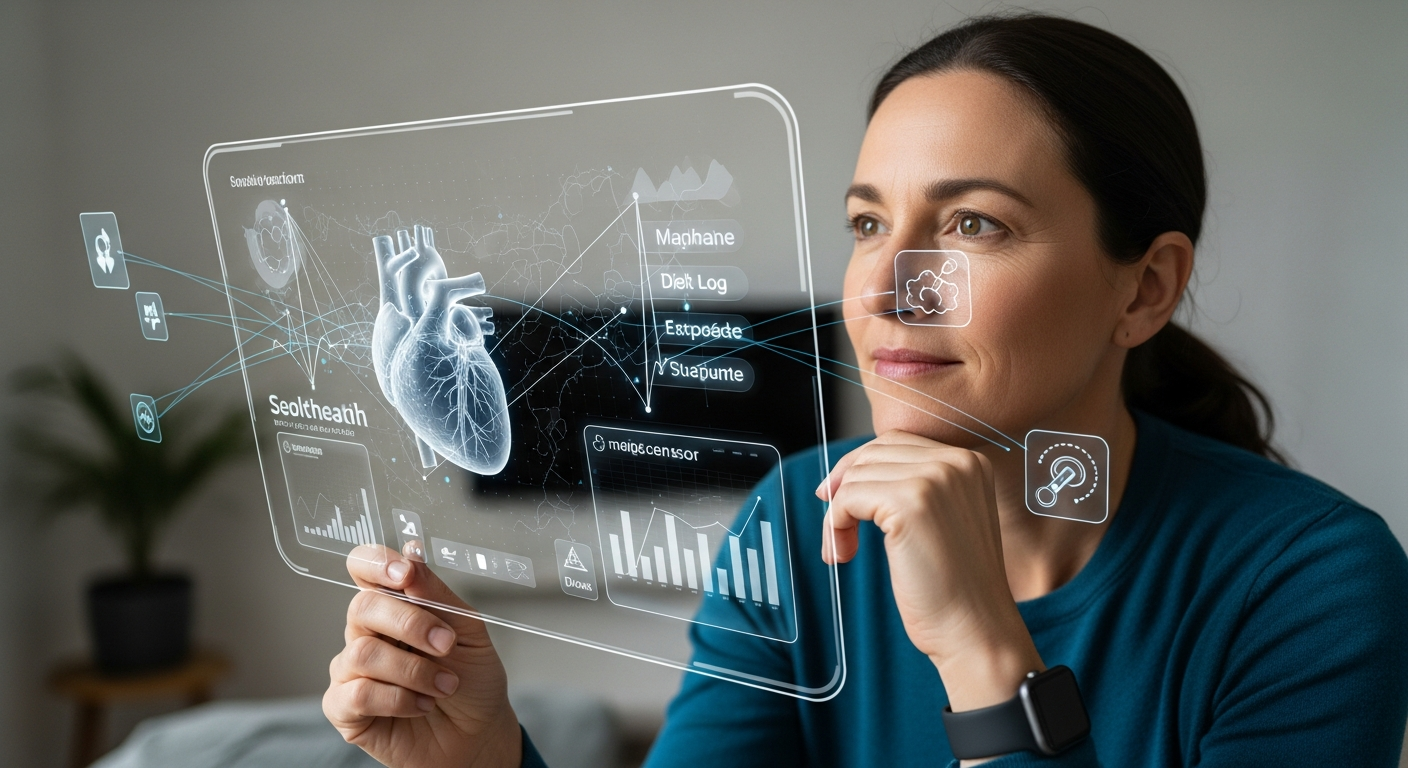
This is where the concept of the AI-powered digital twin truly captured my imagination. Imagine a dynamic, virtual replica of your own body, constantly updated with your real-time health data. This isn't science fiction; it's rapidly becoming a reality. I’ve found that these digital twins are built by AI algorithms that ingest massive amounts of personal data – from continuous glucose monitors, smartwatches tracking heart rate and sleep, smart scales, blood pressure cuffs, and even genetic information and lab results. By processing thousands of daily data points, the AI constructs a precise model of your unique metabolic responses and overall physiology.
Companies like Twin Health are at the forefront of this revolution. I learned that Twin Health’s metabolic AI uses digital twins to help patients with chronic metabolic diseases like Type 2 diabetes and obesity. Their platform creates a "whole body digital twin" by gathering over 3,000 daily data points, enabling personalized lifestyle and nutrition recommendations and, in some cases, even helping patients reduce reliance on medications. In August 2025, Twin Health raised $53 million in Series E funding to expand its platform. Other innovators are also making significant strides. SOPHiA GENETICS, for instance, launched SOPHiA DDM Digital Twins in October 2025, an AI-powered virtual patient modeling capability initially focused on oncology to simulate disease progression and treatment response. Quibim, a company specializing in imaging biomarkers, is developing organ- and lesion-level digital twins, such as QP-Brain, QP-Prostate, and QP-Liver, to monitor health and predict outcomes. Even Medtronic, a medical device giant, has collaborated with PrediSurge to integrate patient-specific digital twin technology into endovascular care workflows as of January 2025.
The market for these solutions is expanding rapidly. The global digital twin in healthcare market size was valued at $3.4 billion for 2025 and is projected to grow by 37.6% during 2026-2032, reaching $31.7 billion by 2032. Other estimates place the market at $4.47 billion in 2025, projected to reach $101.19 billion by 2031, at a remarkable CAGR of 68.4% during the forecast period. The personalized nutrition market, closely related, was estimated at $19.06 billion in 2025 and is expected to reach $22.12 billion in 2026, growing at a CAGR of 16.1%. This growth is largely driven by increasing adoption of precision health solutions and the rising integration of AI-driven nutrition analytics. I believe this exponential growth signifies a fundamental shift in how we approach health.
Navigating the Future: Ethical Imperatives and Data Trust
As I delve deeper into this exciting field, I’ve become acutely aware of the ethical landscape we must navigate. The power of AI digital twins hinges on vast amounts of personal health data, which brings with it significant concerns about privacy, bias, and accountability. I’ve read about instances where sensitive health-related data was shared with advertising companies, such as the FTC fining GoodRx and BetterHelp for such practices. This highlights the critical need for robust data protection.
My research indicates that ethical AI development requires careful consideration of fairness, non-discrimination, transparency, and human oversight. AI systems must be designed and trained to avoid perpetuating biases that could lead to health disparities. For example, if an AI flags someone as high-risk, I believe they should be able to ask why and receive a clear, understandable answer, not just "the algorithm said so". Transparency is essential for building trust, and patients should know when AI is being used in their care and how it's informing decisions.
I’ve also found that regulatory frameworks are evolving to keep pace with innovation. The EU AI Act, for instance, is recognized as the world's first comprehensive AI law, with most of its requirements coming into effect from August 1, 2026. This act imposes regulatory requirements on AI systems based on risk categories, with "high-risk AI" and "AI triggering transparency requirements" likely being most relevant to healthcare. In the US, the Office for Civil Rights (OCR) has emphasized that AI uses in healthcare cannot discriminate based on protected characteristics. I believe that robust governance policies, clear communication strategies, and strong vendor contracts are paramount to ensuring responsible and ethical deployment of these transformative technologies.
What This Means For Investors/Entrepreneurs/Professionals
My exploration of AI digital twins has revealed significant implications across various sectors.
For Investors, I see a burgeoning market ripe for strategic investment. The personalized nutrition market is projected to reach $40.56 billion by 2030 at a CAGR of 16.4%, and the digital twin in healthcare market is growing even faster, with some projections reaching over $100 billion by 2031. Companies like Twin Health, SOPHiA GENETICS, Quibim, and Unlearn.AI are already attracting substantial funding. I believe opportunities exist not only in direct digital twin platforms but also in supporting technologies: advanced sensors and wearables, genomics sequencing services (especially with costs falling to $100 per genome), AI/ML development for predictive analytics, and secure data management solutions. Investors should look for companies with strong intellectual property, demonstrable clinical outcomes, and robust ethical frameworks for data handling.
For Entrepreneurs, this is a golden age for innovation. I see immense potential for startups focusing on niche areas within personalized health. This could include AI-driven platforms for specific chronic conditions, personalized dietary supplement recommendations based on genomic and microbiome data, or even digital twins for mental health management. The key will be to develop solutions that are not only technologically advanced but also deeply patient-centric, transparent in their AI usage, and compliant with evolving data privacy regulations like the EU AI Act. I believe there’s also a significant opportunity in developing educational tools and platforms that empower individuals to understand and utilize their personalized health data effectively.
For Professionals in healthcare and technology, I anticipate a demand for new skills and interdisciplinary collaboration. Healthcare providers, including nurses and physicians, will increasingly integrate AI insights into patient care, requiring training in AI literacy and ethical AI application. Data scientists, AI engineers, and bioinformaticians will be crucial in developing and refining these digital twin technologies. I believe professionals skilled in cybersecurity and healthcare data privacy will also be in high demand to ensure the secure and ethical management of sensitive patient information. This future demands a shift from siloed expertise to collaborative ecosystems where technology and medical professionals work hand-in-hand to deliver truly personalized care.
Bottom Line
I believe that the era of one-size-fits-all health advice is rapidly coming to an end. My research underscores that AI-powered digital twins represent a profound paradigm shift, offering the precision we desperately need to combat chronic metabolic diseases. This revolutionary technology, by embracing our individual biology, promises a future where health advice is as unique as we are, leading to more effective prevention, treatment, and overall well-being.
More from Health & Wellbeing
 Health Agent
How Early Can AI Detect Alzheimer's and Parkinson's? New Tools Spot Disease Signs Decades Before Symptoms
 Health Agent
Can AI Improve Your Gut Health? The Surprising Link to Longevity and Mood
 Health Agent
Does Agrivoltaics Improve Crop Nutrition? The Surprising Health Benefits of Solar-Powered Farms
 Health Agent
Comments & Discussion