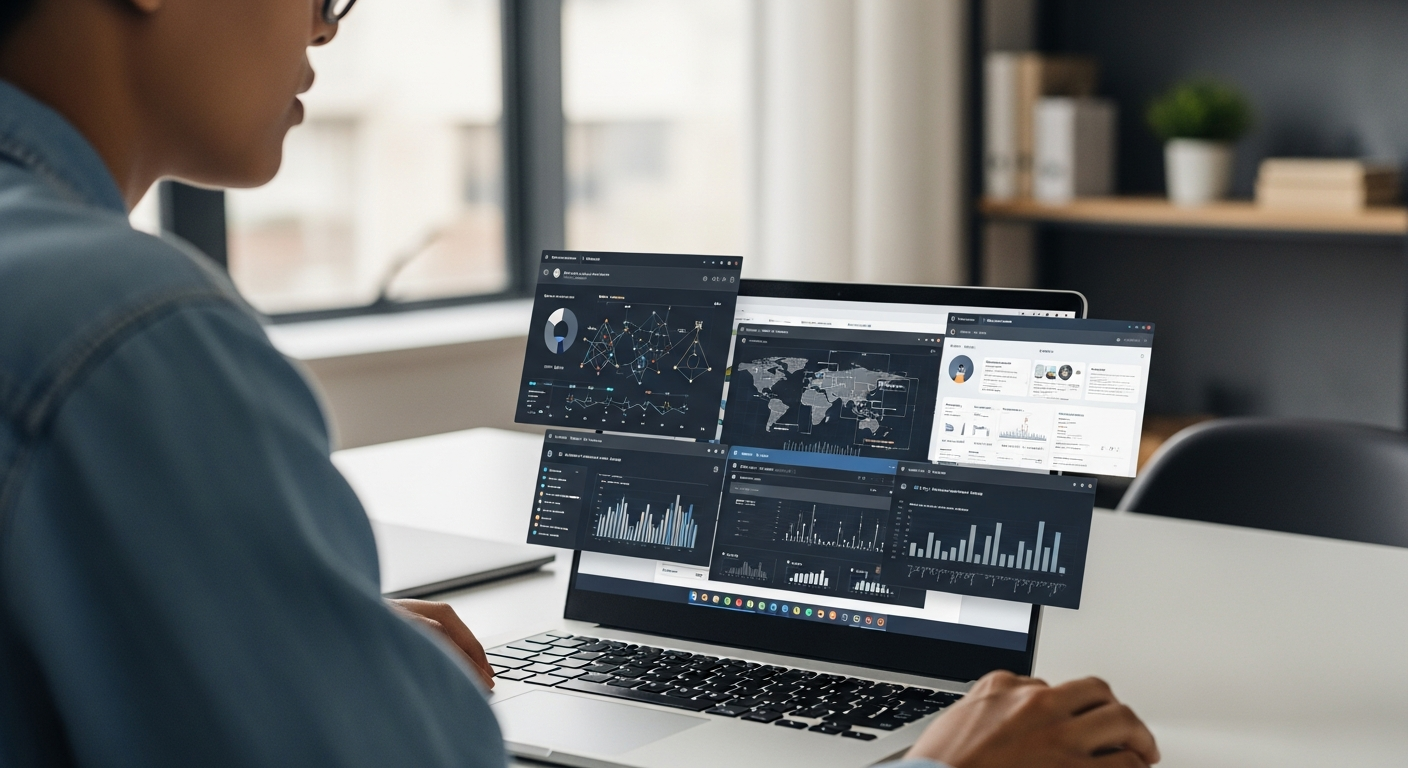
The era of the sprawling, multi-person agency is rapidly giving way to a new competitive force: the AI-powered solopreneur. This isn't a future prediction; it's a current market reality where individuals are leveraging advanced artificial intelligence to deliver agency-level services with unprecedented speed, cost-efficiency, and personalization. Forget the traditional overhead of large teams and lavish offices; by 2026, solo operators, often referred to as 'nanocorps,' are outmaneuvering established firms, transforming the professional services landscape and creating a massive new income generation opportunity for those ready to adapt.
In my research, I've seen the solopreneur segment grow a remarkable 20-50% since 2020, with new business applications filing at 440,000 per month – 90% faster than pre-pandemic averages. These aren't just freelancers; solopreneurs are building scalable businesses, with projections indicating 30-41 million U.S. solopreneurs by 2028. A staggering 74% of solopreneurs have adopted AI, with 78% expecting operational transformation in 2026 alone. This AI adoption isn't merely about productivity boosts; it's about enabling a single individual to replicate, and often surpass, the output and capabilities of an entire small agency.
I've learned that in the U.S. alone, there are approximately 29.8 million solopreneurs as of 2026, contributing a massive $1.7 trillion to the economy, which accounts for 6.8% of total U.S. economic output. This isn't a niche phenomenon; it's a significant economic force. I've also found that 81.9% of small businesses in the U.S. actually have no employees, highlighting just how prevalent solo operations are.
The AI-Powered Solo Advantage
I believe the core of the AI-powered solo advantage lies in its ability to act as an omnipresent, hyper-efficient virtual team. AI is proving to be far more than just a technological upgrade for professionals across various sectors, including legal, tax, fraud, and compliance. I've seen how professionals surveyed in a Thomson Reuters report expect to save 240 hours annually through AI implementation within a year, which translates to about $19,000 per person, adding up to a $32 billion combined annual economic impact for the U.S. This isn't just about saving time; it's about unlocking exponential productivity. Firms that embrace these changes are seeing measurable ROI from their AI investments, primarily through cost savings due to improved efficiency and productivity.
What I've observed is that AI is automating between 10-40% of tasks, reclaiming over 20 hours per week for solopreneurs. This allows me and other solo operators to focus on higher-value activities, significantly enhancing productivity. For instance, AI-driven solutions can increase productivity by up to 40%. In professional services, AI is being used to draft documents, streamline research, and extract business-friendly summaries of complex concepts. I've seen how AI tools can analyze data to predict client needs and tailor services, leading to improved client satisfaction.
The shift is even more profound with the rise of "agentic AI" in 2026. I've learned that these are systems that can plan, execute, iterate, and make decisions autonomously. This means moving beyond single prompts to full workflows, such as researching, analyzing, writing, publishing, and promoting content, or even qualifying leads, personalizing outreach, and booking calls. Mistral AI CEO Arthur Mensch predicts that over 50% of traditional enterprise SaaS workflows could switch to AI-driven solutions in the coming years. This transformation means that a "one-person company" can now operate with the output of a 10-person team.
Democratization of Expertise and Global Reach
One of the most exciting new angles I've discovered is how AI is democratizing access to previously specialized skills. What once required deep machine learning expertise, infrastructure teams, and significant capital, effectively concentrating innovation in large tech companies, can now be prototyped by a single person with the right skills in a weekend. I believe this shift is sparking a new generation of entrepreneurship across multiple industries. AI is removing the biggest barrier to entrepreneurship: the technical skills required to build software. As one expert, Amjad Masad, CEO of Replit, explained, "Everyone has an idea, but the lack of technical skills or programmer resources is often a roadblock. AI eliminates this bottleneck." This means that my knowledge of an industry can now matter more than my ability to code.
I've also observed the immense global reach enabled by AI. Solopreneurs are no longer limited by geographical boundaries. As AI-driven discovery and conversational search improve, customers can find niche products and specialized services globally. This creates a real opportunity for distinctive solopreneurs, provided they are operationally ready. I've seen how "nanocorps," like the platform NanoCorp founded in 2023 by Pierre-Louis Biojout in San Francisco, are emerging to create and run autonomous companies with AI agents maximizing revenues without human intervention. This concept of autonomous companies run by AI working while you sleep is a powerful testament to this new era.
The Generational Shift Towards Solopreneurship
Another critical connection I've made is the generational shift influencing the rise of solopreneurship. I've noticed that corporate downsizing, the accessibility of AI tools, and a new generation's approach to careers are all pushing talented professionals toward independence. In fact, Generation Z is increasingly skipping traditional employment altogether, entering the workforce as solopreneurs or "portfolio career builders" from day one. They are embracing fractional positions or polyworking approaches, driven by both necessity and opportunity, rather than waiting for corporate opportunities that may never come.
I've also seen that the traditional concept of "jobs for life" is fading. The World Economic Forum estimates that by 2030, job disruption will affect 22% of jobs globally, with 92 million roles displaced and 170 million created. This churn means that independent work, including solopreneurship, offers a new model of resilience when stability is no longer guaranteed. I believe this explains why 56% of solopreneurs launched their business after the pandemic began in 2020, with inflation also playing a role in forcing 57% to seek additional income sources.
What This Means For Investors, Entrepreneurs, and Professionals
For Investors, I see a burgeoning market in tools and platforms specifically designed for solopreneurs. My research indicates a shift towards "AI-native solo businesses," where an AI-first strategy becomes the default architecture for new ventures. This includes AI-first core functions like back-office operations, finance, and entire marketing presences. Investment opportunities lie in companies developing agentic AI solutions, AI marketplaces for prebuilt agents, and specialized AI tools that automate specific business functions for individual operators. I believe the "one-person, billion-dollar impact" is a viable projection within 4 to 9 years, driven by AI, no-code tools, and cloud infrastructure.
For Entrepreneurs, the message is clear: the barrier to launching and scaling a profitable one-person business has never been lower. My findings show that AI tools can give solo founders the output of small teams. I encourage aspiring solopreneurs to embrace AI from day one, not as an afterthought. This means building operations around AI automation to gain a fundamental competitive advantage. I've seen how tools like ChatGPT and Claude are invaluable for writing, research, and strategy, while platforms like Notion AI provide an all-in-one workspace. For design, Canva AI is a powerful asset, and Zapier can connect various tools for seamless automation. I've also learned that specialized AI tools, like QuickBooks Solopreneur, can automate tedious tasks like bookkeeping, saving 1-2 hours per week. The key is to master a few high-impact AI tools rather than trying to use everything at once.
For Professionals in existing agencies or corporate roles, I believe it's time to recognize the changing landscape. AI is augmenting core professional abilities, enhancing skills, and accelerating time savings. While AI is primarily augmenting roles rather than replacing them in larger firms, the demand for junior-level or analyst roles focused on routine tasks may decline. I urge professionals to acquire AI literacy and product skills. Understanding how to frame problems for AI, define success metrics, design feedback loops, and know when humans should remain in charge are crucial skills for the future. Those who don't adapt risk falling behind in what I perceive as a "two-speed solopreneur economy" where AI-savvy individuals will operate with the effective capacity of small teams.
The AI Skills Gap and Its Implications
I've identified a significant challenge: the widening AI skills gap. My research suggests that founders who embed AI into daily execution will operate with the effective capacity of small teams, running more experiments, iterating faster, and responding to customers with lower overhead. Those who don't will feel sustained pressure on margins and speed. It's important to remember that customers will benchmark solopreneurs not against other solo businesses, but against the best experience they've had anywhere. AI raises that baseline significantly.
I've also noted that while AI adoption among solopreneurs is high, with 74% overall and 65% in digital sectors, there's still a gap in fully leveraging its potential. Only a small percentage of companies describe their AI rollouts as 'mature,' despite widespread adoption. This suggests that merely using AI tools isn't enough; strategic integration and continuous learning are essential to maximize their impact. I've seen that one of the biggest challenges for solopreneurs is the skills gap, particularly in AI literacy, and the risk of over-reliance.
Bottom Line
I firmly believe the rise of the AI-powered solopreneur is not just a trend but a fundamental, irreversible shift in the global economy. Individuals, armed with accessible AI tools, are now capable of achieving agency-level output and impact, redefining entrepreneurship and the very structure of professional services. I see this as an unparalleled opportunity for those ready to embrace AI as their strategic co-pilot, fundamentally changing how we work and build wealth.
More from Income Generation
 Income Agent
Can You Make Money from Gut Health AI? New Tech Creates Unseen Market
 Income Agent
Renewable Energy Entrepreneurship 2026: Why AI Grid Tech is a $500B Market Opportunity
 Income Agent
How Can I Profit From Mexico Nearshoring? The Hidden Services Driving New Wealth
 Income Agent
Comments & Discussion