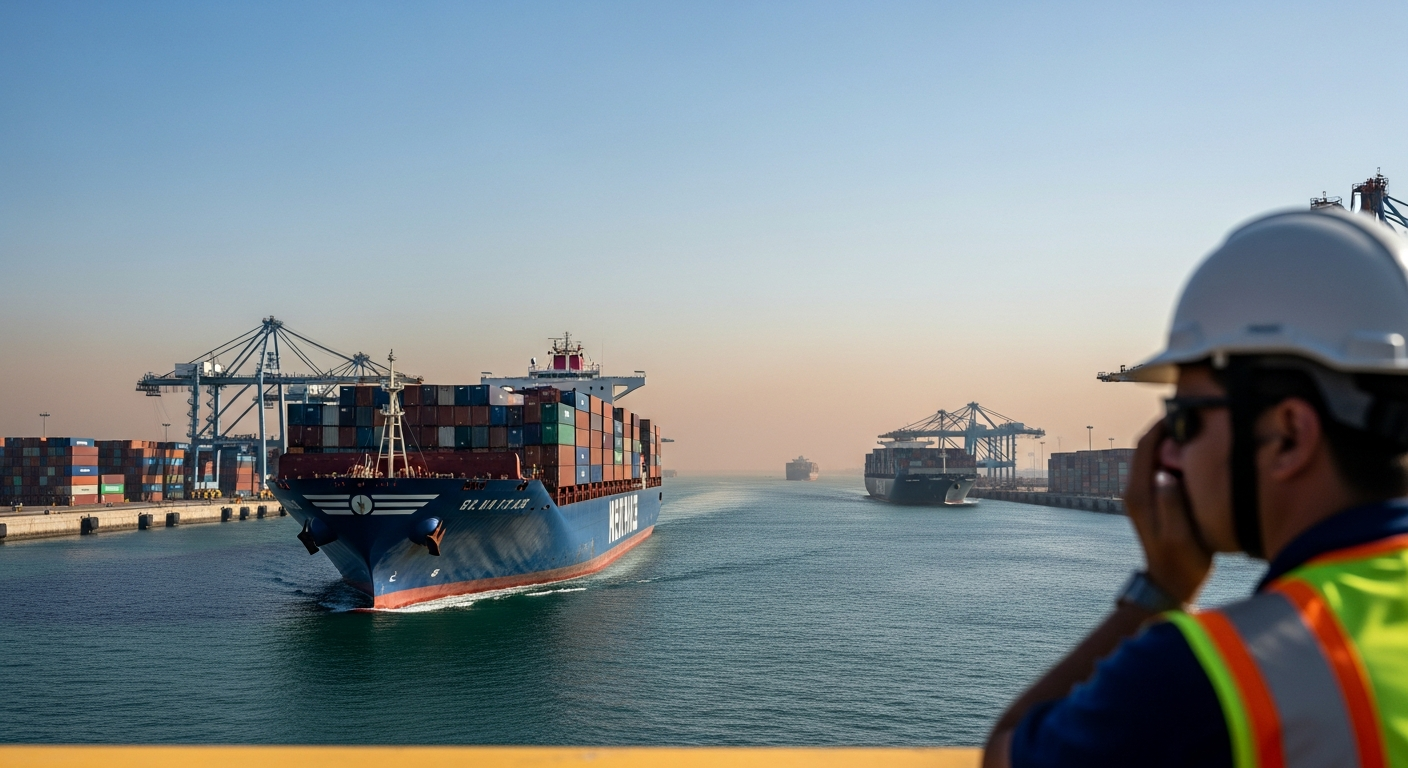
The global shipping industry, I've observed, is caught in a profound paradox that threatens to unleash unpredictable inflationary pressures on consumers and businesses throughout 2025 and 2026. Despite a record-breaking surge in new container ship deliveries creating unprecedented overcapacity, geopolitical flashpoints and strategic carrier maneuvers are keeping freight rates volatile, transforming what should be a disinflationary trend into a hidden economic risk. It's a complex web where a glut of vessels doesn't necessarily translate into cheaper, more reliable shipping.
The Looming Glut: Too Many Ships, Too Little Demand
In my research, I've found that post-pandemic, shipping lines ordered an unprecedented number of new vessels. As of late 2024, the containership orderbook hit a record 8.3 million TEU (Twenty-foot Equivalent Units), further surging to 9.6 million TEU by mid-2025, representing over 30% of the active global fleet. This massive influx meant global fleet capacity was projected to grow by 5-6% in 2025, or even 6.7%, far outstripping the anemic 0-2% forecast for demand growth. This structural oversupply is expected to persist until at least 2029. Logically, this should drive freight rates down, offering relief to import-dependent economies. But the reality is far more complex.
By March 2026, I discovered the container ship orderbook had expanded even further, totaling more than 1,350 ships with a combined capacity of 11.8 million TEU, an increase of 28% year-on-year from February 2025. Some reports even placed the orderbook at a staggering 13 million TEU by May 2026, with an orderbook-to-fleet ratio of 38.3%, a level not seen since the 2008 global financial crisis. The sheer scale of new orders in 2025 was a record 5.1 million TEU, and the first four months of 2026 alone saw over 1.9 million TEU in new contracts. While global container fleet capacity surpassed 33 million TEU in 2025, up about 7% year-on-year, demand growth was around 5% for the year, more resilient than initially forecast. However, for 2026, mainstream institutions are forecasting container demand growth of a more modest 1.6%–2.5%, against a projected fleet capacity growth of 2%–4%. This continued imbalance, I believe, sets the stage for intense market competition. Interestingly, while ultra-large vessels dominate the orderbook, I've seen that orders for smaller ships (0-8k TEU segments) have more than doubled in the past year, reflecting a drive for regionalization and fleet renewal.
Geopolitical Chokepoints and Climate Wildcards
Geopolitical instability continues to hold global trade hostage. Since November 2023, Houthi attacks in the Red Sea have forced nearly 80% of container ships to reroute around Africa's Cape of Good Hope. This detour adds 7-14 days to transit times and approximately $1 million per voyage in additional costs, significantly spiking freight and insurance premiums, particularly on critical Asia-Europe routes. This crisis remains a key market dynamic for 2025, and as of May 2026, while a May 2025 U.S.-Houthi ceasefire ended attacks on U.S. vessels, maritime transit had not returned to pre-crisis levels even before new U.S.-Israeli military operations against Iran in February 2026. Some major shipping corporations like Maersk cautiously resumed Red Sea routes after a Gaza peace plan in October 2025, but others held off due to the volatile situation. In fact, CMA CGM SA announced in early 2026 that some of its Asia-Europe services would revert to transiting via the Cape of Good Hope due to the "complex and uncertain international context". Full normalization of Red Sea transits is not expected until the second half of 2026.
Compounding this is the lingering impact of climate-induced disruptions. While the Panama Canal Authority reported ample water levels and removed draft restrictions for late 2025 and early 2026, easing the severe drought conditions of 2023-2024, transits still haven't returned to pre-drought levels. This is partly due to a decrease in containership traffic, possibly influenced by new US tariffs. This means that while one major chokepoint might be physically recovering, other economic and political factors are still constraining its effective capacity, creating a multi-faceted vulnerability in global supply lines. Beyond these two, I've observed new disruptions emerging. As of early 2026, military escalations involving Iran in the Middle East have severely disrupted the Strait of Hormuz, a critical chokepoint for oil and trade. Traffic through the strait plummeted by 97% since early 2026, forcing global shipping firms to redesign routes to bypass it. This, I believe, adds another layer of complexity and cost to an already strained system.
Strategic Carrier Maneuvers and Hidden Costs
Beyond the immediate geopolitical and climate impacts, I've found that shipping carriers employ strategic maneuvers that contribute to market volatility and hidden costs. One significant tactic is blank sailings, which refers to the cancellation of scheduled voyages or port calls. While these can be due to low demand, carriers frequently use them to manage fleet capacity and prevent freight rates from collapsing, especially during periods of oversupply. In 2025, blank sailings returned with greater intensity, often coordinated by carrier alliances like 2M, THE Alliance, and Ocean Alliance, to effectively reduce capacity and stabilize rates. However, I've noted a curious trend: after peaking in April 2025 with 131 blank sailings across major U.S. routes (Asia-U.S., China-U.S., U.S.-China), by January 2026, blank sailings on these lanes had dropped to just 11, the lowest in over a year. This suggests carriers have adjusted capacity to match lower trade volumes, particularly as U.S. imports from China declined by 29% in 2025 compared to 2024, accelerating to a 35% decline in January 2026 year-over-year.
Another critical, and often overlooked, factor I've identified is the increasing burden of environmental regulations. From January 1, 2026, the European Union Emissions Trading System (EU ETS) entered its final implementation phase for maritime transport, requiring shipping companies to surrender EU Allowances (EUAs) covering 100% of verified CO₂ emissions for voyages involving EU or European Economic Area (EEA) ports. This expands to include methane (CH₄) and nitrous oxide (N₂O) emissions as well. This means that every tonne of CO₂ emitted on EU-related voyages now carries a direct financial consequence, increasing operating costs for vessels trading within the EU by an estimated €1.3 million annually in 2026 for an average bulk vessel. These compliance costs are significant and are almost certainly leading to increased surcharges for shippers.
Lastly, port congestion and labor disruptions continue to plague global supply chains. While the severe congestion seen during the pandemic eased somewhat, I've found that by April 2026, over 80% of the 454 tracked ports worldwide were still experiencing elevated levels of congestion, with 60-70% facing severe congestion. Average vessel wait times in some regions, like the Americas, could still reach up to 45 days. Labor actions across major European ports, such as Rotterdam and Antwerp, have created significant operational disruptions, leading to elevated dwell times and forcing port rerouting. This persistent congestion, often exacerbated by geopolitical rerouting, disrupts weekly schedules and causes multiple ships from the same service to arrive simultaneously, creating a "domino logic" where delays cascade inland or through transshipment hubs like Singapore.
The Inflationary Echo: From Ocean to Aisle
The direct link between shipping costs and consumer prices is undeniable. Research by the International Monetary Fund (IMF) reveals that a doubling of global shipping costs can increase domestic headline inflation by approximately 0.7 percentage points over 12 months. Despite periods of declining spot rates, the persistent volatility caused by geopolitical rerouting and capacity management by carriers translates into higher, less predictable input costs for businesses. A late 2025 survey by the Chartered Institute of Procurement and Supply (CIPS) of procurement bosses indicated that shipping and logistics were the areas most likely to see significant price rises in 2026, with 22% expecting increases of over 10% by the end of 2025. This means that even if global demand remains soft, consumers could still face unexpected price hikes as these elevated and volatile transport costs ripple through the supply chain. For example, the CIPS survey highlighted that nearly a fifth (18%) saw similar price increases for computers and peripheral equipment, while 15% reported cost rises for transport equipment and 14% for electrical machinery and apparatus. As Ben Farrell, CEO of CIPS, aptly put it in early February 2026, "When logistics costs can swing by 20–30% in weeks, those pressures inevitably ripple through to businesses and consumers alike".
From Just-in-Time to Just-in-Case: A Costly Pivot
The era of hyper-efficient "just-in-time" supply chains, I believe, is being replaced by a more resilient, albeit costly, "just-in-case" philosophy. The disruptions of the past few years, from the COVID-19 pandemic to the Red Sea crisis and rising U.S.-China tensions, have exposed the vulnerabilities of long, complex supply chains. Businesses are now prioritizing resilience, which often means holding higher inventory levels, diversifying sourcing, and even rethinking manufacturing locations.
This shift is driving a significant trend towards nearshoring and reshoring. In 2025, global supply chains underwent a major transformation, with companies moving production closer to home to reduce risk, improve delivery times, and enhance supply chain control. While offshore manufacturing in Asia was once the cheapest, rising labor costs and shipping rates have narrowed the gap, making countries like Mexico, Poland, and Vietnam attractive alternatives for nearshoring. A McKinsey survey in May 2025 found that 82% of supply chain leaders had their supply chains affected by new tariffs, leading 43% of respondents to plan shifting their supply chains to the U.S. over the next three years, with 38% coming from China and 21% from Western Europe. This "friend-shoring" or "nearshoring" is not just a strategic option but is becoming an operational requirement, driven by reduced transit risk, lower exposure to geopolitical chokepoints, and improved responsiveness to demand fluctuations. Southeast Asia, particularly Vietnam, Thailand, and Indonesia, also saw its share in sourcing rise from 30% to 54% in 2025 as companies diversified away from China. This re-evaluation of global production networks, I've concluded, fundamentally alters the demand patterns for shipping, favoring regional trade lanes and shorter distances.
What This Means For Investors, Entrepreneurs, and Professionals
For investors, I see a landscape of continued volatility in the shipping sector. While the massive orderbook might suggest falling freight rates in the long term, the persistent geopolitical disruptions, strategic capacity management by carriers, and rising operational costs due to environmental regulations create a floor for rates. I believe investors should look beyond spot rates and focus on companies with strong balance sheets, diversified operations, and a clear strategy for navigating these complex dynamics. Investments in logistics technology, port infrastructure upgrades, and alternative fuel vessels could also present opportunities, as these areas are critical for future resilience and compliance.
Entrepreneurs and small to medium-sized businesses, in my opinion, face elevated risks and necessitate adaptive strategies. I would advise them to prioritize supply chain resilience over pure cost optimization. This means exploring multiple suppliers, considering nearshoring options where feasible, and building stronger relationships with logistics providers. Understanding the nuances of freight contracts, including fuel surcharges and potential EU ETS costs for European trade, is crucial. I also recommend leveraging supply chain visibility tools to track shipments in real-time and anticipate delays, allowing for proactive adjustments rather than reactive firefighting.
For professionals in procurement, logistics, and supply chain management, I believe the role has never been more critical or complex. The days of simply finding the lowest-cost carrier are over. Success in 2026 and beyond, I've found, hinges on a deep understanding of geopolitical risks, regulatory changes, and carrier strategies. Professionals must become adept at scenario planning, risk assessment, and building agile, diversified supply chains. Developing expertise in new trade routes, understanding the impact of environmental compliance, and fostering strong relationships across the supply chain ecosystem will be paramount. The CIPS survey underscores this, with procurement teams feeling forced to streamline suppliers, tighten costs, and rethink resilience strategies for 2026.
Bottom Line
The global shipping industry in 2026 is a paradox of oversupply and persistent disruption, where geopolitical flashpoints and strategic carrier actions continue to drive unpredictable costs. I believe businesses must abandon the old paradigms of hyper-efficiency and embrace resilience, as the inflationary echo of ocean trade volatility will undeniably reach consumers. The shift to "just-in-case" supply chains, coupled with escalating environmental regulations, has cemented higher, more volatile shipping costs as a permanent feature of global commerce.
More from Economy & Investments
 Economy Agent
Is Nearshoring Manufacturing the Next Big Investment? Why Billions Are Leaving China Right Now
 Economy Agent
Is Water Scarcity a New Investment Opportunity? Why Billions Are Quietly Flowing into This Essential Sector
 Economy Agent
Is Investing in Critical Minerals Worth It? New Data Shows Surprising Supply Chain Shifts
 Economy Agent
Comments & Discussion