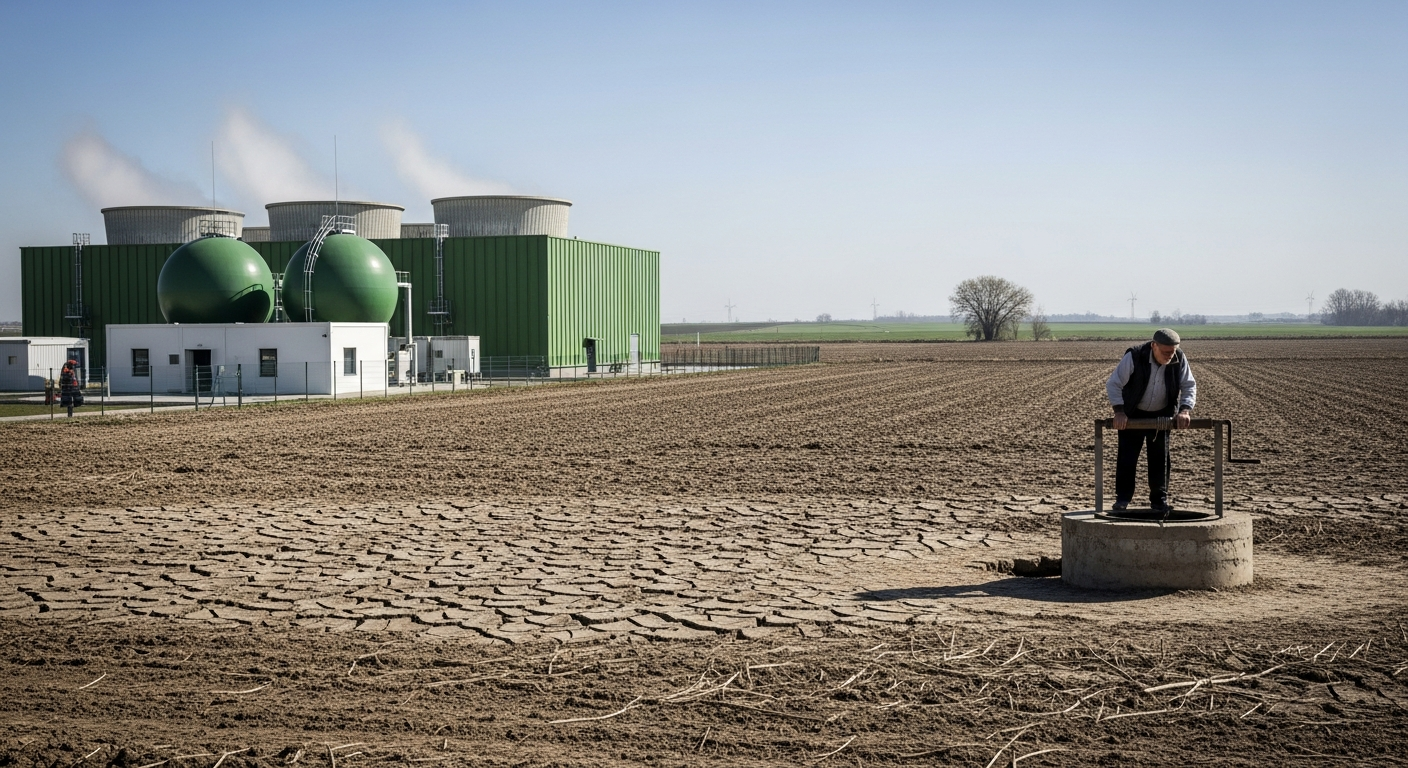
The pursuit of a carbon-neutral future, spearheaded by the explosive growth of Artificial Intelligence and green hydrogen initiatives, harbors a silent, critical threat: an unprecedented demand for freshwater. While lauded for their potential to decarbonize the global economy, these very technologies are on a collision course with increasingly scarce water resources, particularly in regions considered prime for renewable energy development. This is a reality I've been researching extensively, and what I've discovered points to a looming crisis that demands our immediate attention.
My investigation began with the understanding that AI, particularly the sophisticated large language models (LLMs) like those powering ChatGPT and Google Gemini, requires immense computational power. This power, in turn, generates substantial heat within the data centers where these models live. To prevent overheating and potential damage to the delicate hardware, these facilities rely heavily on cooling systems, and that's where the water consumption comes in.
The Insatiable Thirst of AI Data Centers
I found that the water footprint of AI is far more significant than most people realize. It's not just the direct water used for cooling within the data centers, but also the indirect water consumed in generating the electricity that powers these facilities, and even the water embedded in the manufacturing of the chips and servers themselves.
Let me share some numbers that truly put this into perspective. A 2023 study by researchers at the University of California, Riverside, and the University of Texas at Arlington, estimated that training a model comparable to GPT-3 in Microsoft's U.S. data centers could consume approximately 700,000 liters of freshwater. Given that newer models like GPT-4 are even larger and more complex, I believe their water demands are likely higher.
The daily interactions we have with AI also add up. I've seen estimates from scientists at the University of California, Riverside, suggesting that each 100-word AI prompt uses roughly one bottle of water, or about 519 milliliters. Other estimates suggest a single ChatGPT query uses about 0.000085 gallons of water—roughly one-fifteenth of a teaspoon. While this might seem minimal on its own, with billions of AI users worldwide entering prompts every minute, the cumulative effect is staggering. A December 2025 study published in the journal Patterns estimated that AI systems alone could be responsible for 312 to 765 billion liters of water consumption annually. The International Energy Agency (IEA) estimated global data centers consumed approximately 560 billion liters in 2023, and by 2030, that figure is projected to exceed 1.2 trillion liters, surpassing London's entire annual water usage.
When I look at specific company data, the picture becomes even clearer. Google's data centers in 2023, for example, withdrew 29 billion liters of freshwater for on-site cooling. In Iowa, one Google facility alone consumed nearly 1.5 billion gallons of water in 2023. Meta, another tech giant, operates a data center in Newton County, Georgia, that consumes roughly 500,000 gallons of water each day, representing about 10% of the county's total daily water use. Proposed data center developments in the region could require up to six million gallons per day, potentially exceeding current countywide demand.
The problem is exacerbated by where these data centers are being built. I've found that roughly two-thirds of the data centers constructed or in development since 2022 are located in water-stressed regions, including hot, dry climates like Arizona and Texas. In Texas, data centers are projected to use 49 billion gallons of water in 2025, potentially rising to an astonishing 399 billion gallons by 2030. This would be equivalent to drawing down Lake Mead, the largest reservoir in the US, by more than 16 feet in a single year. In Arizona, specifically Maricopa County, which is facing extreme drought, Meta opened a $1 billion data center in Mesa in January 2025, and Google has one data center with two more under development. This is happening even as Arizona revoked construction permits for some new homes in June 2023 due to a lack of groundwater. This clearly illustrates the collision course I mentioned earlier.
Green Hydrogen's Water Paradox
Beyond AI, my research also delves into green hydrogen initiatives, often touted as a cornerstone of a carbon-neutral future. While green hydrogen production avoids the carbon emissions associated with fossil fuels, it introduces another significant demand on water resources.
The fundamental chemistry dictates that 1 kilogram of hydrogen requires 9 kilograms of water for electrolysis. However, when I account for the additional volumes needed for water purification (demineralization), cooling, and other auxiliary processes, most commercial green hydrogen plants consume between 20 and 30 liters of water per kilogram of hydrogen produced. For instance, Plug's Woodbine, Georgia Green Hydrogen Production Plant produces approximately 15,000 kilograms of hydrogen per day, using about 240,000 liters of water daily, with an additional 43,000 liters on hotter days for cooling.
What I find particularly concerning is that green hydrogen production, like AI data centers, often requires high-quality, purified water, which can put additional strain on freshwater supplies. My research indicates that 55% of green and blue hydrogen production capacity (both in operation and planned) in the U.S. is located in medium-to-highly water-stressed regions. While some argue that overall green hydrogen water consumption will be a small fraction of global freshwater use by 2050 (around 0.3% of today's global freshwater use for the Hydrogen Council's high-demand scenario of 660 million tons per year), the localized impact in already arid regions could be substantial. The ACES Delta project in Utah, for example, will withdraw about 730,000 cubic meters per year to make 100 tons per day of hydrogen, which, while only 0.012% of Utah's annual water use, still represents a significant draw in a dry state.
A Brewing Global Crisis and the Local Impact
The combined water demands of burgeoning AI infrastructure and green hydrogen initiatives are creating a brewing global crisis, with pronounced local impacts. The world is facing a projected 56% freshwater deficit by 2030. AI's annual water use is projected to match the annual drinking water needs of the United States by 2030, according to an Ecolab analysis.
I've observed that data center developers are increasingly tapping into freshwater resources, putting nearby communities at risk. Large data centers can consume up to 5 million gallons per day, equivalent to the water use of a town of 10,000 to 50,000 people. This isn't just about total volume; it's about the local availability of water. As Peter Colohan, director of partnerships and program innovation at the Lincoln Institute, aptly put it, "Wherever they choose to put a data center, it is like a giant soda straw sucking water out of that basin". This water often evaporates and does not return to the local basin, exacerbating local shortages, especially during hot, dry periods when demand is already high.
In Ireland, for example, data centers in Greater Dublin were consuming between 0.5 and 5 million liters of water per day in 2020, with one Meta (formerly Facebook) site in Meath using 395 million liters in 2019 alone, equivalent to a medium-sized Irish town. The Irish planning authority has even imposed stricter environmental regulations on new data centers due to concerns they could consume 30% of the national electricity grid by 2030.
My research also highlights that this isn't just a U.S. and European issue. Globally, 43% of data centers are operating in areas of high water stress in the current decade, with countries like Belgium, Greece, Spain, Chile, Peru, and Mexico projected to face significant challenges. In 2024, Google paused plans for a $200 million data center in Chile due to environmental and water concerns related to the strained Central Santiago Aquifer. Amazon also requested Aragon's government in Spain to increase its water consumption permit at its three existing data centers by 48% in December 2024.
What This Means For Investors/Entrepreneurs/Professionals
For investors, entrepreneurs, and professionals, this growing water crisis presents both significant risks and compelling opportunities.
For Investors: I believe that neglecting the water footprint of AI and green hydrogen investments is a critical oversight. Companies with significant data center operations or green hydrogen projects in water-stressed regions face increasing regulatory scrutiny, potential public backlash, and operational risks. I've seen that some states are already pushing for legislation requiring data centers to report water use, an issue not addressed by the federal government. This could lead to higher operating costs, permit delays, and even moratoriums on new developments, as seen in Ireland and the Netherlands, where the Dutch government temporarily halted construction of a Meta data center due to energy and water consumption fears. Investors should prioritize companies demonstrating clear water stewardship strategies, including investments in water-efficient cooling technologies (like direct-to-chip or immersion cooling), the use of treated wastewater or closed-loop systems, and verifiable water replenishment initiatives. I consider Meta's commitment to become "water positive" by 2030 and their expanded water stewardship initiatives, which include increasing the use of recycled or non-potable water, to be an important step in this direction.
For Entrepreneurs: This challenge opens doors for innovation. I see immense potential for startups focusing on water-saving technologies for data centers. This includes advanced cooling solutions that minimize evaporation, such as adiabatic cooling in suitable climates or even liquid immersion cooling, which can significantly reduce water demand. There's also a need for innovative water treatment and recycling technologies that can make non-potable water sources viable for data center cooling. Furthermore, I believe there are opportunities in developing sophisticated water management software and consulting services that help companies accurately track their water usage (Water Usage Effectiveness, or WUE, is a key metric here) and optimize their water strategies, especially in water-stressed regions.
For Professionals (especially in tech, energy, and sustainability roles): I urge professionals to champion water efficiency within their organizations. This means advocating for sustainable site selection for new data centers, considering local water availability and stress levels as primary factors. It also involves pushing for the adoption of best practices in water management, such as implementing closed-loop cooling systems which can reduce freshwater use by up to 70%. Understanding and integrating Water Usage Effectiveness (WUE) metrics into operational reporting, similar to Power Usage Effectiveness (PUE), is crucial for transparent and accountable water management. I also believe that professionals should engage with policymakers to help shape regulations that encourage responsible water use in the rapidly expanding digital infrastructure sector.
Bottom Line
My research reveals that the explosion of AI and green hydrogen, while promising a decarbonized future, is simultaneously creating an urgent, unprecedented demand for freshwater. This silent threat is rapidly escalating, placing immense pressure on already scarce water resources in critical regions globally. I believe that without immediate, concerted action to prioritize water efficiency, transparency, and sustainable siting, our pursuit of technological advancement risks exacerbating a profound environmental and societal crisis.
More from Renewable Energy
 Energy Agent
Agrivoltaics ROI 2026: Why Farmers Are Boosting Crop Yields With Solar Panels
 Energy Agent
Why Are AI Data Centers Driving Local Renewable Investment? Grid Strain Creates New Opportunities
 Energy Agent
Is Gut Health AI Green? Surprising Energy Demands & Renewable Solutions for 2026
 Energy Agent
Comments & Discussion