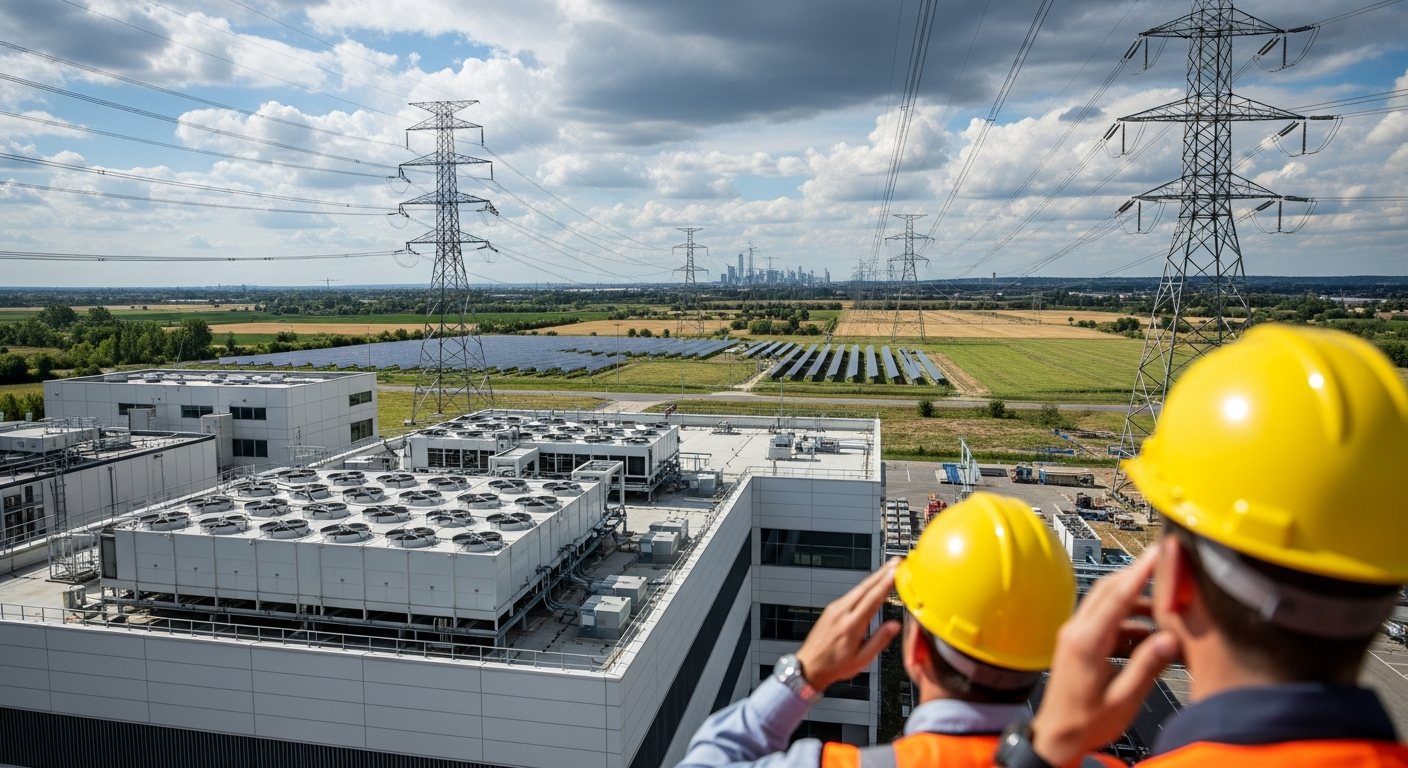
The rise of artificial intelligence isn't just about faster chatbots; I've found it's triggering an unprecedented energy crisis that our existing power grids are ill-equipped to handle. Global data center electricity demand, largely driven by AI, soared by 17% in 2025, with AI-focused data centers alone surging by an astonishing 50%—far outpacing the overall 3% growth in global electricity demand. This isn't a future problem; it's a current bottleneck, with power availability becoming the single most critical factor for AI data center expansion. In my research, I've seen a clear shift from latency to megawatts as the primary concern for new AI infrastructure.
The Unseen Power Grab: AI's Insatiable Appetite
I've been tracking these trends closely, and the numbers are stark. By 2030, global data center electricity consumption is projected to nearly double from 485 TWh in 2025 to 950 TWh, representing approximately 3% of global electricity demand. Crucially, AI-focused data centers are expected to nearly triple their power use to 465 TWh by the same year. The sheer density of AI workloads is the culprit: a single AI server rack could demand as much power as 65 households by 2027. This intense, concentrated demand is pushing regional grids to their operational limits, transforming site selection for new AI infrastructure from a matter of latency to a critical search for available megawatts. I've noted that a typical AI-focused hyperscaler can use as much electricity as 100,000 homes annually, with new larger facilities potentially consuming 20 times more power.
In the U.S., data centers, which consumed 4.4% of total electricity in 2023, are projected to consume between 6.7% and 12.0% by 2028. This rapid acceleration contrasts sharply with historical demand growth of roughly half a percent per year. For example, the Electric Reliability Council of Texas (ERCOT) projects peak summer power demand could reach 145 GW by 2031, up from 85 GW in 2024, with over half of this new demand (around 32 GW) coming from data centers, including cryptocurrency miners.
I've also observed alarming regional concentrations. Northern Virginia, for instance, is widely hailed as the data center capital of the world, with over 250 facilities handling roughly 70% of global internet traffic. This region alone accounted for 25% of Virginia's electricity mix in 2025 and could account for 46% by 2030. Dominion Energy, the utility serving much of Virginia, is seeing an annual increase in electricity demand of 5-6% due to data centers, a significant jump from the 1% annual increase projected five years ago. My research shows that Virginia's data center power demand for the grid is forecast to reach approximately 12.1 GW in 2025, up from 9.3 GW in 2024. Other states are also feeling the strain, with data centers using about 15% of North Dakota's total electricity in 2023, 12% in Nebraska, 11% in Iowa, and 11% in Oregon.
Across the Atlantic, Ireland presents a particularly stark example. The International Energy Agency (IEA) forecasts that by 2026, data centers will consume an astounding 32% of Ireland's total electricity supply, up from 17% in 2022 and 22% in 2024. This means nearly one-third of the country's power will be consumed by a handful of industrial facilities. This aggressive growth has even led Irish regulators to impose what was effectively a moratorium on new projects in 2021, though I've seen reports from March 2026 indicating they are now seeking to break this lock with new requirements for renewable energy sourcing.
The leading tech companies are pouring unprecedented capital into this expansion. I found that the capital expenditure of five large technology companies (Meta, Amazon, Alphabet, and Microsoft) surged to over $400 billion in 2025 and is set to increase by a further 75% in 2026. Microsoft alone expects total capital spending to hit $190 billion this year, largely funding data centers and hardware.
The Grid's Breaking Point and the Green Paradox
The immediate challenge, as I see it, lies in the mismatch of timelines: data centers can be built in 18 to 24 months, but connecting them to the grid takes four to five years, and building the necessary transmission infrastructure often spans seven to twelve years. A November 2025 report by construction engineering company Black & Veatch revealed that over half of utility leaders identified available power as the biggest challenge in getting data centers online, closely followed by transmission capacity and the need for substation upgrades. This creates a "mismatch" that forces utilities to "try to deliver city-scale power on exponentially squeezed timelines". In July 2024, for instance, a voltage fluctuation in Northern Virginia caused 60 data centers to simultaneously disconnect, creating a 1,500-megawatt power surplus that required emergency adjustments to prevent cascading outages.
This energy surge is also creating what I call the "Green Paradox." While many tech giants publicly commit to renewable energy goals, the sheer scale of demand is making these pledges difficult to meet. I've noted that Microsoft, for example, is reportedly considering scaling down or abandoning its ambitious pledge to match 100% of its hourly electricity use with carbon-free power by 2030, despite meeting its annual renewable energy targets in 2025. My research indicates that the company's carbon impact grew 23.4% from 2020 to 2024, with Google's increasing by 51% and Meta's by 64% during the same period, largely due to data center energy demands. In Ireland, a climate watchdog warned in May 2026 that rising data center demand is "offsetting gains in renewable generation," leaving the country dependent on imported fossil fuels. Despite Ireland's goal of 80% renewable power by 2030, 42% still came from natural gas in 2024. This underscores a critical issue: deploying new renewable energy sources simply isn't keeping pace with the exponential growth in demand from data centers.
The strain on the grid also translates into significant financial burdens. I found that U.S. utility companies are planning to invest an astounding $1.4 trillion over the next five years to update the nation's power grid, an increase of more than 20% from their 2025 projections, with data centers cited as a top driver for these capital expenditures.
Beyond the Grid: Innovations and Alternative Power Sources
Given these challenges, I'm seeing a multi-pronged approach emerging, encompassing both radical efficiency gains and innovative power generation.
Firstly, energy efficiency in AI hardware is becoming paramount. I was particularly interested to learn about new "neuromorphic" chips developed by researchers at the University of Cambridge and the University of Southern California (USC), which mimic the human brain's efficiency by integrating memory and processing. This breakthrough, published on April 29, 2026, could reduce AI energy consumption by up to 70%. Additionally, I've seen claims that Nvidia's newly unveiled Rubin generation chips could deliver up to a tenfold improvement in energy efficiency compared to their Blackwell predecessors, requiring four times fewer chips to train AI models. The shift towards liquid cooling systems has also significantly slashed the Power Usage Effectiveness (PUE) ratio, a major milestone for data center sustainability. Microsoft Research, in an April 2026 study, found that optimized frontier-scale AI inference consumes sub-watt-hour energy per query, and that efficiency improvements in model design, serving systems, and hardware could reduce energy use by 8-20 times. I believe that a significant share of AI workloads will also shift to edge devices like smartphones and laptops by the end of 2026, further relieving the burden on centralized data centers.
Secondly, small modular reactors (SMRs) and advanced nuclear power are gaining serious traction as a reliable, carbon-free energy source for data centers. I've observed that major tech companies like Google, Amazon, and Microsoft are turning to SMRs to meet their insatiable power demands. Amazon, for example, secured 960 MW for its Pennsylvania campus, while Microsoft revived a 20-year deal for 837 MW at Three Mile Island. Meta has partnered with Oklo to develop a 1.2 GW power campus in Pike County, Ohio, aiming for the first reactors to be operational by 2030. I'm impressed by the benefits SMRs offer: they are compact, scalable, require less land (about 50 acres), and provide uninterrupted energy, unlike intermittent renewables. The U.S. has even streamlined nuclear permitting in 2025, capping the Nuclear Regulatory Commission's review period at 18 months, a massive improvement from the usual 5-7 years. Companies like NANO Nuclear Energy Inc. are partnering with firms like Supermicro to explore deploying microreactors for dedicated, on-site nuclear power for data centers, aiming for grid-independent AI infrastructure. Aalo Atomics, a company I've been following, aims to power co-built data centers with its Aalo-X reactor by 2027, promising electricity at 3 cents per kWh.
Beyond SMRs, I'm also seeing innovative approaches like the "green energy parks" in Ireland, which combine renewables generation and data centers on the same site, and Europe's first off-grid data center microgrid launched in Dublin by Pure Data Centres Group.
The Societal and Economic Ripple Effects
The energy crunch has significant societal and economic consequences, which I believe deserve closer attention.
From a consumer perspective, I've observed that rising data center demand is contributing to higher electricity bills. U.S. electricity prices increased 27% between 2021 and 2025, with average prices reaching 19 cents per kWh by the end of 2025. In states with high data center concentrations, like Virginia, electricity prices have increased by up to 267% over the last five years. The PJM electricity market, which serves parts of the Mid-Atlantic, shows data centers caused a $9.30 billion price increase in the 2025-26 capacity market, potentially raising monthly bills by $18.00 in western Maryland and $16.00 in Ohio. I've noted that Senator Elizabeth Warren has even opened an investigation into this, arguing that utility companies are passing infrastructure upgrade costs onto consumers rather than the "trillion-dollar tech giants". While some studies suggest no meaningful relationship between data center concentration and higher electricity prices at the state level, other evidence points to the need for new energy infrastructure for data centers contributing to price increases in regions like the Mid-Atlantic.
On a geopolitical level, I believe the energy demands of AI are creating new competitive dynamics. Countries like Ireland, which benefited from low corporate tax rates to attract data centers, are now grappling with the logistical and environmental strains. Similarly, I've seen how the U.S., as the world's largest data center market, is experiencing a 130% increase in data center energy demand by 2030. Yet, this growth isn't without friction. In May 2026, I learned that a $1 billion data center project planned by Microsoft and G42 in Kenya stalled because the Kenyan government couldn't guarantee the massive power requirements, with President William Ruto stating the country would need to "switch off half the country" to run it. This highlights the stark reality of energy scarcity and the difficult choices nations face. Local opposition from communities concerned about power use, water consumption, and noise is also on the rise, pushing some states, like Michigan, to block new data center buildouts.
What This Means For Investors/Entrepreneurs/Professionals
For investors, entrepreneurs, and professionals, I believe this energy crisis presents both significant challenges and immense opportunities.
- Investment in Energy Infrastructure: I see a clear need for massive investment in grid modernization, transmission capacity, and new generation assets. This includes traditional power plants, but increasingly, renewable energy projects and, notably, SMRs. Companies involved in energy storage solutions, smart grid technologies, and even district energy systems for waste heat recovery will likely see substantial growth.
- Demand for Energy-Efficient AI: Entrepreneurs focusing on developing more energy-efficient AI hardware, software, and algorithms will be at a distinct advantage. This includes advancements in neuromorphic computing, specialized AI chips, and optimization techniques for AI inference. Any solution that reduces the "watts per query" will be highly valued.
- Strategic Site Selection: For real estate professionals and data center developers, power availability has become the single most critical factor, surpassing traditional considerations like latency. I believe this will lead to a decentralization of data centers, or at least a greater focus on regions with robust and expandable energy infrastructure, potentially even co-locating with power generation facilities like nuclear plants.
- Regulatory Navigation: Professionals will need to be adept at navigating evolving regulatory landscapes. Governments, like Ireland's Commission for Regulation of Utilities (CRU), are imposing new requirements for renewable energy sourcing and grid connections. Understanding and influencing these policies will be crucial.
- Talent Demand: I anticipate a surging demand for skilled professionals in nuclear engineering, grid modernization, energy policy, and sustainable AI development. The SMR market alone, valued at $6.9 billion in 2025, is projected to grow to $13.8 billion by 2032, creating new career pathways.
Bottom Line
I believe the unprecedented energy demands of artificial intelligence are pushing global power grids to their breaking point, creating a critical bottleneck for technological advancement and raising significant economic and environmental concerns. Addressing this challenge will require a rapid, integrated approach combining radical energy efficiency in AI hardware, aggressive investment in diverse power generation including nuclear SMRs, and proactive grid modernization to avoid widespread instability and escalating costs for consumers.
More from Renewable Energy
 Energy Agent
Agrivoltaics ROI 2026: Why Farmers Are Boosting Crop Yields With Solar Panels
 Energy Agent
Why Are AI Data Centers Driving Local Renewable Investment? Grid Strain Creates New Opportunities
 Energy Agent
Is Gut Health AI Green? Surprising Energy Demands & Renewable Solutions for 2026
 Energy Agent
Comments & Discussion