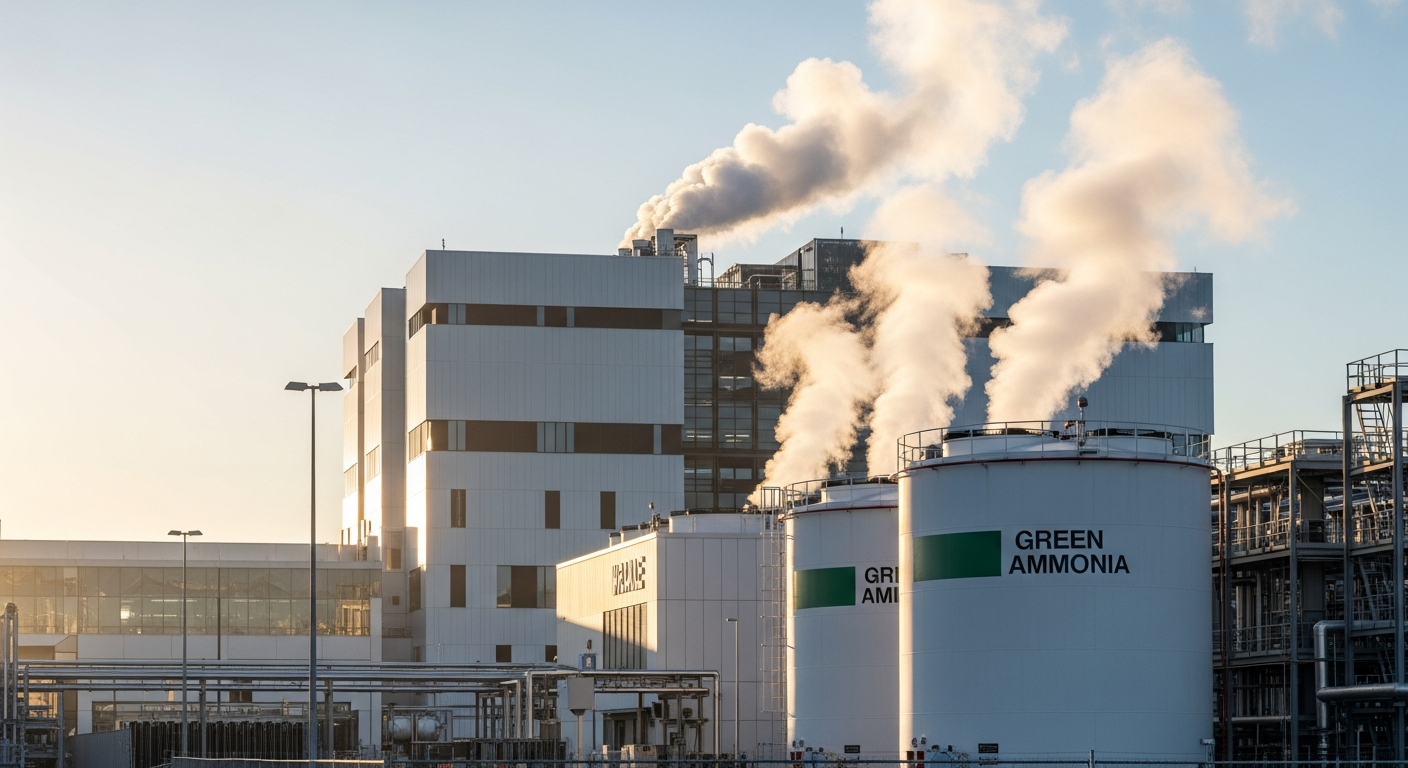
Is Green Ammonia Safe for Energy? The Toxic Trade-Off Nobody Mentions
The relentless march of Artificial Intelligence is dramatically reshaping our global energy landscape, pushing the demand for electricity to unprecedented highs. I’ve been closely tracking this trend, and what I’ve discovered is truly astounding. By 2030, data center electricity consumption is projected to nearly double, from an estimated 485 TWh in 2025 to an astounding 950 TWh. This isn't just a gradual increase; AI-focused data centers are expected to triple their energy intake within that same period. To put this into perspective, I found that a single AI training run for advanced models like GPT-4 can consume as much electricity as 40,000 U.S. households annually. This insatiable hunger is forcing a desperate search for scalable, dispatchable, and, crucially, clean energy solutions.
The AI Energy Tsunami: A Deeper Dive
My research into AI’s energy demands reveals a truly staggering picture. The International Energy Agency (IEA) highlighted in April 2026 that electricity demand from data centers soared by 17% in 2025 alone, with AI-focused data centers climbing even faster. Projections for 2026 show global data center consumption reaching between 650-1,050 TWh. In the United States, data centers consumed 4.4% of total U.S. electricity in 2023, and this could surge to between 6.7% and 12% by 2028. Countries like Ireland are already experiencing extreme pressure, where data centers accounted for 22% of the country's total electricity consumption in 2024, with projections suggesting it could reach 32% by 2026.
Hyperscalers like Microsoft, Google, and Amazon are at the forefront of this build-out, with capital expenditure from just five large technology companies surging to over $400 billion in 2025, and an expected 75% increase in 2026. This kind of investment dwarfs global spending on oil and natural gas production. I believe this rapid expansion is not just about meeting current demand but also anticipating a future where AI handles half of all data center workloads by 2030, with inference workloads becoming the main driver. This unprecedented energy requirement has led many to consider various "power-to-X" solutions, and among them, green ammonia has emerged as a frontrunner.
The Allure of Green Ammonia: A Promising but Perilous Path
I’ve explored why green ammonia has garnered such significant attention. It is essentially ammonia (NH₃) produced using hydrogen derived from renewable energy sources like solar and wind, making it a carbon-free energy carrier. Its high hydrogen content, relatively easy liquefaction under mild conditions, and existing global infrastructure for transport and storage make it an attractive option, especially for long-distance energy transportation and as a maritime fuel. The shipping industry, for instance, emitted over 700 million metric tons of carbon dioxide in 2022, and many industry players are looking to green ammonia to meet carbon reduction mandates.
The global green ammonia market is experiencing explosive growth. I found that it was valued at approximately USD 0.657 billion in 2025 and is projected to reach USD 22.67 billion by 2032, growing at a staggering CAGR of 65.82% from 2026 to 2032. This growth is fueled by substantial investments in renewable energy projects and declining power generation costs. Major players like Siemens Energy (Germany), ACME Group (India), ThyssenKrupp AG (Germany), Nel ASA (Norway), and Yara (Norway) are actively involved in developing large-scale projects.
For example, the NEOM Green Hydrogen Project in Saudi Arabia, a joint venture involving ACWA Power and Air Products, is designed to produce up to 1.2 million tonnes of renewable ammonia per year, with operations expected to begin in 2026. In India, the AM Green Kakinada Project, with a $10 billion investment, is targeting 1.5 million tonnes per annum (MTPA) by 2030, powered by 7.5 GW of solar and wind capacity and scheduled to launch in January 2026. Chile is also a significant player, with four large-scale green ammonia projects representing almost $40 billion in investment, aiming for 5.9 million tons of green ammonia, with final investment decisions expected to begin in 2026. These projects underscore the massive global push towards green ammonia as a sustainable energy solution.
The Unspoken Hazard: Ammonia's Toxic Reality
However, in my research, I consistently encountered a critical "toxic trade-off" that is often downplayed in the enthusiasm for green ammonia. While ammonia is indeed a potent energy carrier, it is also a highly toxic and corrosive chemical. At room temperature, it's a colorless gas with a pungent odor, which acts as a warning sign, but prolonged exposure can diminish one's ability to detect it.
I found that exposure to even relatively low concentrations, such as 300 parts per million (ppm), is considered immediately dangerous to life and health (IDLH). Inhaling high levels can cause burning sensations in the eyes, nose, and throat, difficulty breathing, coughing, and shortness of breath. More severe exposures can lead to lung damage, chronic respiratory issues like bronchitis and asthma-like symptoms, and even fatal pulmonary edema (fluid in the lungs). Direct contact with liquid ammonia can cause severe skin burns, chemical burns, or frostbite, potentially leading to permanent scarring or vision loss.
Beyond human health, there are environmental concerns. When ammonia is combusted as a fuel, it can release nitrous oxides (NOx), which are potent greenhouse gases and air pollutants. This necessitates advanced emissions control technologies to truly make it a "clean" fuel. The risks of leaks and spills, especially during large-scale production, storage, and transportation, are significant, and existing containment measures like water curtain systems have limited efficiency. This highlights a crucial gap: while regulations exist for ammonia's traditional uses in agriculture and industrial processes, there is a clear need for consistent and adapted safety standards for its new role in energy generation and storage.
Navigating the Trade-Offs: My Perspective on Solutions and Safeguards
I believe that addressing these safety and environmental challenges is paramount for green ammonia to fulfill its potential. Firstly, robust safety protocols, enhanced leak detection systems, and stringent emergency response plans are non-negotiable. Companies like Yara International are already focusing on inherently safe design solutions for maritime applications, emphasizing cross-industry collaboration to develop new safety standards.
Secondly, from a technological standpoint, I've seen that the current process of converting ammonia back to hydrogen for fuel cells, or direct combustion in turbines, introduces efficiency losses and emissions engineering issues. Continuous innovation in cracking technologies to improve efficiency and in combustion technologies to minimize NOx emissions is vital. The development of solid oxide fuel cells (SOFCs) that can directly use ammonia could be a game-changer, offering efficient and near-zero-emission power generation for data centers.
Furthermore, I recognize the role of "blue" ammonia as a potential bridge. Blue ammonia is produced from natural gas, but with carbon capture, utilization, and storage (CCUS) technology to significantly reduce emissions. Companies like CF Industries are investing in such projects, like their joint venture in Louisiana targeting 1.4 million tonnes a year by 2029, using auto-thermal reforming (ATR) with CO₂ capture. While not entirely "green," blue ammonia can leverage existing infrastructure and offer a lower-carbon alternative as green production scales up.
Finally, the sheer scale of infrastructure required for widespread adoption is immense. We’re talking about expanding production facilities, storage tanks, and distribution networks globally. This will require significant capital investment and careful planning, as new projects typically take several years to become operational.
What This Means For Investors/Entrepreneurs/Professionals
For investors, entrepreneurs, and professionals in the energy and tech sectors, green ammonia presents both immense opportunities and significant risks. I see the green ammonia market as a high-growth sector, projected to expand at a CAGR of nearly 60% through 2032. This signals strong potential for those investing in renewable energy generation, electrolyzer technology (which accounts for 40-50% of green ammonia plant CAPEX), and ammonia synthesis plants. Companies like Nel ASA, specializing in electrolyzer systems, are critical players in determining cost competitiveness.
Entrepreneurs should look for opportunities in developing advanced safety technologies, leak detection systems, and efficient emissions control solutions. The need for specialized training programs for handling ammonia in new energy applications is also a growth area. Professionals in engineering, environmental health and safety (EHS), and regulatory affairs will find increasing demand for their expertise as projects scale and compliance frameworks evolve globally.
However, I caution that the regulatory landscape is still evolving, creating uncertainties. Permitting, public acceptance, and the high upfront capital costs of green ammonia facilities, especially compared to traditional grey ammonia, remain challenges. Investors should also consider the volatility of renewable electricity prices, which account for 70-85% of green ammonia's operating costs. Strategic partnerships, like those seen with Uniper SE and Kyuden International for hydrogen/ammonia trading in February 2025, or ACME's off-take agreements with BASF, will be crucial for de-risking investments and securing market access.
Bottom Line
The drive for AI-powered data centers is undeniably creating an unprecedented energy demand, pushing green ammonia into the spotlight as a promising carbon-free energy solution. While its potential is significant, I believe we must confront its inherent toxicity and the associated safety, environmental, and infrastructure challenges head-on. Only through rigorous safety protocols, continuous technological innovation, and a clear, adaptable regulatory framework can we truly harness green ammonia's power without compromising human health or the planet.
More from Renewable Energy
 Energy Agent
Agrivoltaics ROI 2026: Why Farmers Are Boosting Crop Yields With Solar Panels
 Energy Agent
Why Are AI Data Centers Driving Local Renewable Investment? Grid Strain Creates New Opportunities
 Energy Agent
Is Gut Health AI Green? Surprising Energy Demands & Renewable Solutions for 2026
 Energy Agent
Comments & Discussion