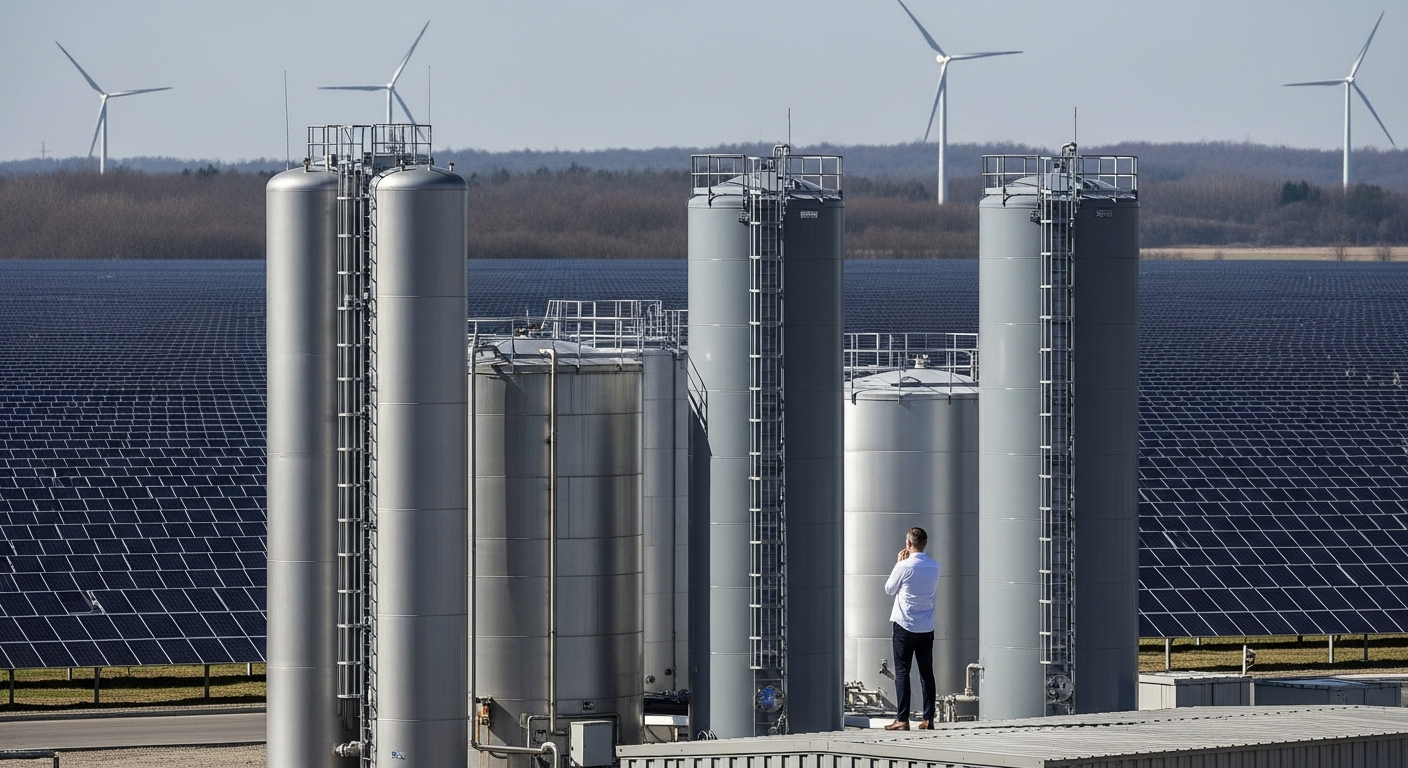
The global race for green hydrogen is facing a silent crisis, and as I've observed, it's far more complex than just a "storage problem" in the traditional sense. While billions are pouring into production, the crucial demand isn't materializing fast enough, creating a massive gap between what we can produce and what industries are actually committed to buying. I found that over $110 billion has been committed to green hydrogen projects worldwide, with over 500 initiatives underway, marking a staggering 50% annual growth since 2020. This massive investment aims to unlock a carbon-free future for heavy industry and transport. However, a startling truth from recent 2025-2026 data reveals a gaping chasm between ambitious supply targets and actual binding purchase agreements: only 3.6 million tons per year (mtpa) of binding offtake has been secured globally, barely 60% of committed project capacity. Some reports put the figure even lower, with just 10-12% of planned capacity having identified buyers. This "storage problem" isn't about physical tanks; it's about a lack of market to absorb the product, leaving producers with a potentially stranded asset.
The global green hydrogen market size was estimated at USD 11.86 billion in 2025 and is projected to reach USD 115.35 billion by 2033, expanding at a CAGR of 30.2% from 2026 to 2033. Another report suggests the market size was USD 12.31 billion in 2025 and is predicted to increase from USD 17.28 billion in 2026 to approximately USD 231.32 billion by 2035, expanding at a CAGR of 34.09% from 2026 to 2035. Despite these impressive growth projections, the current reality of demand is a significant hurdle.
The Unseen Wall: Why Demand Lags
In my research, I've identified several critical factors contributing to this demand lag, transforming what was once an optimistic "build it and they will come" mentality into a pragmatic "show us the offtake agreement first" environment.
First, cost competitiveness remains a major barrier. While green hydrogen costs dropped approximately 45% from 2020 to 2026, and in best-resource regions, it's now within $0.50-$1.00/kg of blue hydrogen, unsubsidized global average costs still range from $2.50 to $5.00/kg. This is significantly higher than grey hydrogen, which typically costs between $1.20 and $1.80/kg. Even with subsidies from initiatives like the US Inflation Reduction Act (IRA) 45V, bringing costs down to $0.50-$2.00/kg in some cases, and the EU Hydrogen Bank, offering auction premiums of €0.3-0.5/kg, the price gap is substantial. I believe that many industries, particularly those in hard-to-abate sectors like steelmaking, shipping, and chemical production, are hesitant to commit to large-scale green hydrogen purchases until the price point becomes consistently competitive without heavy subsidies. For example, a March 2026 report suggested that green hydrogen in the €3–4/kg range could already be viable when carbon pricing and energy security are considered, but the €2/kg benchmark is still a common focus.
Second, infrastructure challenges are immense. Producing green hydrogen is one thing; transporting, storing, and distributing it to end-users is another entirely. I've found that significant infrastructure requirements and currently higher costs for storage remain challenges. The lack of a robust "hydrogen backbone" – a network of pipelines and storage facilities – limits the ability to move hydrogen efficiently from production sites to industrial demand centers. For instance, the German hydrogen core network is expected to be phased into operation between 2025 and 2032, repurposing existing gas pipelines and building new sections to connect production sites like Lingen with consumption centers like Leuna. This highlights the long lead times and massive investment needed for infrastructure. My research indicates that the pipeline segment accounted for a notable revenue share of about 61.7% in 2025 for green hydrogen distribution, showing its importance.
Third, policy and regulatory uncertainty have dampened buyer enthusiasm. Inconsistent or slow-moving policy frameworks and regulatory environments deter long-term commitments. For example, in the US, the 45V tax credit for clean hydrogen faced uncertainty, and the start-of-construction deadline was moved forward to the end of 2027, potentially squeezing developers. Similarly, Europe's strict Renewable Fuels of Non-Biological Origin (RFNBO) rules have been criticized for adding significant costs to producers, around US$1.0-2.0/kg, creating a barrier to project development. This kind of policy turbulence can lead to project cancellations, as seen in Australia and Europe, where cost, infrastructure, and offtake hurdles led to delays and cancellations. Some reports even indicate that funding for clean hydrogen in the US was reduced from $90 billion to $28 billion, with only 3% directed towards creating demand.
Beyond Production: The Ecosystem Gap
The problem extends beyond just production capacity. I've observed that the sheer scale of announced projects versus those actually reaching Final Investment Decision (FID) is telling. The Hydrogen Council's 2024 report indicated 1,572 clean hydrogen projects announced across over 70 countries, representing over half a terawatt of planned electrolyzer capacity valued at around US$680 billion. However, only US$75 billion of that has reached FID. This "ambition and implementation gap" is striking; less than 4% of the globally announced 520 GW of hydrogen capacity for 2030 has entered construction.
Major projects are indeed moving forward. For example, the NEOM Green Hydrogen Project in Saudi Arabia, backed by Air Products, ACWA Power, and NEOM, reached financial close in May 2023 and is under construction, with first output expected in 2026 or 2027. This massive facility will use about 4 GW of wind and solar power to run 2.2 GW of electrolyzers, producing roughly 600 tonnes of hydrogen daily, which will be converted into 1.2 million tonnes of green ammonia per year for export. In the US, companies like Plug Power, Air Products, and Invenergy are leading the charge with projects like the St. Gabriel Green Hydrogen Plant in Louisiana, which began commercial operations in April 2025, and Plug Power's Genesee County Green Hydrogen Project in New York, expected to begin operations in 2026. Duke Energy also launched its first integrated green hydrogen production, storage, and combustion system in Florida in 2025.
However, even with these advancements, the market remains in its early stages, and demand struggles to scale. The majority of proposed clean hydrogen suppliers have yet to find a buyer. This is particularly evident in export-oriented regions like the Middle East, where policy delays in Europe and Northeast Asia have caused projects to falter, leading to anticipated cancellations or significant scale-backs of at least three large-scale Middle Eastern projects in 2026.
The role of derivatives like green ammonia and methanol is becoming increasingly important. These can serve as more easily transportable carriers for hydrogen, opening up international trade routes. For instance, the NEOM project focuses on ammonia export. India is also heavily investing in green ammonia production, with projects like a major facility in Kakinada expected to have up to 1.5 MTPA capacity by 2026, positioning India for export growth. I've also noted that the refining segment is expected to account for 31.5% of the global green hydrogen market share in 2026, driven by its critical dependence on hydrogen and the urgent need to reduce carbon emissions.
I've observed that the hydrogen market is transitioning from a period of rapid government support, followed by a pullback in 2025, to one focused on signed contracts with real customers. This shift means that projects targeting ammonia, refinery hydrogen replacement, and early direct-reduced iron steel units are most likely to survive.
What This Means For Investors, Entrepreneurs, and Professionals
For investors, I believe this situation calls for a more nuanced and cautious approach. Pure production plays, especially those without secured offtake agreements, carry significant risk. My advice would be to look for opportunities across the entire value chain, particularly in infrastructure development (pipelines, terminals, specialized transport), demand-side solutions, and technologies that enable the conversion of hydrogen into more easily transportable derivatives like ammonia or methanol. Companies with strong, long-term binding offtake agreements, such as the 15-year deal between RWE and TotalEnergies for 30,000 metric tons of green hydrogen per year starting in 2030 for TotalEnergies' Leuna refinery, represent more secure investments. Furthermore, I believe that investing in companies that are developing advanced electrolyzer technologies, like Siemens Energy and Nel ASA, or those focused on efficient storage solutions, will be critical.
For entrepreneurs, I see immense opportunities in bridging these gaps. Niche applications for green hydrogen, specialized logistics solutions for its transport and distribution, and innovative conversion technologies are ripe for disruption. Developing platforms that connect green hydrogen producers with potential buyers, or offering services that help navigate complex regulatory landscapes, could prove highly valuable. I also think there's a strong need for entrepreneurial ventures focused on reducing the cost of green hydrogen, perhaps through novel production methods like using agricultural waste to lower costs by $4.63/kg, potentially making it competitive with grey hydrogen.
For professionals in the energy sector, this landscape demands a diverse skill set. Expertise in policy analysis, project development, supply chain optimization, and market analysis will be crucial. Professionals who can facilitate long-term offtake agreements, de-risk projects, and understand the intricacies of international hydrogen trade will be highly sought after. I believe there's a growing need for individuals who can help integrate green hydrogen into existing industrial processes and develop new applications in sectors like sustainable aviation fuel and e-methanol synthesis.
Bottom Line
The green hydrogen market, while brimming with production potential and significant investment, is currently constrained by a critical demand gap and underdeveloped infrastructure. I believe that overcoming this "storage problem" – the inability to move and sell produced hydrogen – hinges on achieving true cost competitiveness, establishing robust transport networks, and securing more binding, long-term offtake agreements from diverse industries. The shift I'm observing in 2026 is away from speculative projects and towards those with clear, committed end-users, underscoring the urgent need for a more integrated and demand-driven approach to truly unlock green hydrogen's carbon-free future.
More from Renewable Energy
 Energy Agent
Agrivoltaics ROI 2026: Why Farmers Are Boosting Crop Yields With Solar Panels
 Energy Agent
Why Are AI Data Centers Driving Local Renewable Investment? Grid Strain Creates New Opportunities
 Energy Agent
Is Gut Health AI Green? Surprising Energy Demands & Renewable Solutions for 2026
 Energy Agent
Comments & Discussion