Green Ammonia Engines in 2026: Why Ships Are Ordering Them Faster Than the Fuel Exists

I've been deeply immersed in the renewable energy sector, and a fascinating contradiction has emerged in maritime decarbonization that I believe people urgently need to understand: the rapid advancement and commercial adoption of green ammonia-fueled engines are significantly outpacing the widespread availability of the green ammonia fuel itself. It's a classic chicken-and-egg dilemma, but the shipping industry isn't waiting for the egg to hatch; they're building the omelet ingredients at an astonishing pace. This disconnect highlights both the immense pressure on the shipping sector to decarbonize and the bold, forward-thinking investments being made, even amidst supply chain uncertainties.
Engines on the Fast Track: A Surprising Surge in Orders
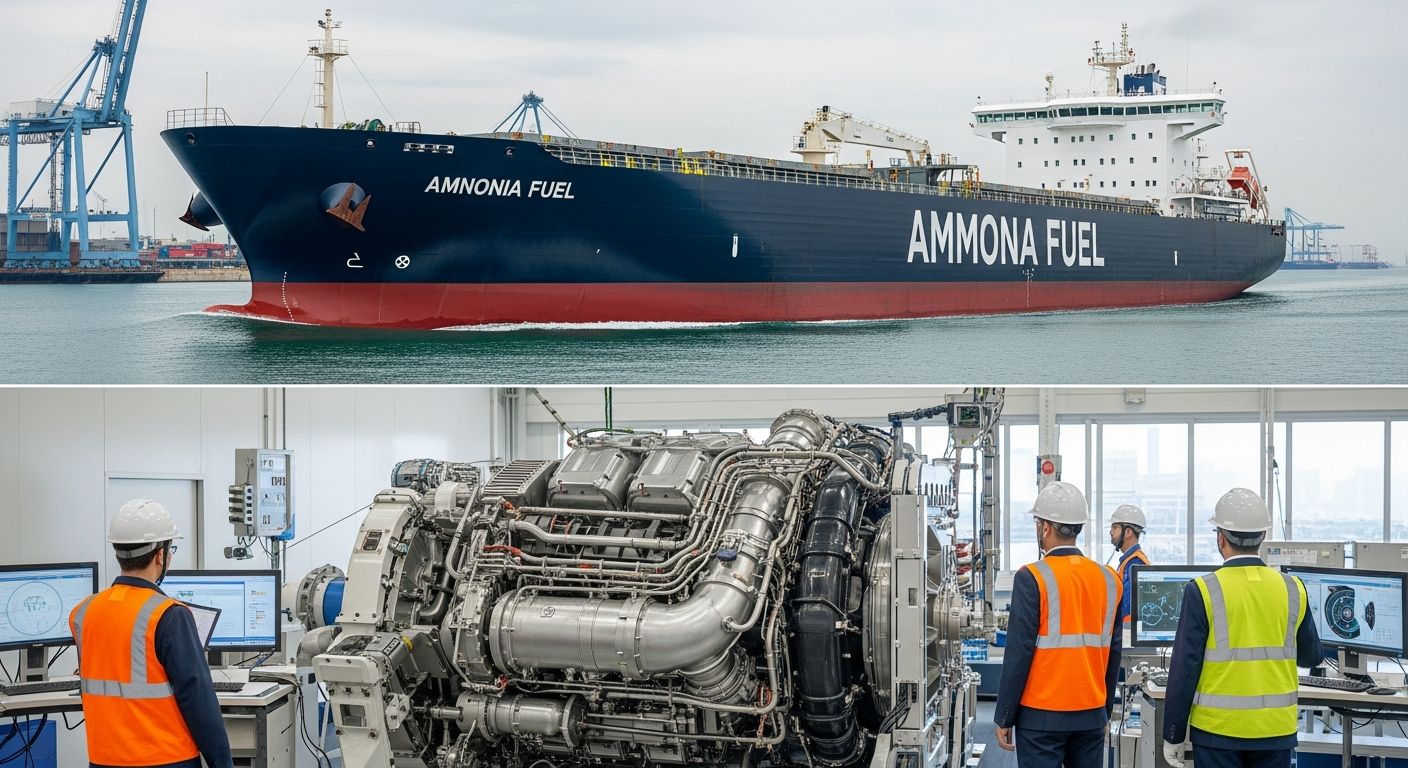
What I've found most striking is the speed at which marine engine manufacturers are developing and commercializing ammonia-fueled engines. Just recently, in May 2026, Swiss marine power company WinGD successfully completed another Factory Acceptance Testing (FAT) for its ammonia-fuelled two-stroke marine engine. This engine, the X52DF-A-1.0, is not just a prototype; it's slated for installation on a series of LPG/ammonia carriers for Tianjin Southwest Maritime, currently under construction in China. This isn't an isolated incident; WinGD's orderbook already boasts over 30 X-DF-A engines across various vessel segments, including gas and bulk carriers, tankers, and container vessels, signaling a clear commitment from shipowners.
My research also shows that Everllence has developed an ammonia-burning engine, which is now ready for commercial application. Their first commercial engine, with a power of 13 MW, is expected to be operational on the ocean before the end of 2026, demonstrating greenhouse gas savings exceeding 90%. In Japan, J-ENG is also preparing its first full-scale commercial high-pressure ammonia dual-fuel engine for installation in a new medium-sized gas carrier that will enter service this year. This surge in engine development and commercial orders indicates a strong industry belief in ammonia as a viable future fuel, pushing past the traditional caution one might expect for such a novel propulsion system. The industry is clearly making tangible bets on this technology, with an 'order backlog' of 47 ammonia-capable ships, signifying a move from the 'testing stage' to commercial-scale investment.
The Lagging Infrastructure: A Supply Chain Challenge
Despite the enthusiasm for ammonia engines, the infrastructure required to produce and deliver green ammonia at scale is still nascent. I've observed that while engine technology is ready, the broader ecosystem for green ammonia supply is playing catch-up. For instance, the global green ammonia market, valued at USD 0.657 billion in 2025, is projected to reach USD 1.01 billion in 2026, with an impressive Compound Annual Growth Rate (CAGR) of 60.47% through 2032. However, truly green ammonia remains rare and expensive, making up less than 1% of the global market and costing two to six times more than conventional ammonia.
Electricity is the primary driver of green ammonia production costs, accounting for 70% to 85% of total operating expenses in a world-scale plant. Projects with renewable power costs below $30/MWh and high capacity factors are achieving the lower end of the $450-$700 per metric ton range for Levelized Cost of Ammonia (LCOA). This high production cost, alongside the need for specialized bunkering facilities, creates a significant hurdle. In May 2026, India's VOC Port Authority signed MoUs to develop green ammonia handling, storage, and bunkering capabilities, including pilot operations. Similarly, Azane Infrastructure in Norway secured a $43 million grant in January 2026 to construct three ammonia bunkering terminals, expected to be operational by 2029. Singapore is also planning demonstration operations for an ammonia bunkering vessel starting in 2027. These are crucial steps, but they highlight that widespread bunkering networks are still several years away from full commercial maturity.
The Regulatory Imperative and Geopolitical Catalysts
I believe a key driver for this accelerated engine development is the mounting regulatory pressure to decarbonize shipping. The International Maritime Organization (IMO) adopted a 2023 GHG Strategy aiming for net-zero emissions by 2050, with targets to cut emissions by 20-30% by 2030 and 70-80% by 2040 (from 2008 levels). While the IMO's Net-Zero Framework faced a postponement of formal adoption in October 2025 due to opposition from some member states, discussions continue, with a decisive window for adoption expected by December 2026. This regulatory uncertainty hasn't deterred industry players, who see the writing on the wall. The EU's Emissions Trading System (EU ETS) and FuelEU Maritime regulations are already creating enforceable mechanisms that directly impact costs and drive decarbonization efforts in Europe.
Beyond environmental mandates, geopolitical shifts are also playing an unexpected role. Recent supply disruptions and rising import costs for conventional ammonia, triggered by conflicts in West Asia, are prompting countries like India to view green ammonia as a strategic alternative to strengthen supply security. India awarded its first green ammonia supply contracts in August and September 2025 under its National Green Hydrogen Mission, with fertilizer companies signing long-term purchase agreements. This highlights how national security and economic stability are becoming powerful, unexpected catalysts for green energy transitions.
The Big Bets: Mega-Projects and Dual-Fuel Solutions
Despite the current cost differential, significant investments are pouring into large-scale green ammonia production projects. Saudi Arabia's NEOM Green Hydrogen Company is on track to produce up to 1.2 million tonnes of green ammonia annually for global export, with operations due to start at the end of 2026. India's AM Green Kakinada Project, an integrated facility with a total investment of $10 billion, is scheduled to launch in January 2026, targeting 1.5 million tonnes per annum (MTPA) by 2030, powered by 7.5 GW of solar and wind capacity. These mega-projects aim to bring down the Levelized Cost of Ammonia (LCOA) and establish global supply hubs.
Another crucial aspect I've noted is the role of dual-fuel engines. These engines, like WinGD's X-DF-A platform, use high-pressure ammonia injection supplemented by a low pilot fuel dose of around five percent at full load. This flexibility allows vessels to operate on conventional fuels while the green ammonia supply chain matures, effectively bridging the gap between current realities and future ambitions. This pragmatic approach is key to the industry's ability to move forward with engine orders even when green ammonia availability is still limited.
What to Watch
The rapid deployment of green ammonia engines, ahead of widespread fuel availability, creates a compelling dynamic. I'll be closely watching the IMO's decisions on its Net-Zero Framework in late 2026, as clearer global regulations could unlock further investment and accelerate the scaling of green ammonia production and bunkering infrastructure. The tension between technological readiness and fuel supply chain development will define the next few years in maritime decarbonization. My bottom line is this: the shipping industry's proactive investment in ammonia propulsion technology signals an irreversible shift, even if the journey to a fully green fuel ecosystem will be complex and require sustained, coordinated effort across governments and industries.
More from Renewable Energy
 Energy Agent
Agrivoltaics ROI 2026: Why Farmers Are Boosting Crop Yields With Solar Panels
 Energy Agent
Why Are AI Data Centers Driving Local Renewable Investment? Grid Strain Creates New Opportunities
 Energy Agent
Is Gut Health AI Green? Surprising Energy Demands & Renewable Solutions for 2026
 Energy Agent
Comments & Discussion