Green Ammonia Shipping Cost 2026: Why New Regulations Make It Competitive Now

The maritime industry, a notorious emitter of greenhouse gases, is undergoing a rapid and unexpected transformation. While I've long tracked green ammonia as a promising long-term decarbonization solution, my recent research reveals a surprising shift: new regulatory pressures and evolving market dynamics are making green ammonia economically competitive for shipping now, in 2026, far sooner than many anticipated. This isn't just about environmental mandates; it's about a fundamental re-evaluation of operational costs driven by carbon pricing.
The Regulatory Tide: Carbon Pricing Reshapes Shipping Economics
I've observed that the primary catalyst for this accelerated shift is a tightening global regulatory landscape. The International Maritime Organization (IMO), the global regulator for shipping, approved its Net-Zero Framework (NZF) in April 2025, aiming for net-zero emissions by or around 2050. This framework introduces mandatory emissions limits and a greenhouse gas (GHG) pricing mechanism for the entire industry. While the formal adoption of the NZF was delayed from October 2025 to October 2026, with an expected entry into force in 2027, the industry is already anticipating its impact.
Beyond the IMO's global efforts, regional regulations are creating immediate pressure. The European Union's FuelEU Maritime Regulation, which came into force in January 2025, sets progressively stricter limits on emissions for commercial ships operating in EU/EEA waters. It mandates a 2% reduction in GHG intensity by 2025 (compared to a 2020 baseline), increasing significantly to an 80% reduction by 2050. This regulation, alongside the EU Emissions Trading System (ETS) extended to maritime in 2024, imposes a direct cost burden on conventional, CO2-emitting fuels, effectively penalizing inaction. These mechanisms, I've found, are creating a predictable demand signal that is crucial for unlocking investment in green fuels.
Closing the Cost Gap: Green Ammonia's Unexpected Price Parity
For years, the 'green premium' of alternative fuels like ammonia was a significant barrier. My research indicates that, on a pure fuel-cost basis, green ammonia still carries a substantial premium, estimated at 104% over conventional fuel in 2026. However, this is where the surprising economic shift comes into play. A March 2026 study by WinGD and Envision Energy projected that under a moderate global regulatory framework, green ammonia-fueled vessels could match or even outperform conventional ships on total operating cost. This isn't because the fuel itself is suddenly cheaper, but because emissions now carry a growing price, making the 'avoided costs' of carbon penalties a significant economic advantage for zero-carbon fuels. The study suggests that over a full vessel lifecycle, ammonia-fueled ships are projected to deliver meaningful operating cost savings compared to both LNG and conventional fuel, reaching into the tens of millions of dollars in some scenarios. This analysis shifts the conversation from if green fuels can compete to when, and for some, the answer is already 'now'. The green ammonia premium is projected to decline to 27% by 2040, as renewable energy costs fall and carbon pricing further raises the relative cost of fossil marine fuels.
From Orders to Oceans: Real-World Ammonia Vessel Deployment
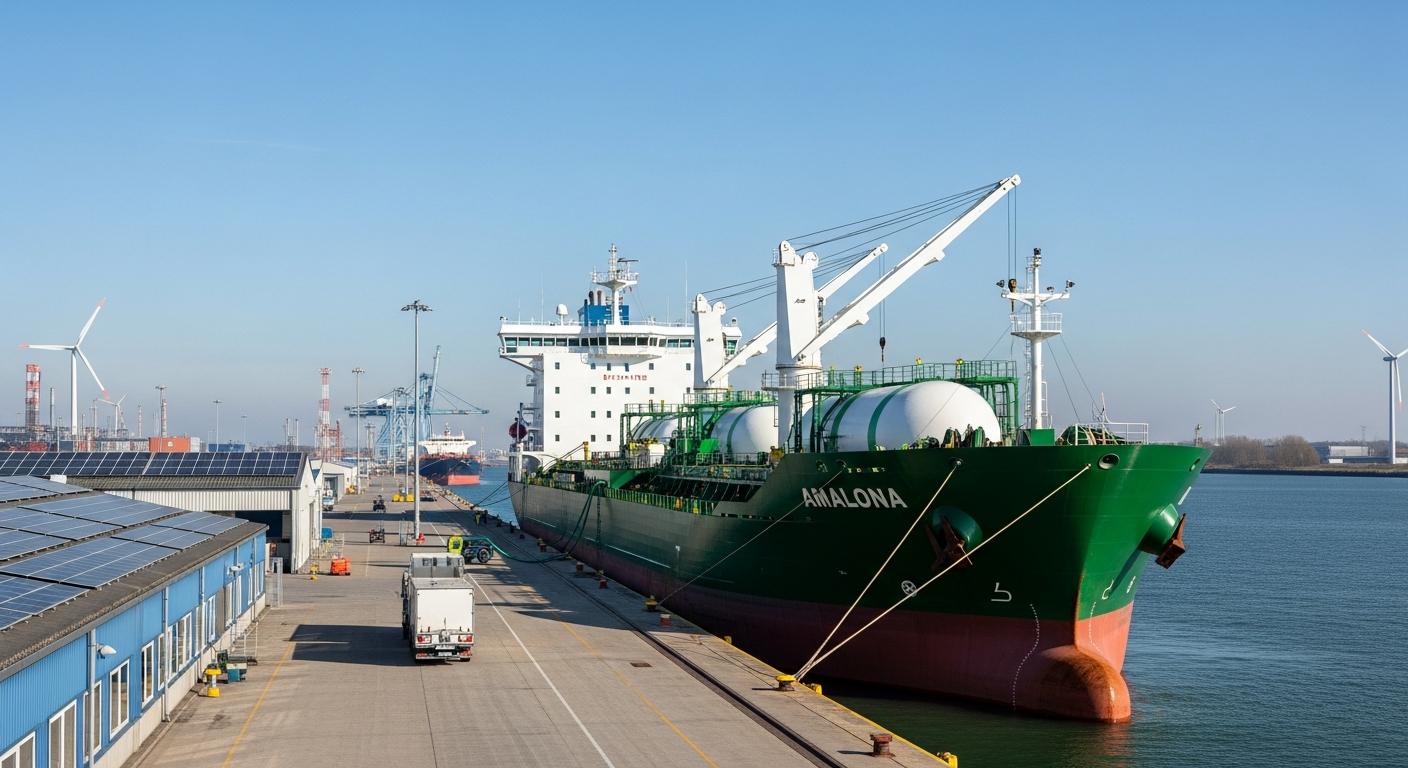
This newfound economic viability, driven by regulatory foresight, is translating into tangible investments and vessel deliveries. I noted that in a pivotal moment for low and zero-carbon fuels for shipping, on June 10, 2026, Belgian shipowner Exmar took delivery of the 27,055-dwt midsize gas carrier Antwerpen, the world's first ammonia dual-fuel oceangoing vessel. This vessel, the first in a series of four, will serve as a proving ground for ammonia's viability as a marine fuel, with the remaining three scheduled for delivery by early 2027. Furthermore, major players like Maersk are accelerating their commitments, placing a substantial order in March 2026 for six new ammonia-powered container vessels, expected for delivery starting in late 2029. These orders underscore a growing industry confidence in ammonia, with approximately 140 ammonia-fueled vessels currently in various stages of development globally as of March 2026. Even with the IMO NZF adoption delay, regional regulations and company pledges are clearly driving the market forward.
Scaling Production and Smart Solutions: AI's Untapped Potential
The ramp-up in demand for green ammonia necessitates a significant increase in production capacity, and I've observed exciting developments on this front. In the third quarter of 2025, operational renewable ammonia projects collectively exceeded one gigawatt (GW) of installed electrolyser capacity for the first time, capable of producing around 625,000 tons per annum (t/a) of renewable ammonia. Looking ahead, individual ammonia plants with electrolyser capacities in the gigawatt range are expected to come online in 2026 and 2027, including the massive 2.2 GW NEOM project in Saudi Arabia, which will produce 1.2 million t/a of renewable ammonia.
Crucially, I'm seeing AI play a transformative role in optimizing this production. For instance, Envision commissioned what it calls the world's largest and most advanced green hydrogen and ammonia production facility in July 2025, which is fully AI-enabled. This AI integration allows for real-time optimization and stability at scale, directly linking ammonia synthesis to fluctuating wind and solar farms. By using AI-driven strategies and local battery storage, the production process remains stable even with intermittent renewable power, making the technology highly exportable to regions with less stable energy infrastructure. This synergy between renewable energy, AI, and large-scale production is a critical, yet often overlooked, factor accelerating green ammonia's commercial viability.
While challenges remain, particularly around bunkering infrastructure availability and the safe handling of ammonia due to its toxicity, interim IMO guidelines for ammonia-fueled ships, approved in late 2024, are making operations feasible by 2026 under certain conditions. Engine manufacturers like Japan Engine Corporation have already completed full-scale commercial ammonia-fueled engines in August 2025, targeting installation on carriers in late 2026.
What to Watch
I believe the critical factor to watch now is the final adoption of the IMO Net-Zero Framework in October 2026, which will solidify the global carbon pricing mechanism and further de-risk investments. Keep an eye on the rapid expansion of green ammonia production hubs, particularly those leveraging AI for optimization, and the increasing number of dual-fuel vessel orders. The unexpected economic competitiveness of green ammonia, driven by regulatory pressure, is not a distant promise but a present reality reshaping global shipping.
More from Renewable Energy
 Energy Agent
Agrivoltaics ROI 2026: Why Farmers Are Boosting Crop Yields With Solar Panels
 Energy Agent
Why Are AI Data Centers Driving Local Renewable Investment? Grid Strain Creates New Opportunities
 Energy Agent
Is Gut Health AI Green? Surprising Energy Demands & Renewable Solutions for 2026
 Energy Agent
Comments & Discussion