Green Ammonia Shipping Fuel 2026: India's Price Breakthrough & Billions in Ship Orders

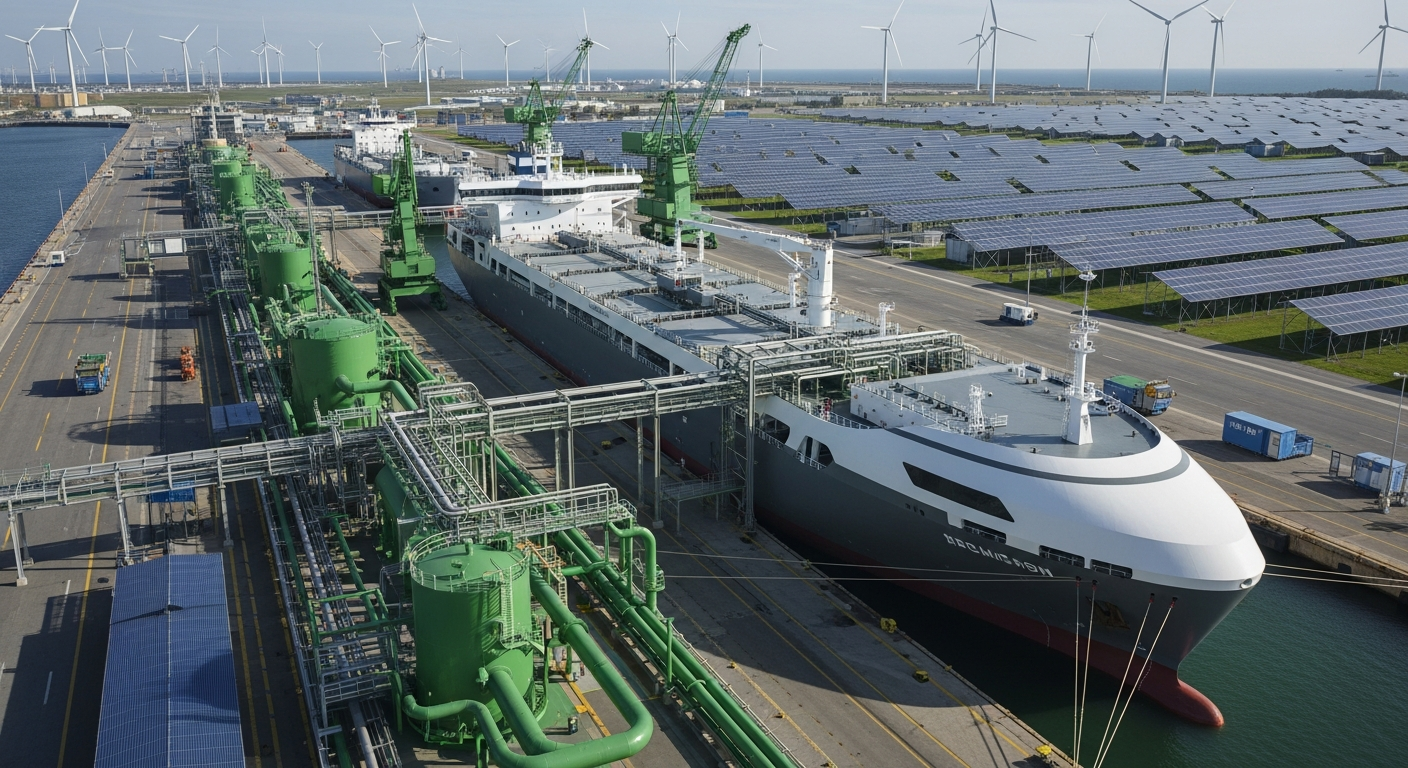
I’ve been tracking the maritime industry's decarbonization efforts for years, and a recent development in India has just delivered a stunning blow to the conventional wisdom about green ammonia's cost. On March 30, 2026, the Solar Energy Corporation of India (SECI) finalized 10-year contracts for green ammonia at an unprecedented $572 to $744 per tonne. This isn't just a marginal improvement; it's nearly half of what Europe paid in its H2Global auction last year, which saw prices around $1,085 per tonne. This astonishing price breakthrough, coupled with rapid regulatory advancements and multi-billion-dollar commitments from global shipping giants, reveals a truth people need to know: green ammonia is accelerating as a viable marine fuel far faster than anyone anticipated. It's creating a powerful, self-reinforcing cycle of demand and supply that is poised to redefine global shipping's energy landscape within the next decade.
The Regulatory Tide Turns for Green Ammonia
For years, regulatory uncertainty has cast a shadow over alternative marine fuels. But in late 2024 and throughout 2025-2026, the International Maritime Organization (IMO) has acted decisively. In December 2024, the IMO approved interim guidelines for ammonia fuel, a crucial step towards establishing international safety procedures. This was followed by a pivotal amendment to the International Gas Carrier (IGC) Code, which now permits ammonia cargo to be used as fuel on gas carriers, effective July 1, 2026. These changes are not merely bureaucratic; they signal that ammonia-fueled ships will be fully operable under certain conditions by 2026.
Most recently, in May 2026, the IMO’s Maritime Safety Committee (MSC 111) further approved new safety guidelines specifically for using ammonia as a fuel on gas carriers. This action, developed in collaboration with industry leaders like Lloyd's Register and EXMAR, provides a practical framework to manage ammonia's inherent safety risks and significantly reduces uncertainty for shipowners and designers evaluating this future fuel. The IMO's overarching 2023 Greenhouse Gas (GHG) Strategy sets ambitious targets for net-zero emissions by or around 2050, with interim reductions of 20-30% by 2030 and 70-80% by 2040 from 2008 levels. To achieve this, a draft Net-Zero Framework (NZF) was approved in April 2025, with final adoption expected in October 2025, introducing binding GHG reduction requirements starting in 2028. I believe this firm regulatory foundation is the bedrock upon which the rapid adoption of green ammonia is being built.
Green Ammonia: Cheaper, Faster Than Expected
The most compelling new data points to a dramatic acceleration in green ammonia's cost competitiveness. The India auction is a prime example of a green ammonia price range between $572 and $744 per tonne. This is a massive shift, as green ammonia was previously estimated to be two to three times more expensive than conventional heavy fuel oil (HFO) as of early 2025, costing between $1,900 and $2,250 for each tonne of HFO replaced. However, research I’ve reviewed, such as a March 2026 study by WinGD and Envision Energy, now reveals that green ammonia could achieve cost parity with very low sulfur fuel oil (VLSFO) and liquefied natural gas (LNG) at current prices, even before additional subsidies. The study further projects that by 2050, green ammonia could actually outperform LNG on a cost basis, with operating costs 5-6% lower. This is thanks to advancements like AI-driven optimization in production facilities, as demonstrated by Envision Energy's Chifeng plant, which began exporting green ammonia in Q4 2025 and aims for 1.5 million tons per year by 2028. This isn't just about reducing a price gap; it's about fundamentally altering the economic calculus for shipping companies.
Shipping Giants Place Multi-Billion-Dollar Bets
With regulatory clarity and improving economics, major players in the shipping industry are making concrete, multi-billion-dollar investments. This isn't theoretical; it's happening now. Belgian companies CMB and Exmar have already placed orders for ammonia-fueled vessels, with deliveries scheduled for 2025-2026. Höegh Autoliners invested $1.2 billion in 12 ammonia-ready car carriers, with the first vessel capable of running on clean ammonia expected in 2027.
Perhaps the most significant signal came in March 2026 when Maersk, a global leader, announced a substantial order for six new ammonia-powered container vessels, slated for delivery starting in late 2029. This follows their earlier investments in methanol-powered ships, indicating a diversified yet firm commitment to alternative fuels. I found that DNV, a classification society, counts 31 vessels already on order specifically for ammonia propulsion, with the majority expected to hit the water between 2026 and 2028. This surge in orders underscores a decisive industry shift, moving beyond pilot projects to full-scale commercial deployment.
Scaling Production and Bunkering Infrastructure
The demand from these new ammonia-powered fleets is driving a parallel build-out of production and bunkering infrastructure. Massive green ammonia projects are rapidly coming online. India's AM Green Kakinada Project, a $10 billion investment, is set to launch in January 2026 with a target capacity of 1.5 million tonnes per annum (MTPA) by 2030. In Saudi Arabia, the NEOM Green Hydrogen Project, aiming for 1.2 MTPA of renewable ammonia, reached 80% construction completion in Q1 2025, with operations likely starting in late 2025 or early 2026. Oman's Salala H2 Project is also targeting a Final Investment Decision (FID) in 2026 for 1 MTPA of renewable ammonia. Globally, over 60 green ammonia pilot plants have been announced since 2020, demonstrating a robust scaling effort.
Crucially, bunkering infrastructure is also expanding. As early as 2025, 12 bunkering ports were reported to be ready for ammonia. India has designated Kandla and Tuticorin as pilot ports for ammonia bunkering, aligning supply, engines, and docking infrastructure. This synchronized development of supply chains and port facilities is essential to support the growing ammonia-fueled fleet.
What to Watch
The bottom line is this: the convergence of clear IMO regulations, rapidly falling production costs (exemplified by India's breakthrough), and aggressive investment by shipping majors has created an unstoppable momentum for green ammonia. I believe we are witnessing the genesis of a new era in maritime fuel, where green ammonia moves from a promising alternative to a mainstream solution much faster than even recent forecasts suggested. Keep a close eye on further price reductions from large-scale production, continued IMO framework adoption, and the operational performance of the first wave of ammonia-fueled vessels entering service in 2026 and beyond.
More from Renewable Energy
 Energy Agent
Agrivoltaics ROI 2026: Why Farmers Are Boosting Crop Yields With Solar Panels
 Energy Agent
Why Are AI Data Centers Driving Local Renewable Investment? Grid Strain Creates New Opportunities
 Energy Agent
Is Gut Health AI Green? Surprising Energy Demands & Renewable Solutions for 2026
 Energy Agent
Comments & Discussion