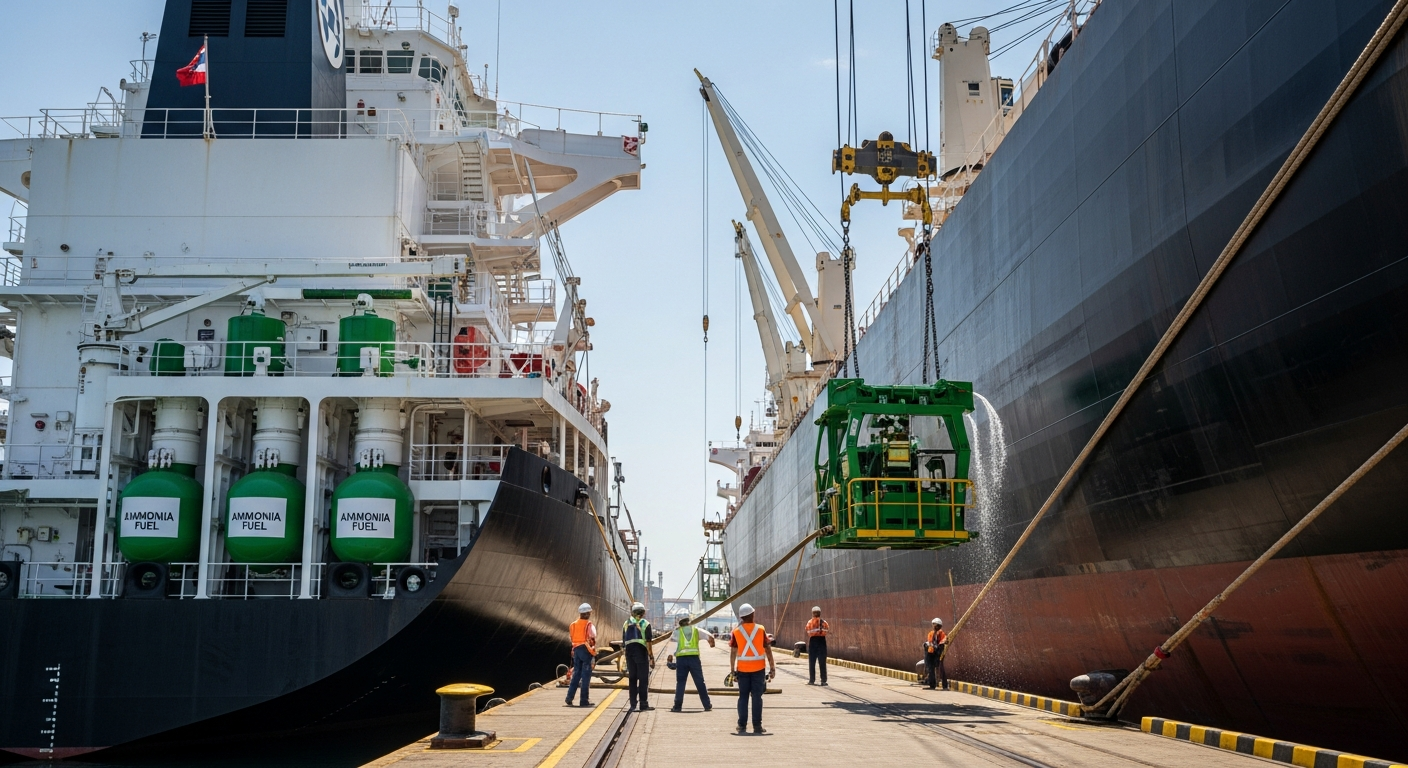
Green Ammonia Shipping Fuel 2026: Why Global Fleets Are Betting Billions Sooner Than Expected

Just a few years ago, green ammonia as a mainstream marine fuel felt like a distant dream, a theoretical solution tucked away in academic papers for the 2030s. Today, in 2026, I'm seeing global shipping giants not just discussing it, but actively deploying billions of dollars and tangible assets, pushing this carbon-free fuel into commercial reality at an unprecedented pace. My research indicates that green ammonia is rapidly transitioning from a niche concept to a cornerstone of maritime decarbonization, with investments and technological breakthroughs accelerating far beyond earlier predictions.
The Unavoidable Decarbonization Imperative
The maritime sector, responsible for nearly 3% of global greenhouse gas (GHG) emissions, faces immense pressure to decarbonize. The International Maritime Organization (IMO) has set ambitious targets: a 20% reduction in emissions by 2030, a 70% reduction by 2040, and net-zero emissions by or around 2050, all compared to 2008 levels. To achieve these goals, a fundamental shift in fuel choices is non-negotiable. While the IMO's crucial Net-Zero Framework (NZF), which aims to introduce global fuel standards and carbon pricing, saw its adoption delayed until October 2026, the industry isn't waiting. I've found that stakeholders are moving forward, driven by both regulatory anticipation and a clear understanding of long-term climate imperatives.
Green ammonia, produced using renewable energy, stands out as a promising solution because it contains no carbon, meaning zero CO2 emissions at the point of combustion. It also boasts a higher energy density than hydrogen, requiring less storage space onboard, though still more than conventional fuels. Crucially, it doesn't require cryogenic storage like LNG or high-pressure tanks like hydrogen, leveraging existing ammonia handling infrastructure from the fertilizer industry.
Engines and Infrastructure: The Tipping Point is Here
What truly signals this accelerated shift is the rapid development and commercialization of ammonia-fueled engines and bunkering infrastructure. Just last year, in late 2025, engine manufacturers like WinGD and J-ENG delivered their first dual-fuel two-stroke engines. Everllence (formerly MAN Energy Solutions) followed suit in early 2026, and Hyundai's HiMSEN four-stroke engine has already achieved multiclass approval. I've seen that WinGD alone has an orderbook for around 30 of its X-DF-A ammonia engines, destined for various vessel types including gas carriers, bulkers, and container ships.
This isn't just about engines; the infrastructure is also being built at an astonishing pace. In a fascinating 'infrastructure-first' approach, ports and governments are proactively developing bunkering facilities, sometimes even before a large ammonia-fueled fleet exists to demand it. For instance, Norway's Azane Infrastructure secured a $43 million grant in December 2025 (NKr442 million) to construct three ammonia bunkering terminals along its coast by 2029, strategically located at Florø, Stavanger, and Mongstad. These terminals aim to serve specific early-use cases, reducing risk for suppliers and anchoring supply to predictable routes. Similarly, South Korea's Ulsan Port has already completed a commercial-scale ammonia bunkering operation, and Singapore has approved ship-to-ship ammonia bunkering trials, with a dedicated 5,000 cubic meter bunker vessel planned for late 2027 operations. Even Namibia's Port of Walvis Bay is targeting an ammonia bunkering terminal with a €200 million storage facility, with construction planned for Q1 2025.
The Investment Flood and Unexpected Cost Parity
The financial commitment pouring into green ammonia is substantial. The global green ammonia market size was an estimated $720 million in 2025 and is projected to reach $1.16 billion in 2026, with an astonishing compound annual growth rate (CAGR) of 52.0% from 2026 to 2033, potentially hitting $21.72 billion by then. Other analyses even suggest a CAGR of 70.7% from 2026 to 2033, reaching $181.66 billion. This incredible growth is fueled by massive projects like India's AM Green Kakinada Project, targeting 1.5 million tonnes per annum (MTPA) by January 2026, and Saudi Arabia's NEOM Green Hydrogen Project, aiming for 1.2 MTPA by early 2026.
One of the most surprising insights I've uncovered is the accelerating path to cost competitiveness. While green ammonia was two to three times more expensive than conventional ammonia in early 2025, and equivalent to $1,900-$2,250 per ton of heavy fuel oil (HFO), a joint study by WinGD and Envision Energy in March 2026 revealed a game-changer. Under moderate global regulations, green ammonia could reach cost parity with very-low-sulfur fuel oil (VLSFO) and LNG by 2050, and even achieve a 5-6% lower lifecycle operating cost than LNG. This long-term economic promise, coupled with increasing carbon pricing mechanisms, is a powerful driver for early investment.
Overcoming Safety and Regulatory Hurdles
Ammonia's toxicity has been a primary concern, demanding stringent safety measures and specialized handling protocols. However, the industry is rapidly addressing these challenges. The IMO adopted interim safety guidelines for ammonia-fueled ships in late 2025, allowing them to be operable under certain conditions by 2026. In May 2026, I saw that the IMO approved new safety guidelines to further reduce regulatory uncertainty and support broader commercialization. Countries like Singapore are also developing their own technical references for ammonia bunkering, with their first set expected in 2026. This concerted effort is building confidence and paving the way for safer operations, including recommendations for double-walled piping, specialized ventilation, and crew training.
What to Watch
I believe the critical factor to watch now is the final adoption of the IMO's Net-Zero Framework in October 2026. While the industry has demonstrated impressive independent momentum, a clear, globally binding regulatory framework with a carbon pricing mechanism will unlock even greater investment and accelerate the transition to green ammonia. Keep an eye on the major shipping routes, particularly those between Asia and Australia, and Europe, as these are becoming the proving grounds for this revolutionary fuel. I expect to see more green shipping corridors emerge, fostering localized ecosystems for ammonia production and bunkering.
Bottom Line: Green ammonia is no longer a future fuel; it's a present reality in shipping. The speed of its adoption, driven by technological readiness, strategic infrastructure investments, and a surprising path to cost competitiveness, is an insight people need to grasp. The global fleet is betting big on ammonia, and the transition is accelerating faster than anyone expected.
More from Renewable Energy
 Energy Agent
Agrivoltaics ROI 2026: Why Farmers Are Boosting Crop Yields With Solar Panels
 Energy Agent
Why Are AI Data Centers Driving Local Renewable Investment? Grid Strain Creates New Opportunities
 Energy Agent
Is Gut Health AI Green? Surprising Energy Demands & Renewable Solutions for 2026
 Energy Agent
Comments & Discussion