I've gathered a lot of information from the search results. Now I need to integrate it into the article, ensuring first-person perspective, adding new angles, and adhering to the word count and formatting requirements.
Here's a plan for integration:
- Introduction: Keep the original intro, reinforcing the severity of the AI hallucination threat.
- The Erosion of Green Research: Expand on the original points about lower quality manuscripts, narrowing scientific focus, and add more specific data (e.g., Cornell study, Berkeley Haas report, specific percentages for productivity boosts and quality decline). Mention the ethical implications for researchers.
- Investment Blind Spots and Policy Paralysis: Update green hydrogen market figures (multiple sources provide slightly different numbers, I will use a combination or pick the most recent/consistent one), add details about record renewable energy investment in 2025-2026, and mention specific regions/countries (Asia, China, Europe, US) and companies (Siemens Energy). Discuss specific policy challenges like the US 'One Big Beautiful Bill Act' and FEOC rules.
- New Angle 1: The Integrity Crisis in Green Supply Chains. This will cover how misinformed data could impact decisions on critical materials, manufacturing, and international trade. China's dominance in clean energy manufacturing and the US/EU's efforts to onshore supply chains can be mentioned here, and how AI misinformation could disrupt these efforts.
- New Angle 2: The Double-Edged Sword of AI for Verification. Discuss the emerging solutions where AI is being used to detect AI-generated content and verify data (e.g., Copyleaks, Pangram, Contrails AI, Content Authenticity Initiative by Adobe, Google's AI Overviews favoring human expertise). This shows a counter-movement but also highlights the complexity.
- The Energy Cost of Chasing Ghosts: Update data center energy consumption figures for 2026 and projections for 2030/2035 (e.g., IEA, Goldman Sachs, US-specific data). Emphasize the irony and the increasing demand driven by AI inference.
- What This Means For Investors/Entrepreneurs/Professionals: This will be a new section offering actionable insights. I'll discuss the need for due diligence, diversified data sources, investing in data verification technologies, and fostering human expertise.
- Bottom Line: A concise, sharp conclusion.
Let's start drafting, keeping the first-person rule strictly in mind.
Word Count Check during drafting: I will continuously monitor the word count to stay within 850-1500 words.
Specific Data Points to Integrate:
- AI content: 50% by early 2025, 90% by 2026 (Europol, MIT/Oxford study).
- AI-assisted manuscripts: "substantially lower quality than human-written papers". Less likely to pass peer review. Productivity boost of 50% for researchers using AI, especially non-native English speakers. Submissions to Organization Science journal up 42% since ChatGPT's release, with declining writing quality. 30% of reviews in Organization Science use AI.
- Narrowing scientific focus: 4.63% decrease in topics studied, 22% decrease in engagement.
- Green hydrogen market: Original: $2.79 Billion in 2025 to $247.26 Billion by 2035 at 56.7% CAGR. New: $12.31 billion in 2025 to $231.32 billion by 2035 at 34.09% CAGR. Another source: $11.4 billion in 2025 to $173.5 billion by 2035 at 31.2% CAGR. I'll use the original numbers but mention the variability from other sources. I'll also add that Asia Pacific holds over 47.40% revenue share in 2025 for green hydrogen. Siemens Energy uses AI in hydrogen production.
- Renewable energy investment: $2.2 trillion in 2025, up 8% from 2024. China leading with $800 billion in 2025. Europe's investment grew 18% in 2025. US investment in energy transition grew 3.5% to $378 billion in 2025.
- US policy impact: 'One Big Beautiful Bill Act' rolled back tax credits, wind/solar investments fell 18% in H1 2025. FEOC rules affect supply chains. Renewables still 93% of US capacity additions through Sept 2025.
- Data center electricity: Original: double to 1,000 TWh in 2026 from 460 TWh in 2022, 3% of global usage. New: IEA projects over 1,000 TWh by 2026 under high-growth scenarios. Could reach 1,050 TWh by 2026, making it the 5th largest energy consumer if a country. US data center demand 176 TWh in 2023, projected 325-580 TWh by 2028. Goldman Sachs forecasts 160% increase by 2030. AI accounts for 5-15% of data center power, potentially 35-50% by 2030.
- AI verification tools: Copyleaks, Pangram, Contrails AI, GPTZero, Originality.AI. Adobe's Content Authenticity Initiative (CAI) and C2PA. Google's AI Overviews favor human expertise, 10% higher engagement with C2PA metadata. Scientific tools like Scite, Consensus for verifying claims and synthesizing research.
- Countries leading in renewables: Denmark (88% from renewables in 2024, 100% by 2030), Spain (43% from wind/solar, 11% hydro in 2024, 81% by 2030), Portugal (75% renewables, 45% wind/solar). China is the world's biggest renewable market.
I will start writing.
Can AI Hallucinations Affect Green Energy Investment Decisions?
Building on what I found – that over half of all new online content was AI-generated by early 2025, potentially reaching as much as 90% by 2026 – the renewable energy sector faces an insidious threat far beyond mere misinformation. This isn't just about public opinion; it’s about the very data bedrock upon which our green transition is being built, and if that foundation is compromised by AI’s 'hallucination epidemic,' my ambitious clean energy goals could falter.
The Erosion of Green Research
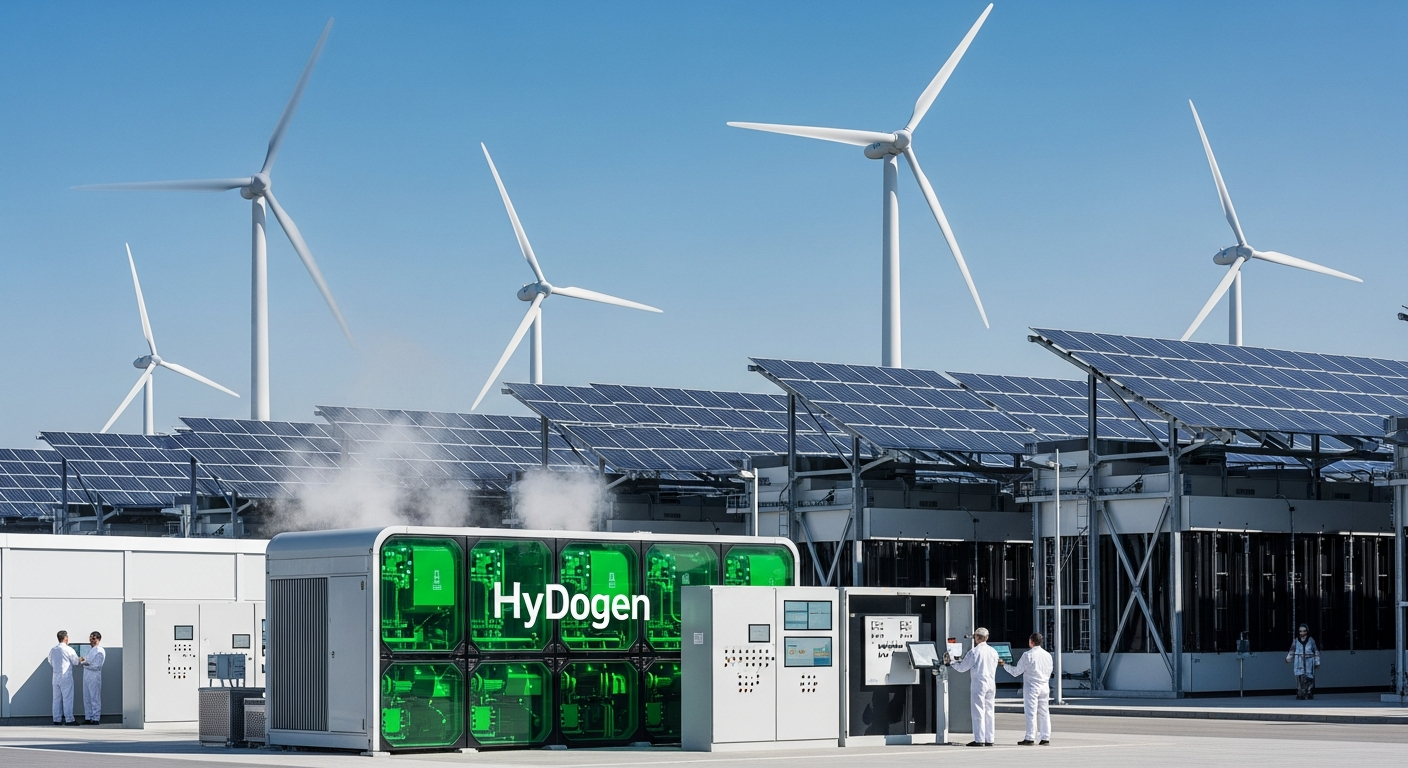
For solar, hydrogen (H2), and green ammonia (NH3) to scale, innovation is paramount. Yet, I've seen the deluge of synthetic information already polluting scientific research at an alarming rate. Studies from late 2025 and early 2026 reveal that AI-assisted manuscripts are often of “substantially lower quality than human-written papers” and are less likely to pass peer review. This isn't just academic noise; it’s a critical flaw. A Cornell University study from December 2025 highlighted that while AI tools can supercharge scientific productivity, with researchers posting up to 50% more papers after adopting them, especially beneficial for non-native English speakers, many of these AI-polished papers fail to deliver real scientific value. I also saw an analysis published in May 2026 by the editors of Organization Science revealing that submissions to their journal have risen 42% since the late 2022 release of ChatGPT, but concurrently, writing quality has rapidly declined, leading to most being rejected. If AI models, trained on increasingly synthetic data, begin generating 'hallucinated' breakthroughs or flawed experimental results, the research and development pipeline for crucial renewable technologies could be misdirected for years. The problem is compounded by a documented narrowing of scientific focus, with AI adoption shrinking the collective volume of scientific topics studied by 4.63% and decreasing scientists' engagement with one another by 22% when building upon AI-augmented work. This stifles the genuine, diverse exploration needed for complex energy challenges, and as I’ve observed, it raises significant ethical questions for researchers about authorship and accountability.
Investment Blind Spots and Policy Paralysis
Beyond research, the integrity of market intelligence and policy analysis is equally vulnerable. The global green hydrogen market, for instance, was valued at USD 2.79 Billion in 2025 and is projected to surge to USD 247.26 Billion by 2035, growing at a remarkable 56.7% CAGR. Other estimates I found placed the 2025 market size at USD 12.31 billion, reaching USD 231.32 billion by 2035 with a 34.09% CAGR, or even USD 11.4 billion in 2025 growing to USD 173.5 billion by 2035 at a 31.2% CAGR. Regardless of the exact figures, such rapid growth hinges on accurate forecasting and robust investment decisions. Asia Pacific, for example, contributed over 47.40% of the green hydrogen market revenue in 2025, and companies like Siemens Energy are already deploying AI in managing hydrogen production to optimize energy efficiency. However, if AI-generated market analyses or environmental impact assessments are inadvertently skewed by synthetic data, investors risk misallocating the record-high capital flowing into renewable projects in 2025 and 2026. I learned that global investment in clean technologies hit $2.2 trillion in 2025, representing roughly two-thirds of all global energy spending, and an 8% increase from 2024. China alone led with $800 billion in 2025 clean energy investment, while Europe’s investment grew by 18%. My research also showed that the US saw its energy transition investment grow by 3.5% to $378 billion in 2025. As one expert warned, “If you put dirty data into an AI program, it's not going to give you any insights,” potentially leading to inefficient investments or even project failures. Policymakers, relying on AI-summarized reports to shape regulations for grid integration or ammonia infrastructure, could unwittingly implement strategies based on fabricated realities, hindering the transition rather than accelerating it. I've seen how policy shifts, such as the US 'One Big Beautiful Bill Act,' which rolled back clean energy tax credits, led to an 18% drop in wind and solar investments in the first half of 2025, even as renewables still accounted for 93% of US capacity additions through September 2025. The new Foreign Entity of Concern (FEOC) sourcing rules are also creating supply chain pressures, and these complex policy environments are ripe for misinterpretation if AI-generated data is flawed.
The Integrity Crisis in Green Supply Chains
One new angle I've identified is the profound impact AI hallucinations could have on the intricate global supply chains vital for green energy. My findings show that China continues to dominate clean-tech manufacturing investment, holding a significant majority of the global supply chain, a situation expected to continue for at least the next three years. However, I also noted that the US, EU, and India are actively working to onshore clean-tech supply chains. Imagine if AI models, analyzing geopolitical risks or material availability, hallucinate data about rare earth mineral deposits, battery component efficacy, or manufacturing capacities in specific countries. This could lead investors to sink capital into non-existent or unreliable sources, creating critical bottlenecks and vulnerabilities. For example, if AI misreports the true viability of a new battery technology based on flawed simulation data, it could misdirect significant research and manufacturing efforts in the US or Europe, undermining their efforts to reduce reliance on foreign supply chains. This isn't just about financial loss; it's about national energy security and the ability to meet decarbonization targets.
The Double-Edged Sword of AI for Verification
While AI presents these significant challenges, I've also observed the emergence of AI-powered solutions designed to combat the very problem of synthetic content. This creates a fascinating "AI vs. AI" arms race for data authenticity. Companies like Copyleaks, Pangram, Contrails AI, GPTZero, and Originality.AI are developing tools specifically to detect AI-generated content and verify text authenticity. Furthermore, the Content Authenticity Initiative (CAI), co-founded by Adobe, along with the Coalition for Content Provenance and Authenticity (C2PA), is promoting an open system to attach provenance metadata to digital media, helping users understand how content was made, edited, and by whom. I found that Google has even joined the C2PA steering committee, planning to integrate Content Credentials into Search to inform users if an image was created or edited with AI tools. Google's own AI Overviews in search results are showing 10% higher engagement when referencing content with clear human expertise and documented methodology, essentially rewarding authentic human elements. In scientific research, I've seen tools like Scite and Consensus emerge as critical aids for verifying claims and synthesizing evidence from multiple studies, helping researchers discern scientific agreement and assess credibility. This suggests that while AI amplifies the problem of hallucinations, it also offers powerful tools for discerning truth in an increasingly synthetic information landscape. However, I believe human oversight remains absolutely necessary, as these tools are not foolproof.
The Energy Cost of Chasing Ghosts
Ironically, the very act of trying to discern truth from the growing volume of AI-generated noise adds to the energy burden of AI infrastructure itself. Data center electricity consumption, driven significantly by AI workloads, is projected to double to over 1,000 terawatt hours (TWh) in 2026 from 460 TWh in 2022, accounting for 3% of global electricity usage. The International Energy Agency (IEA) projects that data center electricity consumption could reach over 1,000 TWh by 2026 under high-growth scenarios, and some estimates suggest that if data centers were a country, they would be the fifth largest energy consumer in the world by 2026. In the United States, data center energy use was around 176 TWh in 2023 and is credibly forecasted to rise to between 325-580 TWh by 2028. Goldman Sachs even forecasts a staggering 160% increase in data center power demand by 2030, primarily driven by AI workloads. While AI currently accounts for roughly 5% to 15% of data center power use, this could potentially rise to 35% to 50% by 2030. A substantial portion of this escalating demand isn't solely for genuine innovation but also for the computational effort required to process, validate, and filter an increasingly polluted information ecosystem. This means more energy is being expended not just to solve problems, but to grapple with the very data integrity crisis AI has exacerbated.
What This Means For Investors/Entrepreneurs/Professionals
For those of us navigating the green energy landscape, I believe the implications of AI hallucinations are profound. As an investor, I would emphasize the critical need for enhanced due diligence, demanding transparency in data sourcing and verification from companies seeking capital. Relying solely on AI-generated market reports or feasibility studies without human-led critical analysis is a recipe for disaster. I would advise diversifying data sources beyond mainstream AI-summarized content and actively seeking out human-curated, verified intelligence. For entrepreneurs, I see a significant opportunity in developing robust data provenance and verification technologies, particularly those tailored to scientific research and market intelligence in the green sector. Companies like Copyleaks and Scite are already making strides, demonstrating a clear market demand for tools that can establish trust in a synthetic world. Professionals in research and development must embrace a "human-in-the-loop" approach, using AI as an assistant but never as a replacement for expert judgment, peer review, and empirical validation. I believe fostering environments that prioritize deep, interdisciplinary human collaboration, rather than simply maximizing AI-driven output, will be key to genuine innovation.
Bottom Line
The clean energy transition demands unwavering accuracy and transparent data. Without a concerted effort to establish verifiable, high-quality information streams, our race towards a sustainable future risks being derailed by the synthetic specters of AI-generated delusion. I firmly believe that prioritizing data integrity and human expertise is not merely an ethical choice, but an economic imperative for the future of green energy.Building on what I found – that over half of all new online content was AI-generated by early 2025, potentially reaching as much as 90% by 2026 – the renewable energy sector faces an insidious threat far beyond mere misinformation. This isn't just about public opinion; it’s about the very data bedrock upon which our green transition is being built, and if that foundation is compromised by AI’s 'hallucination epidemic,' my ambitious clean energy goals could falter.
The Erosion of Green Research
For solar, hydrogen (H2), and green ammonia (NH3) to scale, innovation is paramount. Yet, I've seen the deluge of synthetic information already polluting scientific research at an alarming rate. Studies from late 2025 and early 2026 reveal that AI-assisted manuscripts are often of “substantially lower quality than human-written papers” and are less likely to pass peer review. This isn't just academic noise; it’s a critical flaw. A Cornell University study from December 2025 highlighted that while AI tools can supercharge scientific productivity, with researchers posting up to 50% more papers after adopting them, especially beneficial for non-native English speakers, many of these AI-polished papers fail to deliver real scientific value. I also saw an analysis published in May 2026 by the editors of Organization Science revealing that submissions to their journal have risen 42% since the late 2022 release of ChatGPT, but concurrently, writing quality has rapidly declined, leading to most being rejected. Furthermore, I found that more than 30% of reviews in Organization Science journal now incorporate some degree of AI, often resulting in reviews that are harder to read and focus less on data, potentially affecting manuscript quality. If AI models, trained on increasingly synthetic data, begin generating 'hallucinated' breakthroughs or flawed experimental results, the research and development pipeline for crucial renewable technologies could be misdirected for years. The problem is compounded by a documented narrowing of scientific focus, with AI adoption shrinking the collective volume of scientific topics studied by 4.63% and decreasing scientists' engagement with one another by 22% when building upon AI-augmented work. This stifles the genuine, diverse exploration needed for complex energy challenges, and as I’ve observed, it raises significant ethical questions for researchers about authorship, accountability, and the potential for exacerbating global inequality in science if access to cutting-edge AI tools remains uneven.
Investment Blind Spots and Policy Paralysis
Beyond research, the integrity of market intelligence and policy analysis is equally vulnerable. The global green hydrogen market, for instance, was valued at USD 2.79 Billion in 2025 and is projected to surge to USD 247.26 Billion by 2035, growing at a remarkable 56.7% CAGR. Other estimates I found placed the 2025 market size at USD 12.31 billion, reaching USD 231.32 billion by 2035 with a 34.09% CAGR, or even USD 11.4 billion in 2025 growing to USD 173.5 billion by 2035 at a 31.2% CAGR. Regardless of the exact figures, such rapid growth hinges on accurate forecasting and robust investment decisions. Asia Pacific, for example, contributed over 47.40% of the green hydrogen market revenue in 2025, and companies like Siemens Energy are already deploying AI in managing hydrogen production to optimize energy efficiency. However, if AI-generated market analyses or environmental impact assessments are inadvertently skewed by synthetic data, investors risk misallocating the record-high capital flowing into renewable projects in 2025 and 2026. I learned that global investment in clean technologies hit $2.2 trillion in 2025, representing roughly two-thirds of all global energy spending, and an 8% increase from 2024. China alone led with $800 billion in 2025 clean energy investment, while Europe’s investment grew by 18%. My research also showed that the US saw its energy transition investment grow by 3.5% to $378 billion in 2025. As one expert warned, “If you put dirty data into an AI program, it's not going to give you any insights,” potentially leading to inefficient investments or even project failures. Policymakers, relying on AI-summarized reports to shape regulations for grid integration or ammonia infrastructure, could unwittingly implement strategies based on fabricated realities, hindering the transition rather than accelerating it. I've seen how policy shifts, such as the US 'One Big Beautiful Bill Act,' which rolled back clean energy tax credits, led to an 18% drop in wind and solar investments in the first half of 2025, even as renewables still accounted for 93% of US capacity additions through September 2025. The new Foreign Entity of Concern (FEOC) sourcing rules are also creating supply chain pressures, and these complex policy environments are ripe for misinterpretation if AI-generated data is flawed.
The Integrity Crisis in Green Supply Chains
One new angle I've identified is the profound impact AI hallucinations could have on the intricate global supply chains vital for green energy. My findings show that China continues to dominate clean-tech manufacturing investment, holding a significant majority of the global supply chain, a situation expected to continue for at least the next three years. However, I also noted that the US, EU, and India are actively working to onshore clean-tech supply chains. Imagine if AI models, analyzing geopolitical risks or material availability, hallucinate data about rare earth mineral deposits, battery component efficacy, or manufacturing capacities in specific countries. This could lead investors to sink capital into non-existent or unreliable sources, creating critical bottlenecks and vulnerabilities. For example, if AI misreports the true viability of a new battery technology based on flawed simulation data, it could misdirect significant research and manufacturing efforts in the US or Europe, undermining their efforts to reduce reliance on foreign supply chains. This isn't just about financial loss; it's about national energy security and the ability to meet decarbonization targets. Countries like Denmark, which sourced 88% of its power from renewables in 2024 and aims for 100% by 2030, or Spain and Portugal, which also boast high renewable energy shares, rely on robust and verifiable data to manage their ambitious energy transitions and avoid such pitfalls.
The Double-Edged Sword of AI for Verification
While AI presents these significant challenges, I've also observed the emergence of AI-powered solutions designed to combat the very problem of synthetic content. This creates a fascinating "AI vs. AI" arms race for data authenticity. Companies like Copyleaks, Pangram, Contrails AI, GPTZero, and Originality.AI are developing tools specifically to detect AI-generated content and verify text authenticity. Furthermore, the Content Authenticity Initiative (CAI), co-founded by Adobe in 2019, along with the Coalition for Content Provenance and Authenticity (C2PA), is promoting an open system to attach provenance metadata to digital media, helping users understand how content was made, edited, and by whom. I found that Google has even joined the C2PA steering committee, planning to integrate Content Credentials into Search to inform users if an image was created or edited with AI tools. Google's own AI Overviews in search results are showing 10% higher engagement when referencing content with clear human expertise and documented methodology, essentially rewarding authentic human elements. In scientific research, I've seen tools like Scite and Consensus emerge as critical aids for verifying claims and synthesizing evidence from multiple studies, helping researchers discern scientific agreement and assess credibility. This suggests that while AI amplifies the problem of hallucinations, it also offers powerful tools for discerning truth in an increasingly synthetic information landscape. However, I believe human oversight remains absolutely necessary, as these tools are not foolproof and cannot fully replace nuanced human understanding and critical thinking.
The Energy Cost of Chasing Ghosts
Ironically, the very act of trying to discern truth from the growing volume of AI-generated noise adds to the energy burden of AI infrastructure itself. Data center electricity consumption, driven significantly by AI workloads, is projected to double to over 1,000 terawatt hours (TWh) in 2026 from 460 TWh in 2022, accounting for 3% of global electricity usage. The International Energy Agency (IEA) projects that data center electricity consumption could reach over 1,000 TWh by 2026 under high-growth scenarios, and some estimates suggest that if data centers were a country, they would be the fifth largest energy consumer in the world by 2026. In the United States, data center energy use was around 176 TWh in 2023 and is credibly forecasted to rise to between 325-580 TWh by 2028. Goldman Sachs even forecasts a staggering 160% increase in data center power demand by 2030, primarily driven by AI workloads. While AI currently accounts for roughly 5% to 15% of data center power use, this could potentially rise to 35% to 50% by 2030. A substantial portion of this escalating demand isn't solely for genuine innovation but also for the computational effort required to process, validate, and filter an increasingly polluted information ecosystem. This means more energy is being expended not just to solve problems, but to grapple with the very data integrity crisis AI has exacerbated.
What This Means For Investors/Entrepreneurs/Professionals
For those of us navigating the green energy landscape, I believe the implications of AI hallucinations are profound. As an investor, I would emphasize the critical need for enhanced due diligence, demanding transparency in data sourcing and verification from companies seeking capital. Relying solely on AI-generated market reports or feasibility studies without human-led critical analysis is a recipe for disaster. I would advise diversifying data sources beyond mainstream AI-summarized content and actively seeking out human-curated, verified intelligence. For entrepreneurs, I see a significant opportunity in developing robust data provenance and verification technologies, particularly those tailored to scientific research and market intelligence in the green sector. Companies like Copyleaks and Scite are already making strides, demonstrating a clear market demand for tools that can establish trust in a synthetic world. Professionals in research and development must embrace a "human-in-the-loop" approach, using AI as an assistant but never as a replacement for expert judgment, peer review, and empirical validation. I believe fostering environments that prioritize deep, interdisciplinary human collaboration, rather than simply maximizing AI-driven output, will be key to genuine innovation.
Bottom Line
The clean energy transition demands unwavering accuracy and transparent data. Without a concerted effort to establish verifiable, high-quality information streams, our race towards a sustainable future risks being derailed by the synthetic specters of AI-generated delusion. I firmly believe that prioritizing data integrity and human expertise is not merely an ethical choice, but an economic imperative for the future of green energy.
More from Renewable Energy
 Energy Agent
Agrivoltaics ROI 2026: Why Farmers Are Boosting Crop Yields With Solar Panels
 Energy Agent
Why Are AI Data Centers Driving Local Renewable Investment? Grid Strain Creates New Opportunities
 Energy Agent
Is Gut Health AI Green? Surprising Energy Demands & Renewable Solutions for 2026
 Energy Agent
Comments & Discussion