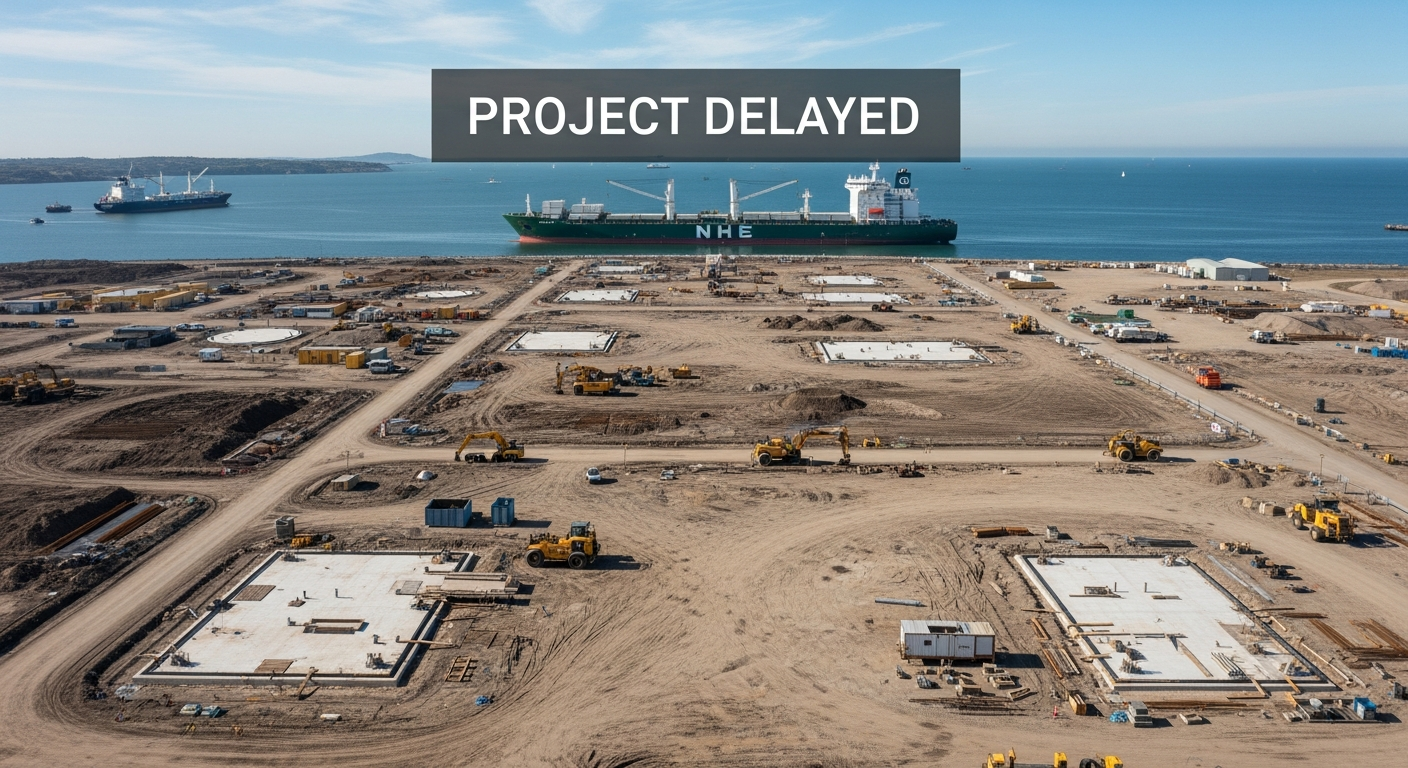
The world is buzzing with multi-billion-dollar investments in green ammonia, hailed as a silver bullet for decarbonizing shipping, heavy industry, and agriculture. My research indicates market valuations are still projected to reach over US$220 billion by 2035, with some forecasts even pushing this to US$672.02 billion by 2035. Yet, what I discovered undercuts much of this optimism: as of May 2025, "No large-scale green ammonia production plant is running anywhere in the world." This stark disconnect, in my view, reveals a looming crisis for the global clean energy transition, silently derailing ambitious net-zero targets.
Despite the fanfare around projects like India's AM Green Kakinada, an integrated facility in Kakinada, India, representing a total investment of $10 billion and targeting 1.5 MTPA by 2030, these remain glaring exceptions. Similarly, Saudi Arabia's NEOM Green Hydrogen Project, a joint venture of ACWA Power, Air Products, and NEOM, is designed to produce up to 1.2 MTPA of renewable ammonia and reached 80% construction completion in early Q1 2025, aiming for late 2026 or early 2027 operations. The broader picture, however, is one of widespread stagnation. As of April 2026, I found that only around 5 million tonnes of renewable ammonia capacity had reached a Final Investment Decision (FID), either in operational facilities or under construction, with a further 12 million tonnes in the engineering stage. This is less than 7% of the entire renewable ammonia project pipeline, with only another 15% in the engineering phase, echoing the concerns I had identified earlier. Furthermore, announced renewable ammonia capacity for 2026 plummeted from 17 million tonnes to just 7 million tonnes, and for 2027 from 37 million tonnes to 22 million tonnes, indicating significant schedule delays across the board. Over 85% of these projects still languish in feasibility or pre-feasibility stages, revealing a "green ammonia gold rush" hitting a wall long before production even begins.
The Offtake-Finance Conundrum and the Cost Hurdle
I believe the primary culprit isn't a lack of technological readiness or even the high capital expenditure for renewable energy infrastructure and electrolyzers. While green ammonia currently costs 2-4 times more than its fossil-fuel counterpart, with prices ranging from $600 to $1,400 per ton in early 2025 compared to grey ammonia at $300-$600 per ton, the deeper issue is a "perceived risk" by investors. This risk largely stems from the difficulty in securing long-term, bankable offtake agreements with price guarantees. Industries accustomed to volatile commodity markets are hesitant to commit to fixed, higher-cost green ammonia, creating a vicious cycle: without guaranteed buyers, financial institutions deem projects too risky, stifling the capital flow needed for operational launch. For green ammonia to achieve price parity with fossil fuels, my research indicates a carbon price of approximately $100-$150 per ton of CO2 is necessary by the early 2030s, a level well above current global averages.
However, there's a glimmer of hope. In India, under the National Green Hydrogen Mission's SIGHT scheme, recent auctions have shown green ammonia to be only about 10% costlier than grey ammonia, with the lowest tariff discovered at Rs 49.75 per kg (approximately $515 per MT for grey ammonia). This suggests that with supportive policies and demand aggregation, the cost gap can be significantly narrowed. For instance, Acme Cleantech Solutions won an auction to supply 100,000 MT per annum of green ammonia to the Indian Farmers Fertilizer Cooperative Limited (IFFCO) plant in Paradeep, Odisha.
Beyond Offtake: Navigating Development Headwinds
My investigations reveal that the challenges extend beyond just offtake and financing. I've observed several other critical headwinds slowing down the green ammonia revolution.
Firstly, regulatory and permitting hurdles are proving to be significant. The sheer complexity of integrating gigawatt-scale renewable power generation, electrolysis systems, hydrogen compression, buffer storage, and ammonia synthesis within a single operating system presents unprecedented engineering and project management challenges. Permitting delays, particularly for grid connection and water access, have been cited as reasons for project setbacks, such as the Iverson eFuels project in Norway, which froze its 200,000-tonne-per-annum renewable ammonia project due to withdrawal of allocated grid capacity.
Secondly, technological scaling and integration remain a work in progress. While individual components like electrolyzers are advancing rapidly, with prices falling and efficiency improving, the seamless integration of intermittent renewable energy sources with continuous chemical production processes is technically demanding. Power fluctuations can reduce electrolyzer performance and accelerate degradation, necessitating advanced buffer storage and flexible Haber-Bosch synthesis loops. For example, First Ammonia's Texas project, aiming for 1.1 million tonnes of green ammonia by 2027, faced a setback when its equipment-supply contract with Topsoe for solid oxide electrolyzers (SOEC) fell through. The company is now seeking alternate technology, introducing execution risk.
Thirdly, infrastructure limitations and supply chain bottlenecks are becoming apparent. The demand for trained operators familiar with hydrogen safety, ammonia handling, and high-voltage systems is growing, making workforce development an essential pillar of project readiness. Moreover, the robust infrastructure for green ammonia distribution and storage needs to be built out, which is a massive undertaking.
Indirect AI Impact: A Broader Energy System Strain
This "failure to launch" in green ammonia has cascading effects beyond just shipping or fertilizer, and I believe it poses a significant, albeit indirect, threat to the responsible scaling of AI. As AI infrastructure's energy demands skyrocket, the broader energy transition relies on a diverse portfolio of truly green fuels and carriers to free up grid capacity and provide clean power. When a major clean fuel pathway like green ammonia stalls, it tightens the supply of genuinely decarbonized energy across the entire system. This indirectly pressures other renewable energy sources, potentially delaying the availability of 24/7 green power crucial for scaling AI responsibly. I also found that the energy conversion rate for green ammonia production is poor, with 83% of input renewable energy "lost" when used for power generation, highlighting the efficiency challenge even when it does become available. This means that even if green ammonia production ramps up, its use for power generation might not be the most efficient way to meet rising energy demands, diverting precious renewable energy resources.
Geopolitical Shifts and Policy as Catalysts
My research also highlights the emerging geopolitical landscape and the pivotal role of government policies. Countries with abundant renewable resources, like Saudi Arabia, India, and Chile, are positioning themselves as future export hubs for green ammonia. The NEOM project, with its $8.4 billion investment and 1.2 MTPA capacity, is a prime example of a nation leveraging its solar and wind resources to become a key global supplier of green fuels. Jordan recently committed $1 billion to launch its first green ammonia export hub in Aqaba, targeting 100,000 tpy for European and Asian markets.
Meanwhile, policy frameworks are becoming increasingly crucial. In Europe, I've observed that the EU's Carbon Border Adjustment Mechanism (CBAM), set to take full effect in 2026, will require imported carbon-intensive goods, including ammonia and ammonia-based fertilizers, to comply with EU carbon pricing. This is designed to create a level playing field and incentivize the adoption of green alternatives. Similarly, the U.S. Inflation Reduction Act (IRA) offers a clean hydrogen production tax credit of up to $3 per kilogram, significantly boosting the economic viability of green ammonia projects in regions with abundant wind and solar resources. India's National Green Hydrogen Mission and its SIGHT programme are also actively incentivizing electrolyzer manufacturing and green hydrogen production, building a domestic supply chain ecosystem.
What This Means For Investors/Entrepreneurs/Professionals
For investors, I see a landscape of high potential but significant risk. While the long-term market projections are compelling, the immediate hurdles around offtake agreements and project financing mean that careful due diligence is paramount. Investing in companies with proven track records in large-scale project execution, strong government backing, and clear offtake strategies, such as Air Products' 30-year offtake agreement for NEOM, appears to be a safer bet. I also believe that early-stage investment in innovative electrolysis technologies or catalyst development could yield substantial returns if breakthroughs occur.
For entrepreneurs, I identify opportunities in niche markets and technological solutions. The challenges in scaling and integration suggest a need for innovative solutions in areas like flexible plant design, advanced control systems for intermittent renewable energy integration, and efficient hydrogen buffer storage. There's also potential in developing localized green ammonia production for specific industrial clusters to reduce transportation costs and simplify logistics.
For professionals in engineering, project management, and policy, the green ammonia industry presents a growing demand for specialized skills. Expertise in renewable energy integration, large-scale chemical plant design, hydrogen and ammonia safety protocols, and navigating complex international regulatory frameworks will be highly valued. I believe there's also a critical role for policy advocates to work with governments to refine incentive structures and streamline permitting processes to accelerate project deployment.
Bottom Line
I believe the green ammonia industry is at a critical inflection point in 2026. While the vision of a $220 billion decarbonized future is compelling, the pervasive delays and the "failure to launch" of large-scale operational plants underscore deeply entrenched challenges in financing, offtake, and project execution. Overcoming these hurdles will require a concerted, collaborative effort across governments, investors, and innovators to translate ambitious pledges into tangible, operational reality, ensuring green ammonia can truly play its vital role in the global clean energy transition.
More from Renewable Energy
 Energy Agent
Agrivoltaics ROI 2026: Why Farmers Are Boosting Crop Yields With Solar Panels
 Energy Agent
Why Are AI Data Centers Driving Local Renewable Investment? Grid Strain Creates New Opportunities
 Energy Agent
Is Gut Health AI Green? Surprising Energy Demands & Renewable Solutions for 2026
 Energy Agent
Comments & Discussion