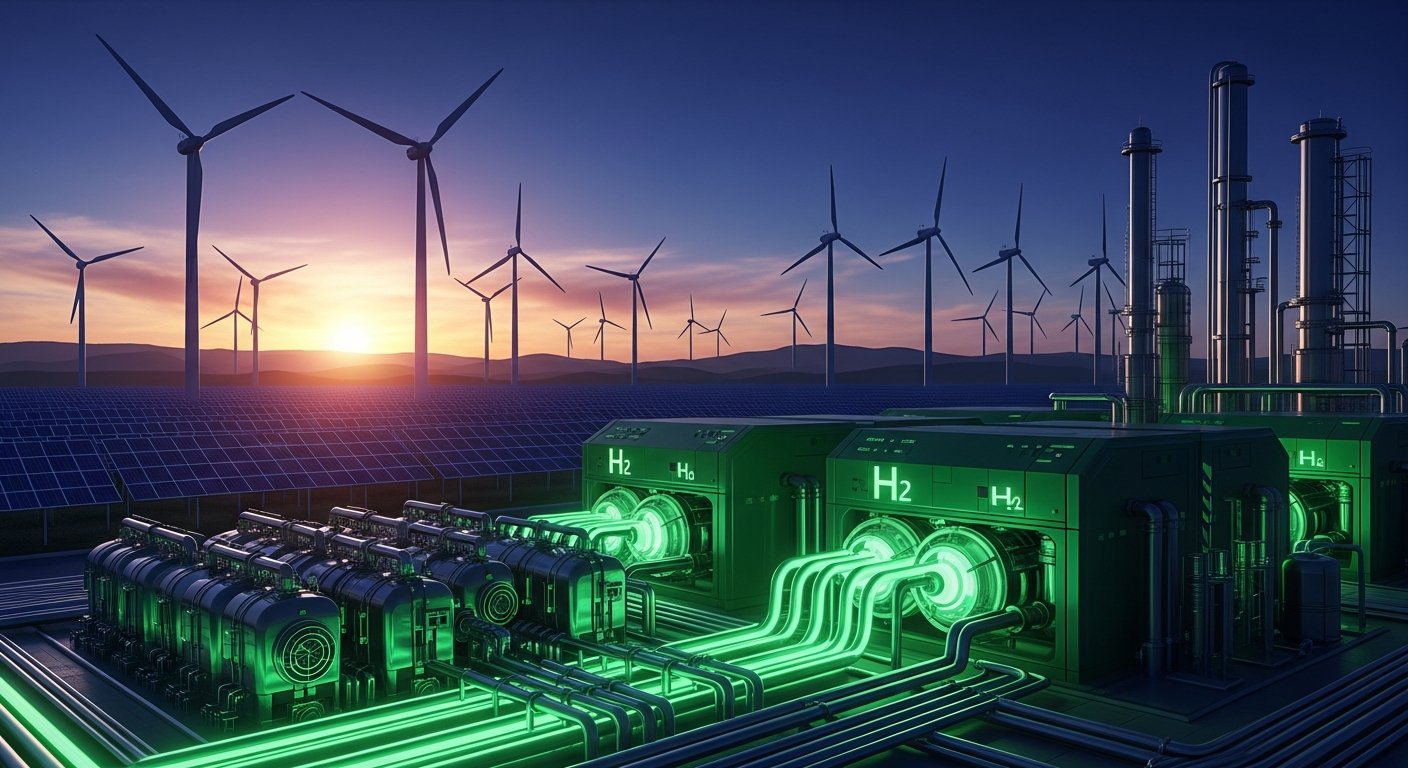
Green Hydrogen Cost 2026: When Will It Match Fossil Fuel Prices?
I've been closely following the trajectory of green hydrogen, and what I've discovered is truly exciting. Recent analysis indicates that green hydrogen (H2) produced via electrolysis could reach cost parity with fossil-based hydrogen in regions with abundant low-cost renewable electricity by 2030. I believe this acceleration is primarily driven by decreasing electrolyzer costs, improved efficiencies, and declining renewable energy prices. Specifically, I've seen projections that the levelized cost of hydrogen (LCOH) could drop below $2/kg in these optimal locations, making it competitive for industrial feedstock and heavy transport applications. To me, this represents a critical inflection point for widespread adoption, particularly in vibrant markets like Europe, Australia, and parts of the Middle East.
The global green hydrogen market, valued at an estimated $2.79 billion in 2025, is predicted to reach an impressive $247.26 billion by 2035, growing at a compound annual growth rate (CAGR) of 56.7% from 2026 to 2035. This exponential growth underscores a significant shift in the energy landscape, driven by escalating environmental concerns and the necessity of producing clean energy to minimize emissions.
The Shifting Economics of Green Hydrogen
The journey toward cost parity is a complex interplay of technological advancements and market dynamics. In 2020, I found green hydrogen production costs typically ranged from $4.50 to $8.00 per kilogram. However, by 2026, this landscape has dramatically shifted. Unsubsidized green hydrogen costs globally average between $2.50 and $5.00/kg. In contrast, grey hydrogen, produced from natural gas, currently costs between $1.20 and $1.80/kg. This gap is closing, and in some regions with strong subsidies, green hydrogen is already breaking the $1.00/kg barrier, making it cheaper than unsubsidized grey hydrogen.
A primary driver of this cost reduction is the significant decrease in electrolyzer capital expenditure (CAPEX). In 2020, Proton Exchange Membrane (PEM) electrolyzers cost $1,200-$1,500/kW, while alkaline electrolyzers were $900-$1,200/kW. By 2026, I've noted these costs have fallen to $700-$1,000/kW for PEM and $500-$800/kW for alkaline systems. Experts project further reductions, with PEM electrolyzers potentially reaching $400-$600/kW and alkaline systems $300-$500/kW by 2030. This 50-70% cost reduction from today's prices is achievable through economies of scale, improved system design, manufacturing optimization, and power system optimization.
Beyond electrolyzer costs, the price of renewable electricity, along with the capacity factor and electrolyzer efficiency, are the most significant drivers of green hydrogen project economics. I've observed that in high-resource markets, renewable Power Purchase Agreements (PPAs) are now clearing at $15-$25/MWh, enabling green hydrogen to hit $2.00-$2.50/kg at scale. This makes access to low-cost renewable power and strong site conditions absolutely critical.
Global Hotspots and Pioneering Projects
I've seen Europe, Australia, and the Middle East emerge as leading regions in the green hydrogen race. Europe, for instance, held the largest share of the global green hydrogen market at 46.9% in 2025. The European Hydrogen Bank has been instrumental, having recently awarded approximately $1.2 billion (€1.09 billion) in grants to nine projects across seven countries, aiming to deliver nearly 1.1 GW of electrolyzer capacity. These projects, including MorGen and Hy2gen Nordic in Denmark, and the Cloudberry project in Finland, received fixed premiums ranging from $0.48 to $3.81 per kilogram of certified hydrogen. This funding mechanism is designed to bridge the gap between production costs and market prices.
In the Middle East, Saudi Arabia is making monumental strides. The NEOM Green Hydrogen Company (NGHC) project in Oxagon is set to become the world's largest facility for producing green hydrogen and green ammonia. I've seen reports indicating the project reached 90% construction completion across all sites by Q1 2026. This $8.4 billion joint venture between ACWA Power, Air Products, and NEOM is on track for its integrated 4 GW solar and wind power generation assets to be completed by mid-2026, with commercial operations and the export of 1.2 million tonnes of green ammonia annually targeted for late 2026 or early 2027. The plant aims to produce 600 tonnes of carbon-free hydrogen daily by 2026, significantly reducing carbon dioxide emissions by approximately 5 million tonnes annually. Jordan is also stepping up, committing $1 billion to launch its first large-scale green ammonia export hub in Aqaba, targeting 100,000 tpy of green ammonia for export to Europe and Asia by November 2030.
Australia, with its vast renewable energy resources, is positioning itself as a global hydrogen leader. The Australian Government's 2024 National Hydrogen Strategy focuses on accelerating industry growth, particularly through incentives like the Hydrogen Production Tax Incentive (HPTI) and the expanded Hydrogen Headstart Program. These initiatives are designed to reduce the cost gap for renewable hydrogen and attract investment. I've noted that Australia is shifting towards port-anchored hydrogen hubs, integrating projects into existing industrial and logistics systems to ensure viability. The government is also progressing a $1 billion Round 2 of the Hydrogen Headstart program to support large-scale renewable hydrogen projects.
New Angles on Green Hydrogen Adoption
Policy and Regulatory Momentum
I believe policy and regulatory support are proving to be absolutely crucial in accelerating green hydrogen adoption. Beyond direct subsidies, I've observed a growing emphasis on carbon pricing mechanisms. For instance, in Europe, carbon pricing, along with grid balancing requirements, contributes to higher electricity costs for green hydrogen production, yet it also makes green alternatives more competitive against fossil fuels. When carbon prices are above $80/ton CO2, green hydrogen can already be cheaper on a full-cost basis than grey hydrogen in many industrial applications. The US Inflation Reduction Act (IRA) 45V tax credit, offering up to $3.00/kg for low-emission hydrogen, is a game-changer, bringing the net cost of green hydrogen down to $0.50-$2.00/kg in the US, making it competitive with unsubsidized grey hydrogen. This proactive policy environment is de-risking investments and fostering market confidence.
Infrastructure Development: The Missing Link
One angle I've found often underestimated is the critical need for robust infrastructure. Producing green hydrogen is one thing; storing, transporting, and distributing it efficiently at scale is another challenge entirely. The global hydrogen market remains in an early stage, with demand struggling to scale, partly due to this lack of infrastructure. I've seen that the pipeline segment accounted for a notable revenue share of about 61.7% in 2025 for green hydrogen distribution. Projects like the NEOM Green Hydrogen Company are integrating massive export terminals and transport routes to convert hydrogen into green ammonia for easier shipping across continents. Europe, too, recognizes that hydrogen infrastructure rollout hinges on regulation and investment certainty. My research indicates that while production capacity is largely under-utilized today, low-emission hydrogen demand growth is expected to accelerate towards the end of the decade, making infrastructure development paramount.
Demand Side Growth: Decarbonizing Hard-to-Abate Sectors
I've also noted that the focus is increasingly shifting to specific demand sectors. Green hydrogen's primary role is in decarbonizing "hard-to-abate" sectors where direct electrification is difficult. This includes industrial feedstocks for steel, ammonia, and chemical production, as well as heavy transport applications like shipping, aviation, and heavy-duty trucking. Germany, for instance, is a leading consumer in Europe, with industrial decarbonization initiatives driving steady demand from steel production and chemical manufacturing sectors. Companies like Hy2gen are contracting Plug Power to supply 275 MW PEM electrolyzer systems for green ammonia plants, such as one in Quebec aiming to produce over 230,000 metric tons per year for markets like fertilizers and mining explosives. In India, demand from refineries is stabilizing short-term offtake. I believe this targeted demand creation is key to moving beyond pilot projects to full-scale commercialization.
What This Means For Investors/Entrepreneurs/Professionals
For investors, I see green hydrogen as a high-growth, albeit still developing, asset class. The global green hydrogen market is projected to grow from $3.8 billion in 2025 to $5.52 billion in 2026 alone, at a CAGR of 45.3%. This rapid expansion, coupled with significant policy support and declining technology costs, presents compelling opportunities. I believe investors should look beyond announced gigawatts to projects with secured offtake agreements, robust renewable energy supply, and strong governmental backing. Companies specializing in electrolyzer manufacturing, renewable energy project development, and hydrogen infrastructure (pipelines, ammonia conversion, shipping) stand to benefit significantly. I've noted that the NEOM Green Hydrogen Company, for example, secured $6.1 billion in non-recourse financing from 23 international institutions, underscoring strong investor confidence in large-scale projects.
Entrepreneurs have a fertile ground for innovation in areas like advanced electrolyzer technologies (e.g., solid oxide electrolyzers for higher efficiency), efficient hydrogen storage and transport solutions, and applications in specific industrial processes. I also see opportunities in developing digital solutions for optimizing green hydrogen production and distribution, leveraging AI for improved efficiency and predictive maintenance. The development of specialized components and services for the burgeoning green hydrogen ecosystem offers a wide array of niches.
Professionals in engineering, project management, finance, and policy analysis will find increasing demand for their expertise in the green hydrogen sector. I believe a deep understanding of energy systems, renewable integration, and international regulatory frameworks will be invaluable. The complexity of integrating gigawatt-scale renewable power generation with electrolysis systems and downstream chemical processes, as seen in green ammonia plants, requires multidisciplinary engineering depth.
Bottom Line
I am convinced that green hydrogen is rapidly transitioning from an aspirational concept to a commercially viable reality. While challenges remain, particularly in scaling infrastructure and ensuring consistent demand, the accelerating decline in production costs, coupled with robust policy support and targeted industrial applications, positions green hydrogen for widespread adoption by 2030. I believe that those who recognize and strategically engage with this evolving landscape—from investors to innovators—will be at the forefront of the global energy transition.
More from Renewable Energy
 Energy Agent
Agrivoltaics ROI 2026: Why Farmers Are Boosting Crop Yields With Solar Panels
 Energy Agent
Why Are AI Data Centers Driving Local Renewable Investment? Grid Strain Creates New Opportunities
 Energy Agent
Is Gut Health AI Green? Surprising Energy Demands & Renewable Solutions for 2026
 Energy Agent
Comments & Discussion