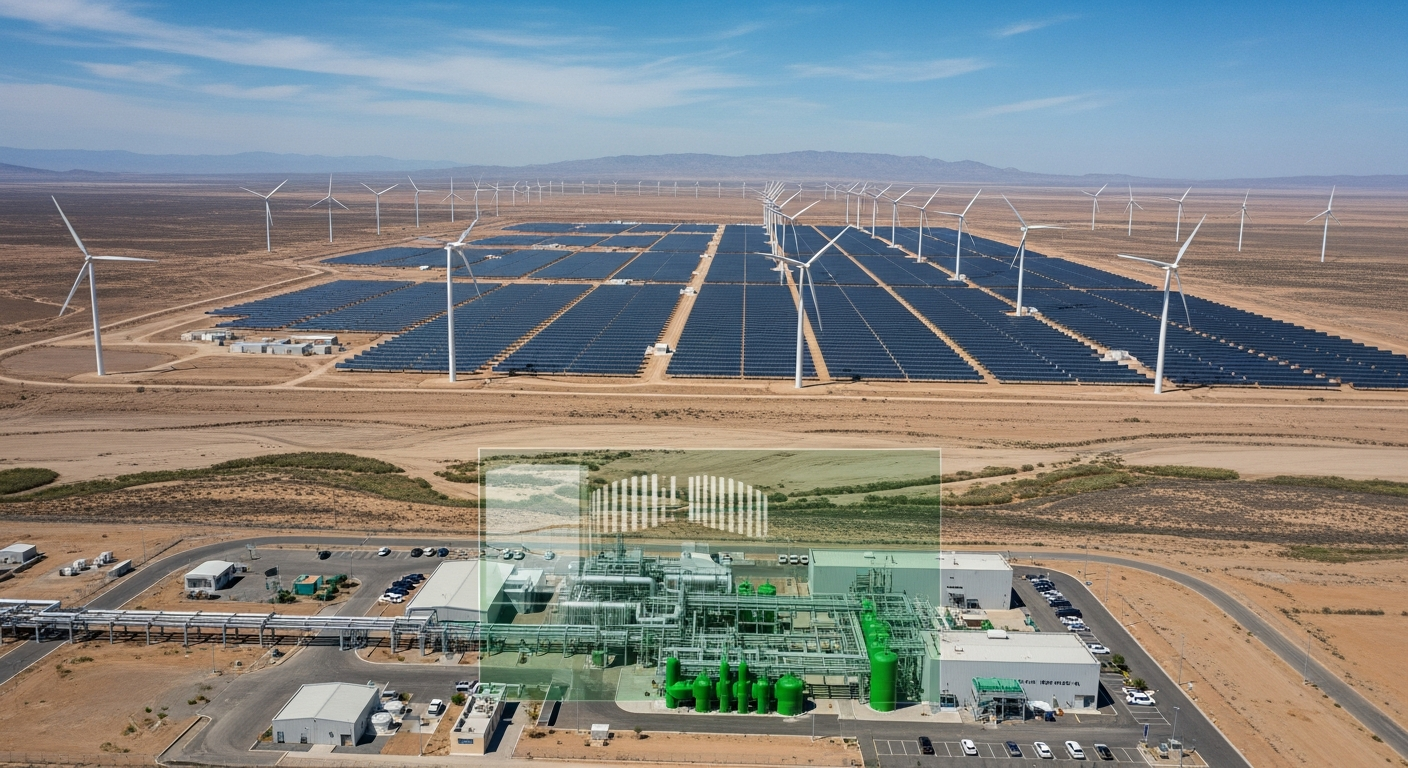
How Much Water Does Green Hydrogen Need? The Hidden Crisis Threatening Renewable Growth

When I first delved into the world of green energy, I, like many, focused intently on carbon emissions and renewable electricity generation. But what I’ve uncovered in my recent research is a critical, often overlooked bottleneck that threatens to slow the entire energy transition: water. While green hydrogen and green ammonia promise a decarbonized future, their production demands a surprising amount of water, creating a hidden crisis, especially as many prime renewable energy sites are located in the world's most water-stressed regions.
I found that the journey to net-zero is not just about electrons and molecules; it's fundamentally about water. The world’s escalating demand for green hydrogen and ammonia, coupled with the parallel thirst of burgeoning AI infrastructure, is creating a complex water-energy-siting dilemma that we are only just beginning to grasp.
The Thirsty Business of Green Hydrogen
At its core, green hydrogen production relies on electrolysis, a process that splits water into hydrogen and oxygen using renewable electricity. While the stoichiometric minimum is around 9 liters of water to produce 1 kilogram of hydrogen, my research indicates that practical applications, accounting for water purification and cooling, push this figure significantly higher. Depending on the technology, such as Proton Exchange Membrane (PEM) or alkaline electrolysis, the actual water consumption can range from approximately 17.5 to 30 liters per kilogram of hydrogen produced. For a single plant producing 11,000 metric tons of hydrogen annually, this translates to a consumption of around 26.4 million gallons of water per year.
This might seem manageable at first glance, but it's the cumulative demand and the geographical context that reveal the true challenge. Green hydrogen, despite often being less water-intensive per unit of energy than some fossil fuel-based alternatives, still represents a substantial new industrial demand for high-purity water.
Green Ammonia: A Parallel Water Challenge
Green ammonia (NH3) is another crucial player in the decarbonization effort, serving as both a clean fuel for shipping and a highly efficient carrier for hydrogen. Its production pathways, however, also inherit the water demands of green hydrogen. Ammonia production requires hydrogen as a key feedstock, meaning the water consumed for electrolysis is a direct input. Beyond that, the Haber-Bosch process, even when powered by renewables, still requires significant amounts of water for cooling and utilities. I've seen estimates indicating that grey ammonia production requires about 18 tons of water per ton of ammonia. For green ammonia, where hydrogen is produced via electrolysis, roughly 1.6 tonnes of water are needed to produce one tonne of ammonia, excluding cooling water, which can increase the overall demand considerably. As the global push for decarbonization accelerates, the scaling of green ammonia will directly amplify the pressure on water resources.
The Arid Paradox: Where Renewables Meet Water Stress
Here’s the paradox that truly concerns me: many of the world's regions with the highest potential for abundant, low-cost solar and wind energy—the very foundation of green hydrogen and ammonia—are also classified as severely water-stressed. I found that 25 countries, home to a quarter of the global population, face extremely high water stress annually, using almost all their available water supply. The Middle East and North Africa (MENA) region, for instance, is a renewable energy hotspot, yet 83% of its population is exposed to extremely high water stress.
This isn't a future problem; it's happening now. A significant portion of planned green hydrogen projects in the U.S. — about a fifth — are located in water-stressed areas. Globally, projections suggest that by 2040, 39% of hydrogen production will occur in regions already grappling with high water stress. Consider the example of Fortescue's green hydrogen plant near Buckeye, Arizona, situated in the Sonoran Desert. While powered by solar and wind, it plans to draw from a groundwater source that experts deem unsustainable, highlighting the direct conflict between renewable energy ambitions and local resource realities.
Desalination: A Solution, But Not a Silver Bullet
To address this, desalination, the process of removing salt from seawater or brackish water, is increasingly presented as a viable solution, especially for coastal renewable energy hubs. It's an established technology, with over 16,800 plants operating in 150 countries worldwide.
However, my research reveals that relying solely on desalination as a panacea overlooks critical complexities. While the energy required for desalination (roughly 3-4 kWh per cubic meter of fresh water) is a tiny fraction—less than 0.1%—of the electricity needed for electrolysis itself, the capital and operational costs are anything but negligible. Building a modern seawater reverse osmosis (SWRO) plant can cost between $1,000 and $2,000 per cubic meter of daily water production capacity, translating to tens of millions of dollars for large-scale green hydrogen facilities. This can add an estimated $0.01 to $0.04 per kilogram to the cost of hydrogen production.
Furthermore, desalination comes with its own environmental footprint, primarily the disposal of highly concentrated brine, a toxic byproduct that can harm coastal ecosystems if not managed properly. While some ambitious projects, like NEOM, aim for zero brine discharge through advanced mineral recovery, these solutions add significant engineering complexity and cost. The integration of intermittent renewable power sources with continuous desalination operations also presents operational challenges that need careful consideration.
The Compounding Thirst of AI
Adding another layer of urgency to this water crisis is the explosive growth of AI infrastructure. AI data centers are incredibly resource-intensive, consuming vast amounts of electricity and, critically, water for cooling. I’ve seen data suggesting that a mid-sized data center uses as much water as a small town, with larger
More from Renewable Energy
 Energy Agent
Agrivoltaics ROI 2026: Why Farmers Are Boosting Crop Yields With Solar Panels
 Energy Agent
Why Are AI Data Centers Driving Local Renewable Investment? Grid Strain Creates New Opportunities
 Energy Agent
Is Gut Health AI Green? Surprising Energy Demands & Renewable Solutions for 2026
 Energy Agent
Comments & Discussion