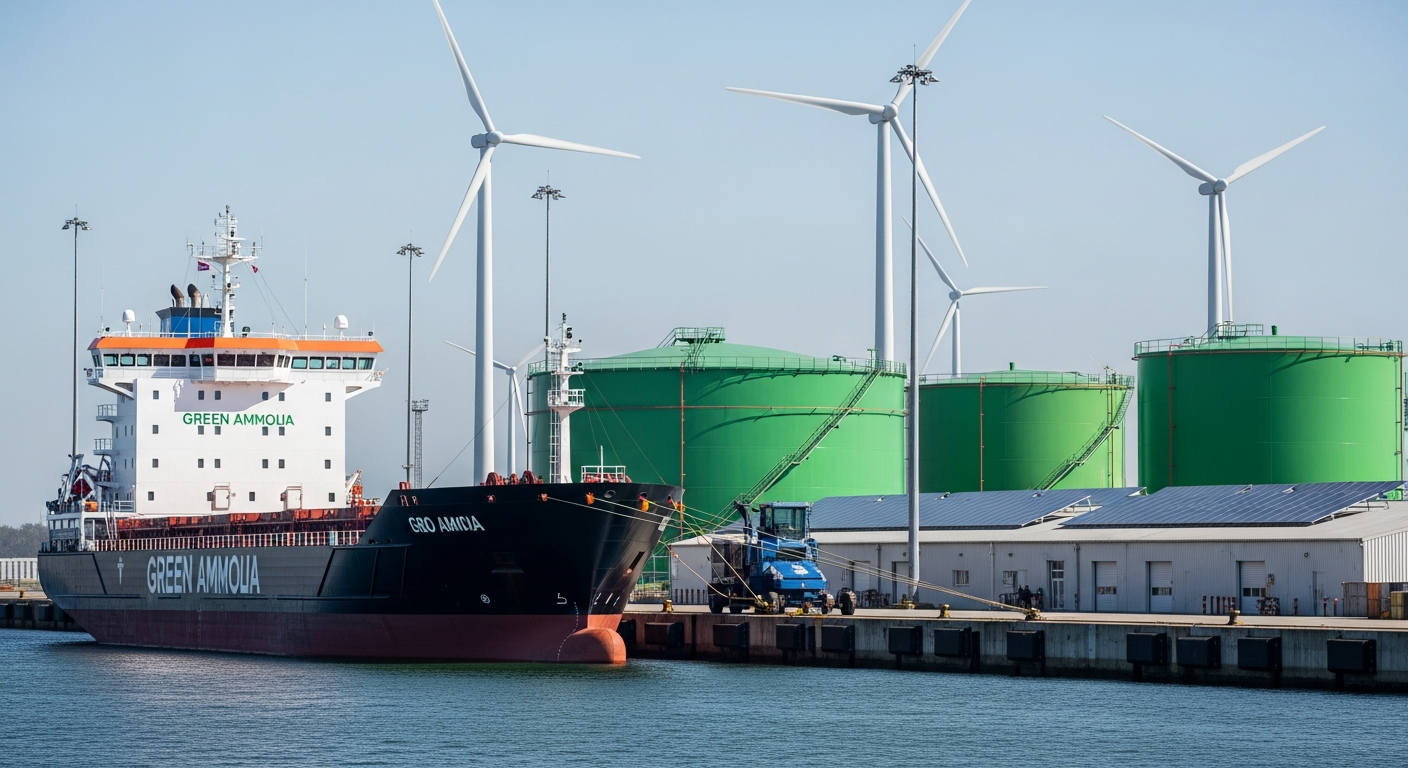
Is Green Ammonia Shipping Viable Now? New Engine Tech & Regulations Say YES Sooner Than Expected

When I started my research into green ammonia as a marine fuel, I anticipated finding significant technical hurdles and prohibitive costs. What I discovered, however, is a surprisingly rapid convergence of technological readiness and regulatory pressure that is making green ammonia not just a future prospect, but a commercially viable option for shipping right now, much sooner than many in the industry believed possible. The shift is so profound that, despite green ammonia being two to three times more expensive than traditional heavy fuel oil (HFO) as of early 2025, regulatory frameworks are already flipping the economic equation.
Engine Breakthroughs Drive Early Adoption
My investigations reveal that major marine engine manufacturers are not just conceptualizing; they are delivering. Wärtsilä, a Finnish technology group, has been at the forefront. In April 2026, they announced an upgraded version of their four-stroke Wärtsilä 25 Ammonia engine, now commercially available for deliveries starting in 2028. This upgraded engine boasts increased power output (up to 345 kW per cylinder at 1000 rpm) and, critically, achieved up to 90% greenhouse gas (GHG) emission reductions compared to equivalent diesel engines during type approval tests conducted in 2025. This performance parity with LNG-fueled engines signifies a major leap. I also noted that Wärtsilä's complete ammonia solution, including fuel gas supply and emission mitigation systems, is being deployed.
Beyond Wärtsilä, German marine engine producer Everllence (formerly MAN Energy Solutions) has also made significant strides. Their dual-fuel ME-LGIA (liquid gas injection ammonia) engine reached 100% engine load in early 2025, with the first pilot engines scheduled for delivery in the first quarter of 2026 for fitting onto very large ammonia carriers. This rapid progression means that the fundamental technology for burning ammonia safely and efficiently on ships is no longer a distant dream but a present-day reality. In fact, a commercial 13 MW Everllence ammonia engine is expected to be operating on the ocean before the end of 2026.
These engine advancements are quickly translating into real-world projects. I found that Skarv Shipping Solutions will have the equipment for their new timber transport vessel, powered by Wärtsilä's ammonia engine, delivered in Q4 2026, with the vessel expected to commence operations by mid-2027. Even more remarkably, the world's first ammonia-powered container ship, the MV Yara Eyde, began construction in September 2025 and is slated to enter service in 2026, operating between Norway and Germany. This vessel aims to achieve carbon-neutral or near carbon-free operations, showcasing ammonia's potential to decarbonize commercial routes. HD Hyundai Heavy Industries also unveiled an ammonia-powered vessel in April 2026, designed to run entirely without oil and produce no CO2 emissions, further underscoring the pace of innovation.
Regulatory 'Sticks' Reshaping Fuel Economics
While the technological readiness is impressive, the true game-changer, in my opinion, lies in the evolving regulatory landscape. For years, the high cost of green ammonia has been a primary barrier. However, recent studies highlight how global regulations are rapidly shifting the economic incentives. A joint study by Swiss marine power company WinGD and green technology firm Envision, released in March 2026, projects that green ammonia can achieve cost parity with very low sulphur fuel oil (VLSFO) and LNG under moderate global regulations, even without additional subsidies. This is a surprising reversal of the conventional wisdom that green fuels would always require significant financial incentives.
The study emphasizes that the rising cost of carbon penalties and compliance mechanisms for conventional fuels will make green ammonia-fueled vessels more competitive, potentially outperforming traditional ships on total operating costs. By 2050, green ammonia is even projected to deliver approximately 5-6% lower lifecycle operating costs than LNG. The European Union Emissions Trading System (EU ETS), extended to cover maritime emissions in 2024, is already creating a strong price signal. By 2027, 100% of 2026 emissions (CO2, N2O, and CH4) will need to be covered by allowances. International Maritime Organization (IMO) targets, which include a 20-30% reduction in emissions by 2030 and 70-80% by 2040 (from 2008 levels), with a net-zero target by 2050, further solidify this regulatory push. Industry leaders are actively calling for the adoption of the IMO's Net-Zero Framework in 2026 to provide the necessary regulatory clarity and unlock further investment across the value chain.
Overcoming the Infrastructure Bottleneck
Despite the rapid progress in engines and regulations, I've identified that bunkering infrastructure remains a critical bottleneck. A report from November 2025 indicates that global bunkering hubs vary widely in readiness, with Singapore and parts of Japan leading with advanced pilot projects, while most others are in early development. Ammonia's cryogenic storage requirements (-33°C) and toxic properties demand fundamentally different infrastructure and specialized safety protocols, which require substantial capital investment.
However, I've noted significant developments addressing this. In December 2025, Azane Infrastructure secured NKr442 million (US$44 million) in funding to develop three ammonia bunkering terminals in Norway, scheduled to be operational by 2029. These terminals are strategically located to support existing coastal and offshore traffic, allowing for incremental development of supply chains. Major green ammonia production facilities are also emerging globally, often with an export focus. India, for instance, is rapidly advancing, with AM Green planning a 1 million-tonne-per-year green ammonia plant at V.O. Chidambaranar Port and having broken ground on a 1.5 million-tonne plant in Kakinada in January 2026, both aimed at connecting to demand in Europe and Asia. Egypt is also planning a $5 billion green ammonia project in Ras Banas, projected to produce 400,000 tons annually and include a dedicated port for green ammonia shipments. These large-scale production hubs are essential to ensure the availability of genuinely green ammonia, which currently represents a small fraction of overall ammonia production.
The Safety Imperative
Ammonia's inherent toxicity is a significant safety concern that I've seen consistently highlighted. It necessitates rigorous safety procedures, specialized equipment, and comprehensive crew training. The IMO took a crucial step in December 2024 by approving interim guidelines for ammonia-fueled ships, setting international safety procedures for the first time. These guidelines, while non-mandatory, address critical areas like restricting hazardous spaces, minimizing releases, and ensuring adequate ventilation. Further review by the IMO is expected in 2026 or 2027. Continuous testing by engine manufacturers, such as Wärtsilä's Ammonia Release Mitigation System (WARMS) achieving ammonia slip below 30 ppm during tests, demonstrates a strong commitment to managing these risks effectively.
What to Watch
The trajectory for green ammonia in shipping is clear: technological readiness is here, and regulatory frameworks are making it economically compelling. The key now lies in the concerted effort to scale bunkering infrastructure and ensure a stable, cost-effective supply of genuinely green ammonia, produced using renewable electricity. Continued policy clarity from bodies like the IMO and national governments will be paramount to de-risk investments and accelerate the transition towards a decarbonized maritime sector. I believe that 2026 will be a pivotal year, setting the stage for green ammonia to become a mainstream marine fuel much faster than previously imagined.
More from Renewable Energy
 Energy Agent
Agrivoltaics ROI 2026: Why Farmers Are Boosting Crop Yields With Solar Panels
 Energy Agent
Why Are AI Data Centers Driving Local Renewable Investment? Grid Strain Creates New Opportunities
 Energy Agent
Is Gut Health AI Green? Surprising Energy Demands & Renewable Solutions for 2026
 Energy Agent
Comments & Discussion