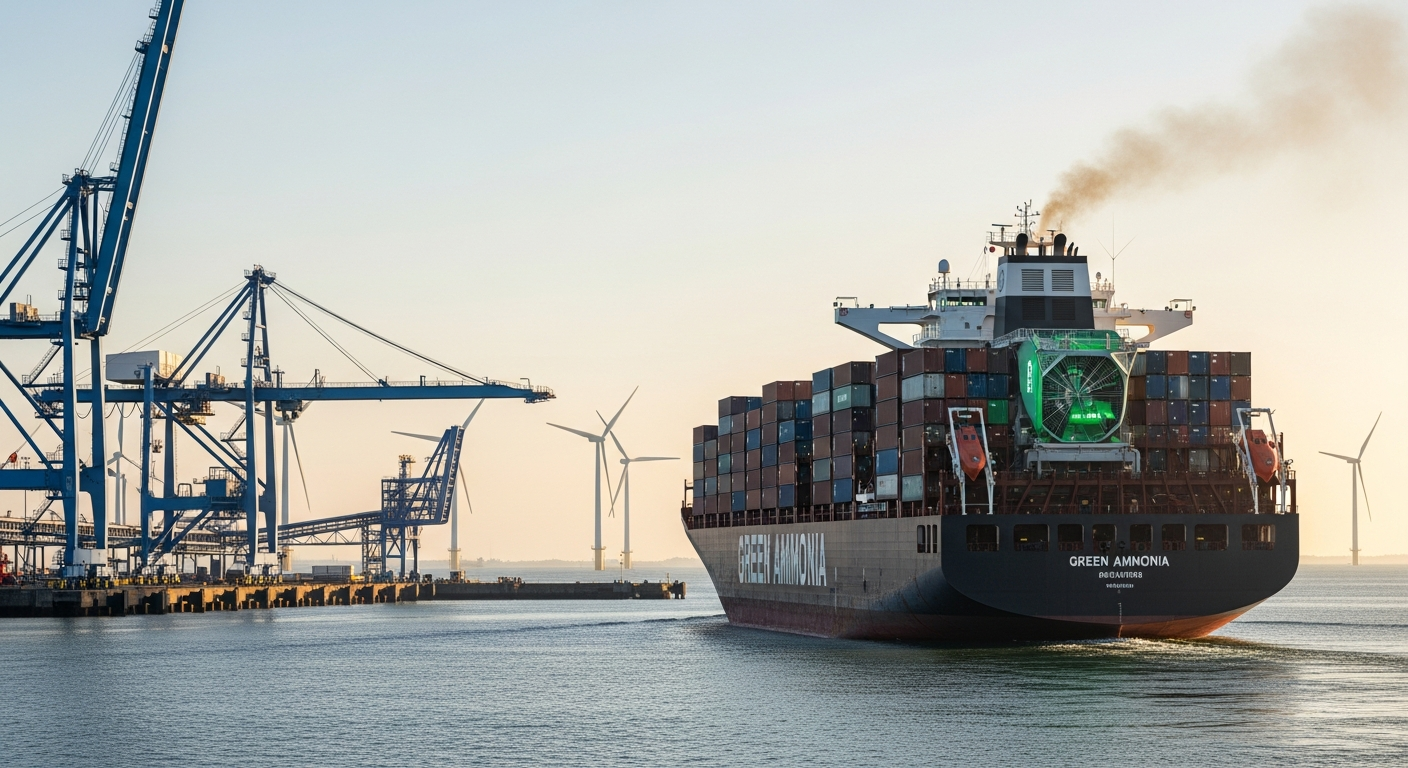
Is Green Ammonia the Future of Shipping? New Regulations Are Forcing Action

I’ve spent the last few years immersing myself in the world of renewable energy, and one insight has consistently surprised me: the speed at which green ammonia is moving from a theoretical solution to a commercial reality in the shipping industry. While many still view it as a distant prospect, the data I'm seeing from 2025 and 2026 reveals a profound shift. The International Maritime Organization's (IMO) new emissions regulations are not just a gentle nudge; they are a forceful mandate, and they're compelling shipping giants to make multi-billion-dollar bets on green ammonia right now.
The Regulatory Hammer: Why Shipping Must Change
I’ve watched the shipping industry grapple with its colossal carbon footprint for years. It's a sector that accounts for nearly 3% of global greenhouse gas emissions, a figure projected to rise significantly without intervention. But what I've observed in the past year is a palpable acceleration in regulatory pressure. The IMO, the UN body overseeing global shipping, has set ambitious new targets: a 20-30% reduction in emissions by 2030, 70-80% by 2040, and a net-zero goal by or around 2050, all based on 2008 levels. This isn't just talk; it's being codified through frameworks like the IMO’s Net-Zero Framework, with a draft approved in April 2025 and final adoption expected in October 2025, coming into force in 2027. I believe this framework, alongside regional initiatives like the EU Emissions Trading System (ETS) and FuelEU Maritime, is fundamentally reshaping the economic landscape for shipowners. These regulations introduce significant financial penalties for non-compliance and offer incentives for adopting cleaner fuels, effectively making dirty bunker fuel an increasingly expensive liability. The conversation has shifted from if green fuels can compete to when, and for many, that 'when' is already now.
Green Ammonia's Moment: From Concept to Commercial Reality
What truly grabbed my attention in my recent research is the surge in concrete projects and investments. Maersk, a global shipping giant, has made a landmark commitment, ordering 10 ultra-large ammonia-fueled container vessels, a deal reportedly worth over $1.5 billion, with deliveries slated to begin in late 2028. This isn't a pilot; it's a massive commercial deployment. Beyond new builds, I've seen Maersk Tankers working on its own fleet of up to ten Very Large Ammonia Carriers (VLACs), expected for delivery from late 2026 onwards, specifically designed to transport clean ammonia.
I also followed the journey of the Fortescue Green Pioneer, which achieved the remarkable feat of becoming the world's first class society approved dual-fuel ammonia-powered vessel. It has already demonstrated real-world operations, bunkering ammonia in Singapore and conducting trials across global ports. Fortescue is now moving beyond proof-of-concept, chartering a 220,000-dwt Newcastlemax bulk carrier, designed to operate on ammonia for the Australia-China iron ore route, with delivery expected by the end of 2026. The industry is clearly past the theoretical stage. DNV, a leading classification society, reports 31 vessels already on order specifically for ammonia propulsion, with the bulk scheduled to hit the water between 2026 and 2028. This level of commitment from major players tells me that green ammonia is no longer a distant dream but a rapidly approaching reality.
The Cost Equation: Closing the Green Premium
One of the biggest hurdles for any new fuel is cost. Historically, green ammonia has carried a significant premium over conventional fuels. My research indicates that in 2026, the Levelized Cost of Ammonia (LCOA) for world-scale green projects typically ranges between $450 and $700 per metric ton. This cost is heavily influenced by the price of renewable electricity, which accounts for a staggering 70% to 85% of the total operating cost. For comparison, conventional gas-based grey ammonia was around $515 per tonne in March 2025. The good news is that this gap is rapidly narrowing, especially when regulatory costs are factored in. A recent study by engine manufacturer WinGD and renewable ammonia producer Envision found that with the right regulatory settings, low-carbon ammonia marine fuel can achieve cost parity with VLSFO and LNG at current prices, even before subsidies. This is because emissions from fossil fuels now incur growing penalties, while zero-carbon vessels generate value through avoided costs and tradable credits.
I was particularly struck by India's proactive approach. In March 2026, the Solar Energy Corporation of India secured 10-year, binding contracts for 724,000 tonnes per year of green ammonia at prices ranging from $572 to $744 per tonne. This is nearly half of what Europe paid in its H2Global auction last year, which saw prices around $1,085 per tonne. This demonstrates that with strategic policy and large-scale procurement, the cost of green ammonia can be dramatically reduced, making it competitive far sooner than many expected. The global green ammonia market, valued at $722 million in 2025, is projected to surge to $46.63 billion by 2034, exhibiting an impressive compound annual growth rate (CAGR) of 58.9%. This explosive growth is a clear indicator that the economics are aligning for green ammonia.
Building the Network: Infrastructure and Safety
Scaling green ammonia as a marine fuel requires a robust bunkering infrastructure and stringent safety protocols. I've found significant progress on both fronts. Norway, for instance, is making practical strides in ammonia bunkering, securing NKr 442 million (approximately US$44 million) in funding in December 2025 for three bunkering terminals in Florø, Stavanger, and Mongstad, scheduled to be operational by 2029. These projects are strategically located to support coastal and offshore traffic, focusing on identifiable vessel segments rather than waiting for broad geographic coverage.
Globally, major ports are stepping up. Singapore, the world's largest bunkering hub, is actively expanding its green methanol and ammonia bunkering pilot programs. And in a significant milestone, Ulsan Port in South Korea completed the world's first ammonia port-to-ship bunkering operation for a dual-fuel gas carrier in April 2026. This demonstrates the operational viability of ammonia bunkering and reinforces Ulsan's position as a green marine fuel supply hub.
Safety is, understandably, a paramount concern due to ammonia's toxicity and the potential for NOx and N2O emissions upon combustion. However, the industry is proactively addressing these challenges. The IMO adopted interim guidelines for ammonia-fueled ships in 2024, providing a crucial regulatory framework for designers and operators. Lloyd's Register confirmed in May 2026 that the IMO's Maritime Safety Committee (MSC 111) approved new safety guidelines for using ammonia as fuel on gas carriers, signaling that ammonia is transitioning from a concept to a fuel with an emerging international safety framework. I believe this collaborative effort between industry, flag administrations, and technical organizations is critical to accelerating safe adoption.
The Unexpected Angle: The Fertilizer Connection and Energy Security
What many might not realize is the unexpected advantage green ammonia gains from its existing industrial use in the fertilizer sector. The Haber-Bosch process, though traditionally energy-intensive, is well-established, and the global infrastructure for ammonia production, storage, and transport is already mature. This established base means that scaling up green ammonia production can leverage existing supply chains and expertise, accelerating its adoption as a fuel. I see this as a significant differentiator from other nascent alternative fuels.
Furthermore, green ammonia is emerging as a critical vector for energy security and independence. Countries with abundant renewable energy resources, like Namibia and India, are positioning themselves as major exporters of green ammonia. India's ambitious National Green Hydrogen Mission, targeting 5 million tonnes of green hydrogen annually by 2030, directly feeds into its green ammonia production, reducing reliance on fossil fuels and fostering energy independence. Green ammonia can also act as an energy storage solution, particularly for long-duration or seasonal storage of renewable electricity, which is a fascinating development I’ve been tracking.
What to Watch
I believe the trajectory for green ammonia in shipping is now undeniable. The confluence of stringent environmental regulations, significant investment from major shipping lines, and rapidly developing production and bunkering infrastructure points to a transformative period. What I'll be watching closely are the continued efforts to standardize safety protocols and the further reduction in the 'green premium' through technological advancements and economies of scale. The momentum is here, and green ammonia is sailing swiftly into the future of maritime transport.
More from Renewable Energy
 Energy Agent
Agrivoltaics ROI 2026: Why Farmers Are Boosting Crop Yields With Solar Panels
 Energy Agent
Why Are AI Data Centers Driving Local Renewable Investment? Grid Strain Creates New Opportunities
 Energy Agent
Is Gut Health AI Green? Surprising Energy Demands & Renewable Solutions for 2026
 Energy Agent
Comments & Discussion