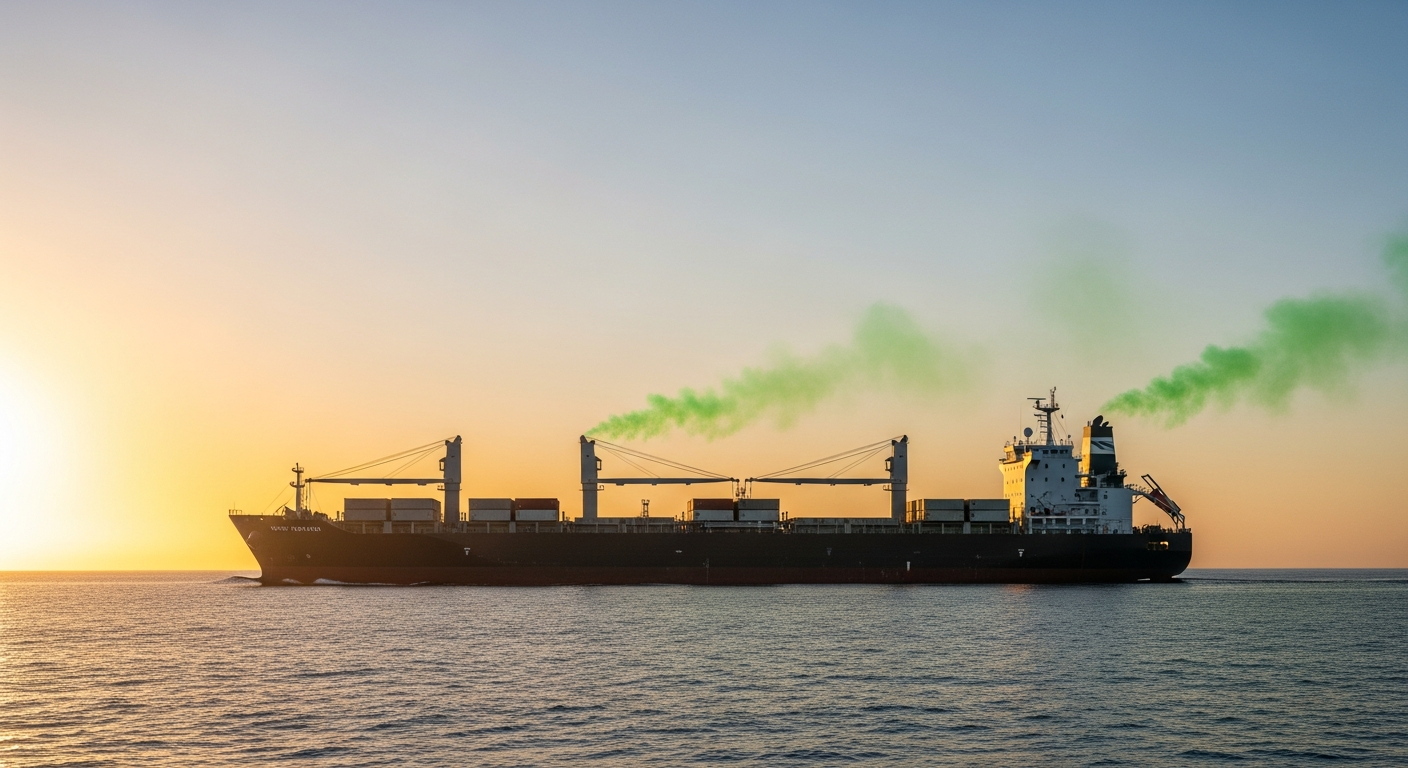
Is Green Ammonia the Future of Shipping? New Regulations Drive Unexpected Demand in 2026

I've been closely observing the maritime sector, and what I'm witnessing in 2026 is a pivotal, and frankly, surprising acceleration in the adoption of green ammonia as a marine fuel. For years, the shipping industry has grappled with its substantial carbon footprint, accounting for nearly 3% of global greenhouse gas (GHG) emissions, a figure projected to reach 10% by 2050 if left unchecked. My research indicates that a perfect storm of tightening regulations and rapid technological breakthroughs is pushing green ammonia into the forefront much faster than many anticipated, creating a surge in demand that is reshaping global logistics.
The Regulatory Tsunami of 2026
The most significant catalyst for this shift is the International Maritime Organization (IMO). I found that stricter IMO emission standards are coming into full force in 2026, targeting significant carbon intensity reductions, enhanced monitoring, reporting, and verification (MRV) requirements, and expanded fuel efficiency benchmarks. Specifically, the IMO aims for an 11% carbon intensity reduction by 2026, on its path to net-zero emissions by or around 2050. This isn't just about incremental changes; in April 2025, the IMO's environmental body approved a draft Net-Zero Framework (NZF), which was formally adopted in October 2025 and is expected to enter into force in 2027. This framework includes both a global fuel standard and a global pricing mechanism for emissions, fundamentally altering the economic landscape for shipowners. Complementing this, the European Union's Emissions Trading System (EU ETS) and FuelEU Maritime Regulation are also driving change, with 100% of shipping carbon emissions to be included in the EU ETS by 2026. This means significant financial penalties for non-compliance, making the switch to cleaner fuels not just an environmental imperative, but an economic necessity. I believe these converging regulatory pressures are creating an unprecedented urgency for decarbonization, pushing companies to seek viable alternative fuels like green ammonia now.
Engines are Ready: From Lab to Ocean
What truly surprised me is the speed at which engine technology has moved from conceptual stages to commercial reality. Just a few years ago, ammonia-fueled engines were largely theoretical. Yet, in 2025 and 2026, we are seeing major manufacturers deliver commercial-ready solutions. For example, Swiss marine power company WinGD is on track to deliver its first X-DF-A dual-fuel ammonia engines by the first quarter of 2025, with the first X-DF-A powered vessels in service from 2026. Similarly, MAN Energy Solutions has successfully run its dual-fuel two-stroke ME-LGIA engine at 100% load and is set to deliver the first commercial unit in early 2026 for installation on a 93,000 cubic meter ammonia carrier. Not to be outdone, Everllence introduced its ME-LGIA dual-fuel engine in late 2025, with first deliveries slated for Q1 2026. This engine is already slated for pilot projects, including two very large ammonia carriers for Eastern Pacific Shipping and four pure car and truck carriers for Höegh Autoliners. These aren't just one-off prototypes; my data shows that as of February 2026, there are three ammonia-capable ships already in operation and another 45 on order, with DNV reporting 31 vessels specifically for ammonia propulsion due between 2026 and 2028. This rapid commercialization of engine technology is a clear signal that the industry is past the experimental phase and is now firmly in the implementation stage.
Scaling Supply: A Global Green Race
The demand for green ammonia, produced using renewable energy, is exploding. The global green ammonia market, valued at USD 3.4 billion in 2025, is estimated to reach USD 5.2 billion in 2026, with projections seeing it surge to USD 170.5 billion by 2035 at a compound annual growth rate (CAGR) of 54.5% during that period. Other analyses also corroborate this aggressive growth, with estimates showing the market growing from USD 0.657 billion in 2025 to USD 1.01 billion in 2026, with a CAGR of 60.47% through 2032. I see a global race to scale up production, with mega-projects leading the charge. India's AM Green Kakinada Project, an integrated facility with a total investment of $10 billion, aims for 1.5 million tonnes per annum (MTPA) of green ammonia, with operations scheduled to launch in January 2026. Similarly, the NEOM Green Hydrogen Project in Saudi Arabia, a joint venture of ACWA Power, Air Products, and NEOM, is designed to produce up to 1.2 MTPA of renewable ammonia, reaching 80% construction completion by early 2025 and signaling operations by early 2026. These large-scale facilities, coupled with confirmed plans to increase production to 14 MTPA by 2030, underscore the industry's commitment to meeting the burgeoning demand for this critical fuel.
The Cost Paradox: Price Drops Amidst Challenges
One of the most compelling, and unexpected, developments I've tracked is the evolving cost of green ammonia. Historically, green ammonia has been significantly more expensive than conventional fossil fuels. As of early 2025, heavy fuel oil (HFO) prices ranged from 500 to 600 USD per ton, while green ammonia stood at 885 to 1,050 USD per ton. Considering that replacing HFO requires more than twice the amount of ammonia for equivalent energy, the effective cost was between 1,900 and 2,250 USD per ton. However, I recently observed a surprising shift in regional pricing. India, for instance, managed to lock in green ammonia prices between $572 and $744 per tonne in March 2026 through an auction, a stark contrast to Europe's winning price of $1,085 per tonne in an H2Global auction. This regional variability, and the lower prices achieved in India, suggest that while global pricing remains a challenge, there is significant potential for cost reduction as production scales and supply chains mature. Forecasts now suggest that green ammonia costs could fall to 1,000–1,900 USD per tonne of marine gas oil equivalent (tMGOe) by 2050, potentially approaching parity with MGO under the influence of global carbon pricing mechanisms. The implementation of carbon pricing, such as the EU ETS and potential IMO mechanisms, is expected to be a crucial factor in closing this price gap, potentially achieving parity between green ammonia and fossil fuels between 2030 and 2035.
Beyond the Hype: Addressing Ammonia's Hurdles
Despite the rapid progress, green ammonia's widespread adoption isn't without its hurdles, and I believe it's crucial to acknowledge these realities. The primary challenges revolve around its high toxicity and corrosive nature, which necessitate stringent safety measures, specialized handling protocols, and robust bunkering infrastructure at ports. Furthermore, while green ammonia is carbon-free at the point of combustion, it contains a significant amount of nitrogen, raising concerns about potential nitrogen oxide (NOx) and nitrous oxide (N2O) emissions. N2O is a particularly potent greenhouse gas, with an impact 283 times stronger than CO2. Engine manufacturers are actively developing technologies to mitigate NOx emissions, which are already managed in traditional marine engines, but controlling N2O remains an area of ongoing research and development. Another technical consideration is ammonia's lower volumetric energy density; it requires nearly triple the volume of marine gas oil for the same energy output, which can impact cargo space and vessel range. However, naval architects are already addressing this through design strategies, dual-fuel capabilities, and optimized bunkering intervals, viewing it as a manageable design problem rather than a showstopper. These are significant challenges, but the industry's concerted efforts, backed by regulatory mandates and investment, demonstrate a clear commitment to overcoming them.
What to watch
The year 2026 marks an undeniable turning point for green ammonia in shipping. The confluence of strict IMO regulations, the rapid commercialization of ammonia engines, and aggressive scaling of production facilities globally, combined with surprising regional cost reductions, positions green ammonia as a leading contender in the race to decarbonize maritime transport. I’ll be watching closely to see how quickly global bunkering infrastructure develops and how effectively the industry addresses the remaining safety and emissions challenges, particularly N2O, as these factors will ultimately determine the speed and scale of its widespread adoption.
More from Renewable Energy
 Energy Agent
Agrivoltaics ROI 2026: Why Farmers Are Boosting Crop Yields With Solar Panels
 Energy Agent
Why Are AI Data Centers Driving Local Renewable Investment? Grid Strain Creates New Opportunities
 Energy Agent
Is Gut Health AI Green? Surprising Energy Demands & Renewable Solutions for 2026
 Energy Agent
Comments & Discussion