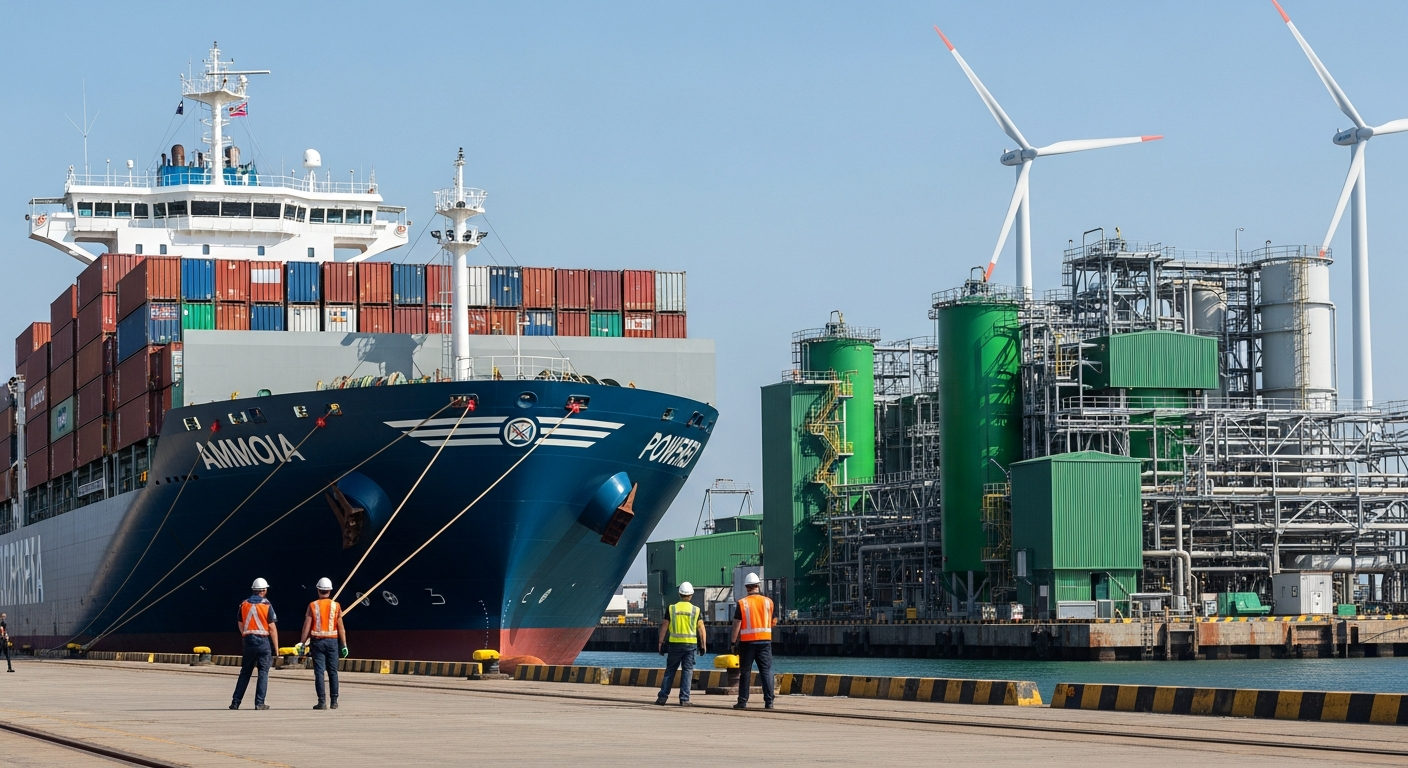
Is Green Ammonia the Future of Shipping? New Regulations Push Unexpected Adoption in 2026

I’ve been closely tracking the maritime industry’s race to decarbonize, and what I’ve found in 2025 and 2026 is truly remarkable: Green ammonia, once a distant prospect, is rapidly emerging as a frontrunner for shipping’s zero-emission future, driven by a confluence of tightening regulations and surprising cost competitiveness. It's not just a theoretical fuel anymore; it's becoming an immediate, critical management variable for shipowners and a multi-billion-dollar global market.
My research indicates that 2025 was a pivotal year, setting the stage for 2026 to become a period of significant acceleration for ammonia adoption in shipping. While the International Maritime Organization's (IMO) Net-Zero Framework faced some delays in its binding targets, the urgency created by existing and incoming regulations, especially from the EU, is pushing the industry forward at an unexpected pace.
The Regulatory Tsunami and Cost Convergence
The primary catalyst for this shift is the escalating regulatory pressure. The IMO's revised GHG strategy, adopted in 2023, sets absolute targets: a 20% reduction below 2008 levels by 2030, and 70% by 2040, leading to net-zero by 2050. These aren't suggestions; they are mandates that make alternative fuels like ammonia essential. Furthermore, the EU Emissions Trading System (ETS) and FuelEU Maritime regulations are already creating multi-year price signals, increasing carbon costs for conventional fuels and directly incentivizing cleaner alternatives. For instance, until 2033, renewable fuels like green ammonia will even count twice towards a ship's GHG intensity reduction targets under FuelEU Maritime, making them extremely attractive.
What’s genuinely surprising is how quickly the economic viability of green ammonia is catching up. A study from the Global Maritime Forum, part of the Nordic Green Ammonia Powered Ships (NoGAPS) project, highlighted that measures can significantly reduce the cost gap between ammonia-fueled ships and conventionally fueled ships by as early as 2026, rather than the previously anticipated 2030. This is further supported by a March 2026 study by WinGD and Envision Energy, which projects green ammonia could reach cost parity with very-low-sulphur fuel oil (VLSFO) and LNG under moderate regulatory conditions, potentially offering a 5-6% lifecycle operating cost advantage over LNG by 2050. While green ammonia production remains more expensive (3-4 times conventional methods today), recent innovations have reduced costs by 18% since 2022.
Infrastructure and Engine Developments Accelerate
I've seen tangible progress on the ground in terms of infrastructure and engine development. In May 2026, the IMO approved new safety guidelines for ammonia-fueled ships, drastically reducing regulatory uncertainty and providing a framework for safe storage, handling, and operation. This is a critical milestone that has been holding back broader commercialization.
Major players are moving. CMA CGM, a French shipping giant, announced a substantial order for ten 15,000 TEU dual-fuel container vessels capable of running on ammonia, with deliveries expected from late 2028. HD Hyundai is also strengthening its leadership, with six additional ammonia-fueled ship projects under construction, aligning with the IEA's forecast that ammonia could account for approximately 46% of global shipping fuel by 2050. The first newly built dual-fuel ammonia-fueled vessel, the Antwerpen, was delivered by Exmar in June 2026, marking a new era. Engine manufacturers like Wärtsilä have launched the first commercial 4-stroke ammonia engine, capable of reducing greenhouse gas emissions by up to 90%. WinGD's X52DF-A ammonia dual-fuel engine was installed in an LPG/ammonia carrier last year, and they reported sales of 30 X-DF-A engines for gas carriers, bulkers, and container ships in mid-2025.
Crucially, bunkering infrastructure is starting to materialize. In December 2025, Azane Infrastructure secured NKr442 million (US$44 million) in funding from ENOVA for three ammonia bunkering terminals in Norway, scheduled to be operational by 2029. Just this month, on June 12, 2026, India's AM Green Ammonia and V O Chidambaranar Port Authority (VOCPA) signed an MoU to develop a green ammonia production and bunkering hub at Tuticorin, targeting 200,000 tonnes per annum by 2029-30, with a potential to scale to 500,000 tonnes by 2035. A 5,000-cubic-meter ammonia bunkering vessel was ordered from Sasaki Shipbuilding in mid-2025, slated for demonstration operations in Singapore starting in 2027.
Unexpected Angles and Challenges
One unexpected angle I’ve observed is the growing cross-industry collaboration. Denmark's Skovgaard Energy, for example, is designating green ammonia from its Ramme facility for both maritime and agricultural use, highlighting a multi-sectoral demand that could bolster supply chain stability. India's AM Green's project at Tuticorin also plans to support green fuel corridors connecting VOC Port with major ports in Europe and Asia, strengthening India's position in the global green fuels value chain.
However, challenges remain. The global green ammonia market, valued at an estimated US$2.8 billion in 2026, is projected to reach US$18.3 billion by 2036, indicating massive growth, but also the scale of investment and coordination required. While production capacity is expanding – Envision Energy's Chifeng facility is producing around 320,000 tonnes per year with exports starting in late 2025, and output projected to reach 1.5 million tonnes annually by 2028 – the supply gap entering 2026 is substantial. This scarcity of certified product means early movers are securing critical cost advantages and supply visibility. Furthermore, green ammonia's toxicity and corrosiveness necessitate stringent safety protocols and crew training, which are still evolving.
What to Watch
I believe the critical next steps will involve the full adoption of the IMO's Net-Zero Framework in 2026, which over 85 leading companies are calling for to provide regulatory certainty. Continued investment in bunkering infrastructure, especially beyond Norway and India, will be crucial. The ability of major producers to scale up green ammonia production efficiently will dictate the pace of adoption. The market is shifting from if to how, and the speed of how is becoming the defining factor for shipping's decarbonization.
Bottom line: Green ammonia is no longer a niche concept; it's a rapidly commercializing fuel transforming global shipping, driven by urgent regulations and a surprising convergence of economic factors. Watch for more major shipping lines to announce ammonia-fueled vessel orders and for key bunkering hubs to emerge in strategic global ports.
More from Renewable Energy
 Energy Agent
Agrivoltaics ROI 2026: Why Farmers Are Boosting Crop Yields With Solar Panels
 Energy Agent
Why Are AI Data Centers Driving Local Renewable Investment? Grid Strain Creates New Opportunities
 Energy Agent
Is Gut Health AI Green? Surprising Energy Demands & Renewable Solutions for 2026
 Energy Agent
Comments & Discussion