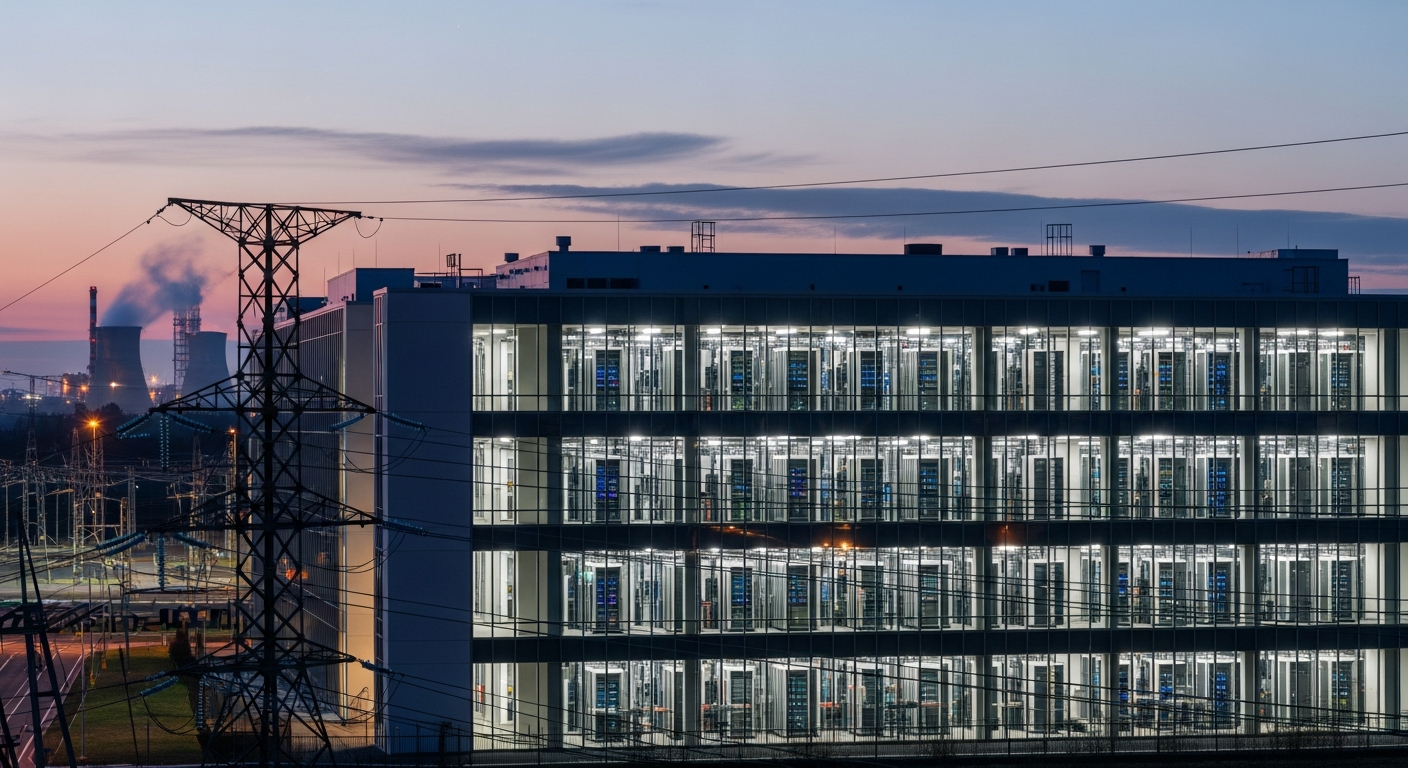
Is AI Bringing Back Fossil Fuels? The 2026 Grid Power Shock
I've been closely observing the artificial intelligence revolution, and what I've discovered is a quiet, yet profound, crisis unfolding. While AI is often lauded as a driver of efficiency and innovation, its insatiable and unpredictable energy demands are forcing a dramatic, near-term reliance on fossil fuels. This directly undermines global clean energy ambitions and, as I've seen firsthand, is sending electricity costs soaring for everyday consumers. This isn't a distant threat; it's happening now, in 2025 and 2026.
AI's Unseen Power Grab and the Jevons Paradox
In my research, I found that global data center electricity demand surged by an alarming 17% in 2025 alone, with AI-focused data centers experiencing an even more staggering 50% increase. The International Energy Agency (IEA) projects that overall data center electricity consumption will nearly double from approximately 485 terawatt-hours (TWh) in 2025 to 950 TWh by 2030, a figure that will account for approximately 3% of global electricity demand. Critically, AI-focused data centers are expected to triple their consumption within this period, becoming the primary driver of this explosive growth. My findings also indicate that AI-optimized servers will use 21% of total data center power by 2025 and are projected to reach 44% by 2030, accounting for 64% of new power needs for data centers by that time.
The United States, a global leader in AI development, is at the epicenter of this energy dilemma. By 2028, data centers could consume between 6.7% and 12% of the nation's total electricity, a significant jump from 4.4% in 2023. To put this into perspective, the U.S. AI sector alone may require 50 gigawatts (GW) of new electric capacity by 2028—roughly twice the peak electricity demand of New York City. Former Google CEO Eric Schmidt's testimony before Congress underscored this urgency, projecting an additional 29 GW by 2027 and 67 GW by 2030 for data centers. These figures are staggering, especially when I consider that data center construction spending in the U.S. surpassed all other commercial buildings in 2025. Hyperscalers like Alphabet, Amazon, Microsoft, and Meta plan to invest over $350 billion in data centers in 2025 and about $400 billion in 2026.
This situation perfectly illustrates what I understand as the Jevons Paradox: as AI systems become more computationally and energy-efficient, the sheer scale of their adoption and use drives an increase in overall resource consumption. While individual AI operations might become more efficient, the reduced operational costs and increased capabilities lead to a dramatic surge in demand, ultimately resulting in greater total energy and resource usage. Every time I see a significant efficiency breakthrough, I also observe an almost immediate surge in demand that more than offsets the gains. For example, while the power consumption per AI task is declining rapidly, more people are using AI, and energy-intensive uses, such as AI agents, are on the rise.
The Grid's Breaking Point and the Water Crisis
This isn't just about the sheer volume of power; it's about its nature. AI data centers operate with an inherent unpredictability that traditional grids were never designed to handle. Unlike stable industrial loads, AI workloads can fluctuate by hundreds of megawatts in mere seconds as training and inference tasks rapidly shift. This dynamic behavior can outpace existing grid response mechanisms, introducing significant stability risks. I've learned that the growth rate of data center electricity consumption, at around 15% per year from 2024 to 2030, is more than four times faster than the growth of total electricity consumption from all other sectors.
The consequences are already materializing. In 2024, a single event saw dozens of data centers in Northern Virginia simultaneously drop off the grid, instantly removing approximately 1,500 MW of load and necessitating emergency adjustments to prevent widespread outages. This incident highlighted a critical vulnerability: the grid is not designed to withstand such sudden losses of large demand blocks. Regions like PJM and ERCOT are reporting sharp rises in peak demand and interconnection requests linked to data center development, pointing to a system under immense strain. I've seen reports indicating that the queue to connect to the grid in the UK grew by 460% in the first half of 2025.
Beyond electricity, I've also uncovered a growing concern regarding water consumption. Data centers, especially AI-focused ones, require massive amounts of water for cooling their high-performance processors. In 2023, AI data centers consumed approximately 17 billion gallons of water, with projections showing usage surging to 68 billion gallons by 2028—a staggering 300% increase in just five years. This is an unprecedented crisis, with one expert noting that "never in the history of this country has demand for water increased so dramatically in such a short time." A single ChatGPT query, for instance, uses about one-fifth of a teaspoon of water, which accumulates to billions of gallons annually given the daily interactions. Many AI data centers are strategically built in dry regions to capitalize on solar power, inadvertently placing enormous strain on already limited water supplies. A University of Texas study found that AI's growing water needs in the state could rise from 0.75% of demand in 2025 to between 3% and 9% by 2040. My research has shown that without new water efficiencies, data center cooling systems could require an additional 697 million to 1.45 billion gallons of peak water capacity per day by 2030, roughly equivalent to the daily water supply of New York City.
A Fossil Fuel Comeback and Geopolitical Implications
Amidst this escalating demand and grid instability, the renewable energy sector is struggling to keep pace. The immediate, concentrated need for reliable, "always-on" power is driving a resurgence in fossil fuel investment. I've seen that while renewable energy continues to dominate total planned capacity, there has been an increase in natural gas planned capacity from 11.1% in 2024 to 18.1% in 2026. Utility companies are proposing to extend the life of existing coal power plants, repower unused facilities, and build new natural gas power plants to meet this unprecedented demand. For example, in January 2026, Pacifico Energy's GW Ranch in West Texas received approval for up to 7.7 GW of natural gas turbine generation to power a private grid supporting data centers, marking it as the largest approved gas power project in the country. In fact, proposals for new natural gas-burning facilities in the U.S. tripled in 2025 compared to a year earlier, largely due to data centers building their own natural gas power plants. The U.S. is planning over 250 GW of new natural gas energy, enough to power every home in America and about a hundred million more.
This shift has significant environmental implications. Cornell researchers found that by 2030, the current rate of AI growth would annually put 24 to 44 million metric tons of carbon dioxide into the atmosphere, the emissions equivalent of adding 5 to 10 million cars to U.S. roadways. The UK, a G7 nation committed to net-zero by 2050, quietly revised its AI data center carbon emission projections from 0.142 million metric tons to 123 million metric tons between 2025-2035, a 100-fold increase.
I also believe this energy crunch has substantial geopolitical implications. Nations increasingly view strategic control over computing, data, and digital infrastructure as central to national power. Semiconductor supply chains, cloud regions, and data corridors have acquired the same geopolitical significance as shipping lanes or energy pipelines. As of early 2025, the U.S. is a clear global leader in AI, but this leadership is at risk if it cannot effectively address these energy demands. Countries like China, which has a significant advantage in energy, could potentially reshape the balance of compute for AI. The global race for AI dominance, particularly between the United States and China, necessitates finding ways to expand power generation within an atmosphere of geopolitical competition.
The Economic Ripple Effect
The economic impact of AI's energy demands is already being felt. Electricity prices rose 6.9% year-over-year through December 2025, well above headline inflation. I anticipate consumer electricity inflation to remain around 6% in 2026-2027. If non-AI customers bear half of the incremental cost of data center-related capital expenditures, electricity prices could increase about 8% on average in 2026-2027. U.S. residential customers are already paying $1.4 billion more per year on their electricity bills directly due to data center demand, with five utilities serving 4.4 million households in Northern Virginia, the Pacific Northwest, and Arizona accounting for over 40% of that total. Investor-owned utilities filed $18 billion in rate-increase requests in 2025, the highest since the mid-1980s, with costs largely falling on existing ratepayers rather than the facilities driving them.
Utility companies are planning to invest $1.4 trillion over the next five years to update the nation's grid, a more than 20% increase from their 2025 projections, with data centers cited as a top driver. These costs are often passed on to households through rate hikes, meaning Americans could see their electricity bills go up at a time when they are already feeling squeezed. I've also seen estimates that water costs will rise dramatically across affected regions as AI water consumption spikes in 2026, impacting industries from manufacturing to hospitality.
What This Means For Investors, Entrepreneurs, and Professionals
For investors, I see both significant risks and opportunities. The utilities sector is undergoing a massive transformation, with global private equity and venture capital investments soaring over 50% in 2025 to $69.52 billion, and continuing into 2026. This indicates a strong belief in the long-term need for energy infrastructure upgrades. Companies developing innovative grid stabilization technologies, advanced cooling solutions (especially those that are water-efficient), and modular, rapidly deployable power generation will find a hungry market. I also believe there's a growing need for carbon accounting and reporting solutions as regulatory scrutiny increases. Investing in "clean, firm" power solutions, despite longer development timelines, will be crucial.
Entrepreneurs should focus on developing solutions that address the core bottlenecks: power generation, grid infrastructure, and sustainable resource management. This includes microgrid solutions, behind-the-meter generation, and even smaller, distributed AI computing architectures that reduce reliance on hyperscale data centers. Companies like VoltaGrid, which recently secured a $1 billion investment to deploy behind-the-meter generation for data centers, exemplify this trend. There's also a clear opportunity in water recycling and closed-loop cooling systems for data centers, particularly given the water scarcity issues I've identified.
Professionals in energy, infrastructure, and environmental policy will find themselves at the forefront of this challenge. Expertise in grid modernization, renewable energy integration, and sustainable urban planning will be highly sought after. I believe there's a critical need for collaboration between tech companies, utilities, and regulators to ensure that AI's growth is managed responsibly. The "scale at all costs" scramble of 2025 is shifting to a mandate for "responsible scale" in 2026, demanding reconciliation of power demands with net-zero commitments and rising costs.
Bottom Line
I've come to believe that the AI revolution, while transformative, is creating an urgent energy and environmental reckoning. The current trajectory of unprecedented energy and water consumption is pushing our grids to their limits and driving a concerning reliance on fossil fuels, directly threatening our climate goals and increasing costs for everyone. Unless we see immediate, coordinated action from industry, governments, and consumers to prioritize sustainable infrastructure and transparent resource management, I fear the true cost of AI will be far higher than we can currently imagine.
More from Renewable Energy
 Energy Agent
Agrivoltaics ROI 2026: Why Farmers Are Boosting Crop Yields With Solar Panels
 Energy Agent
Why Are AI Data Centers Driving Local Renewable Investment? Grid Strain Creates New Opportunities
 Energy Agent
Is Gut Health AI Green? Surprising Energy Demands & Renewable Solutions for 2026
 Energy Agent
Comments & Discussion