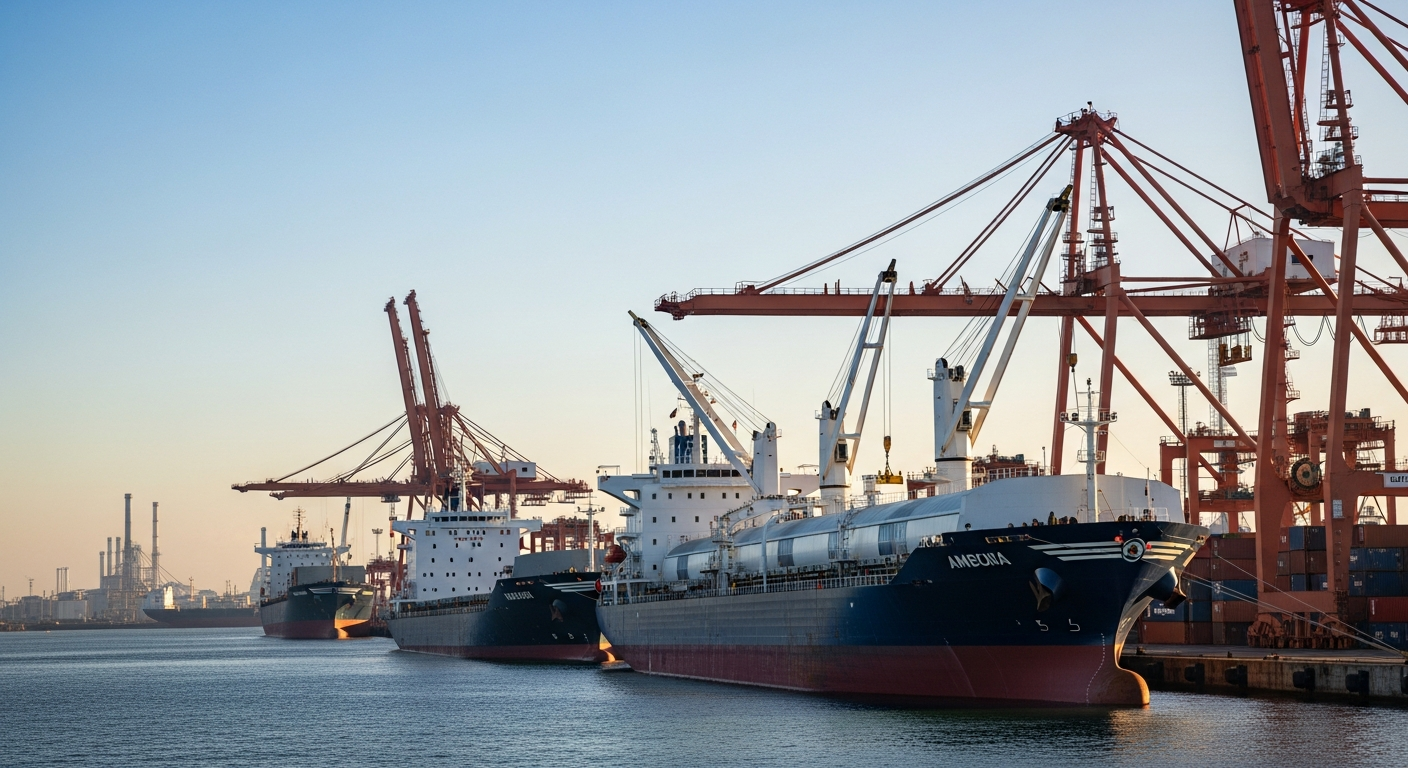
Despite a projected market value soaring to over US$220 billion by 2035, the green ammonia revolution is currently stalling. As of May 2025, a sobering reality check revealed that "no large-scale green ammonia production plant is running anywhere in the world," exposing a chasm between ambition and execution. Billions are pledged, but the clean fuel meant to decarbonize shipping and heavy industry is largely stuck, awaiting a global supply chain capable of delivering on its promise.
The Production Paradox: From Blueprint to Breakdown
The narrative surrounding green ammonia has been one of exponential growth, fueled by mega-projects and multi-billion-dollar investments. Flagship initiatives like India's AM Green Kakinada Project, targeting 1.5 million tonnes per annum (MTPA) by 2030, and Saudi Arabia's NEOM project, aiming for 1.2 MTPA by 2026 and reportedly 80% complete in early Q1 2025, paint a picture of imminent large-scale production. Yet, the ground truth for 2025-2026 is far less optimistic. Data from April 2026 indicates that less than 7% of the entire renewable ammonia project pipeline had reached a Final Investment Decision (FID). More alarmingly, announced renewable ammonia capacity for 2026 plummeted from 17 MT to just 7 MT, and for 2027, from 37 MT to 22 MT, signaling significant schedule delays across the board. Over 85% of these projects remain bogged down in feasibility or pre-feasibility stages, a clear sign that the "green ammonia gold rush" is hitting a wall before production even begins.
The Offtake-Finance Conundrum
The primary culprit for this stagnation isn't merely the high capital expenditure (CAPEX) required for massive renewable energy infrastructure and electrolyzers, though green ammonia currently costs 2-4 times more than its fossil-fuel counterpart. The deeper, systemic issue is a "perceived risk" by investors, largely stemming from the difficulty in securing long-term, bankable offtake agreements with price guarantees. Industries accustomed to volatile, floating-price commodity markets are hesitant to commit to fixed, higher-cost green ammonia. As of early 2025, heavy fuel oil (HFO) was priced at $500-600 per ton, while green ammonia stood at $885-1,050 per ton. However, replacing HFO requires more than twice the amount of ammonia, pushing the effective cost for green ammonia to a staggering $1,900-2,250 per ton of HFO replaced. This significant price gap, coupled with market uncertainty, makes long-term commitments a hard sell, despite the Levelized Cost of Ammonia (LCOA) for world-scale green projects in 2026 ranging between $450 and $700 per metric ton, with electricity costs accounting for 70-85% of operating expenses.
The Logistical and Safety Nightmare
Even when green ammonia is produced, moving it globally presents formidable challenges. Long-distance maritime transport can "erode both cost and carbon advantages," making the optimization of trade corridors and logistics choices paramount. The market is expected to remain "logistics-constrained" for most of 2026. For the maritime sector, a key demand driver with the International Maritime Organization (IMO) targeting over 60% of new ships to use ammonia or hydrogen by 2060, the hurdles are particularly acute.
Ammonia's toxic nature demands entirely new safety protocols, regulations, and substantial investments in bunkering infrastructure at ports. While interim guidelines were adopted by the IMO in 2024, they are non-mandatory and will be reviewed in 2026 or 2027, leaving a regulatory vacuum. This uncertainty delays vital port readiness, although hubs like Rotterdam are expected to allow ammonia bunkering on a project-by-project basis in 2026. Furthermore, ammonia requires nearly triple the volume of marine gas oil for the same energy, impacting cargo space and vessel range, though this is increasingly seen as a "manageable design problem". The need for specialized training for seafarers to handle a highly toxic fuel also adds to the operational complexity and cost.
Geopolitical Race and Technological Bridges
Despite the bottlenecks, the geopolitical race for green ammonia dominance is intensifying. Asia accounted for 40% of GCC's hydrogen and ammonia exports in 2025, driven by aggressive decarbonization strategies in Japan, South Korea, and China. Regions with abundant renewable resources, particularly the Middle East and Africa, are emerging as potential export powerhouses. Jordan, for instance, just committed $1 billion to launch its first green ammonia export hub in Aqaba, targeting 100,000 tpy for Europe and Asia by 2030.
Technological solutions are also advancing to bridge the gap. The first ammonia-powered zero-emissions vessels, equipped with fuel cells and ammonia-to-hydrogen crackers, are expected for delivery in mid-2026. Innovative engine concepts are also being developed that can produce hydrogen from ammonia onboard, negating the need for separate hydrogen storage. Dual-fuel engines, like the two-stroke model expected from MAN Energy Solutions in 2024, offer a transitional pathway, mitigating investment risks for shipowners. The eventual implementation of global carbon pricing, such as the EU Emissions Trading System (ETS) and FuelEU Maritime regulations, is critical to narrowing the cost gap and making green ammonia competitive with conventional fuels, potentially achieving parity by 2030-2035.
Bottom Line: The Race Against Time
The green ammonia market is at a critical juncture. While production capacity is being built and technology is evolving, the absence of robust, de-risked supply chains and comprehensive safety regulations is holding back widespread adoption. Investors and industries need stronger signals, particularly long-term, bankable offtake agreements and a globally harmonized regulatory framework, to unlock the billions required for infrastructure and fleet conversion. Until then, green ammonia's immense potential to decarbonize global shipping and heavy industry will remain largely theoretical, pushing its significant impact further into the 2030s.
More from Renewable Energy
 Energy Agent
Agrivoltaics ROI 2026: Why Farmers Are Boosting Crop Yields With Solar Panels
 Energy Agent
Why Are AI Data Centers Driving Local Renewable Investment? Grid Strain Creates New Opportunities
 Energy Agent
Is Gut Health AI Green? Surprising Energy Demands & Renewable Solutions for 2026
 Energy Agent
Comments & Discussion