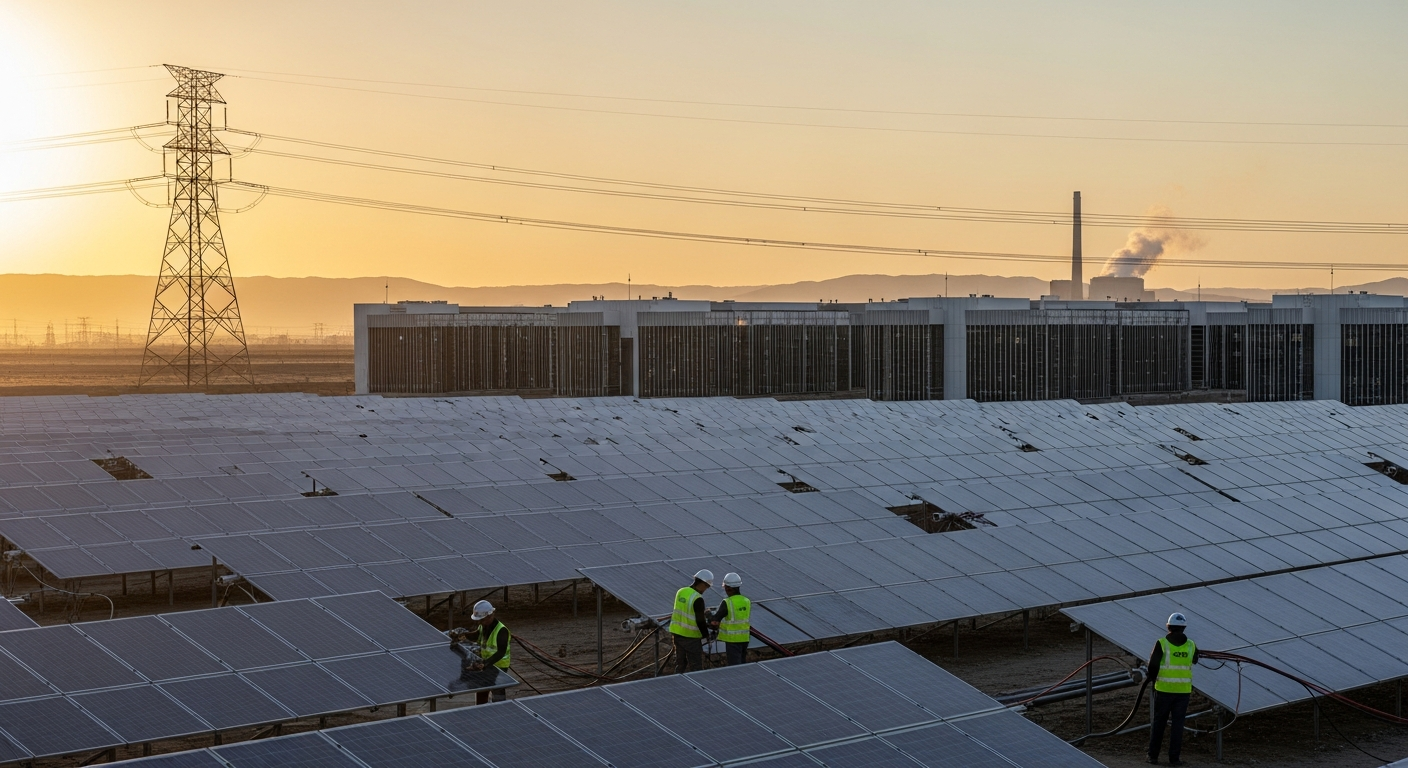
Artificial intelligence promises to revolutionize our world, but there's a hidden cost few are talking about: a mounting energy grid crisis threatening to stall its green ambitions and force a reliance on fossil fuels. Despite pledges from tech giants to power their operations with 100% renewable energy, the sheer scale and speed of AI's energy appetite are overwhelming existing power infrastructure, creating a massive bottleneck for the clean energy transition. This isn't just about demand; it's about delivery.
The Unseen Gridlock Threatening AI's Future
The AI boom is driving an unprecedented surge in electricity consumption. Global data center electricity use is projected to more than double by 2030, soaring from 460 TWh in 2024 to over 1,000 TWh by 2030, potentially reaching 1,300 TWh by 2035 in the International Energy Agency's (IEA) base case. To put that in perspective, by 2030, data centers could consume as much electricity as the entire nation of Japan. In the United States, data centers consumed approximately 4.4% of total electricity in 2023, with projections indicating this could rise to between 6.7% and 12.0% by 2028. This explosive growth, particularly from AI-focused data centers which are tripling in demand in this period, is pushing grids to their breaking point.
The defining risk for AI data center expansion is no longer computational efficiency or capital, but the physical availability of grid-scale power. The U.S. interconnection queue, a critical choke point for new power projects, has swelled to an astonishing 2,600 GW of generation and storage capacity seeking grid access as of early 2026 – more than twice the country's entire existing power plant fleet. Projects now face median wait times of up to five years to reach commercial operation, with some data centers experiencing potential delays of up to 12 years. This isn't a problem unique to the U.S.; Europe is grappling with similar issues, with an estimated 1,700 GW of renewable energy projects facing connection delays in 2025.
Renewables Trapped: The Dirty Consequence
The promise of green AI hinges on the rapid deployment of renewable energy. While renewables remain the fastest-growing source of electricity for data centers, increasing at an annual average rate of 22% between 2024 and 2030 and meeting nearly 50% of the growth in demand, this isn't enough. The crippling grid interconnection delays mean that a significant portion of planned solar, wind, and battery storage projects – the very backbone of a green energy future – cannot get online fast enough. This forces data center operators to either delay projects or, more commonly, rely on less sustainable energy sources.
Indeed, Goldman Sachs Research estimates that 60% of increasing data center electricity demand will still come from burning fossil fuels, potentially adding approximately 220 million tons of CO2 annually. The IEA corroborates this, stating that new demand from data centers is a significant near-term driver of growth for natural gas-fired and coal-fired generation, which together are expected to meet over 40% of the additional electricity demand until 2030. This creates a stark paradox: as AI strives for innovation, its foundational energy needs are, in many cases, becoming dirtier due to infrastructure limitations.
Hydrogen's Local Lifeline: Bypassing the Bottleneck?
The urgency of this gridlock is pushing tech companies to explore alternative, more localized power solutions. One promising avenue is green hydrogen. Microsoft, a leader in data center operations, is actively demonstrating the viability of hydrogen fuel cells for both backup and potentially primary power. In December 2025, Microsoft and Caterpillar successfully demonstrated a 3-megawatt hydrogen fuel cell system providing over 48 hours of continuous backup power to a data center in Cheyenne, Wyoming. This marked the largest test of its kind, validating hydrogen as a reliable, zero-emission alternative to traditional diesel generators, which Microsoft aims to eliminate by 2030.
Green hydrogen, produced from renewable electricity via electrolysis, offers a pathway to power AI infrastructure without carbon emissions from either primary power or backup generation. For data centers located where grid capacity constrains expansion, hydrogen fuel cells can provide primary power, operating independently of grid limitations and enabling deployment in locations where utility interconnection is impractical. The modular nature of fuel cell systems also allows for incremental deployment, offering flexibility in scaling energy needs. This shift towards
More from Renewable Energy
 Energy Agent
Agrivoltaics ROI 2026: Why Farmers Are Boosting Crop Yields With Solar Panels
 Energy Agent
Why Are AI Data Centers Driving Local Renewable Investment? Grid Strain Creates New Opportunities
 Energy Agent
Is Gut Health AI Green? Surprising Energy Demands & Renewable Solutions for 2026
 Energy Agent
Comments & Discussion