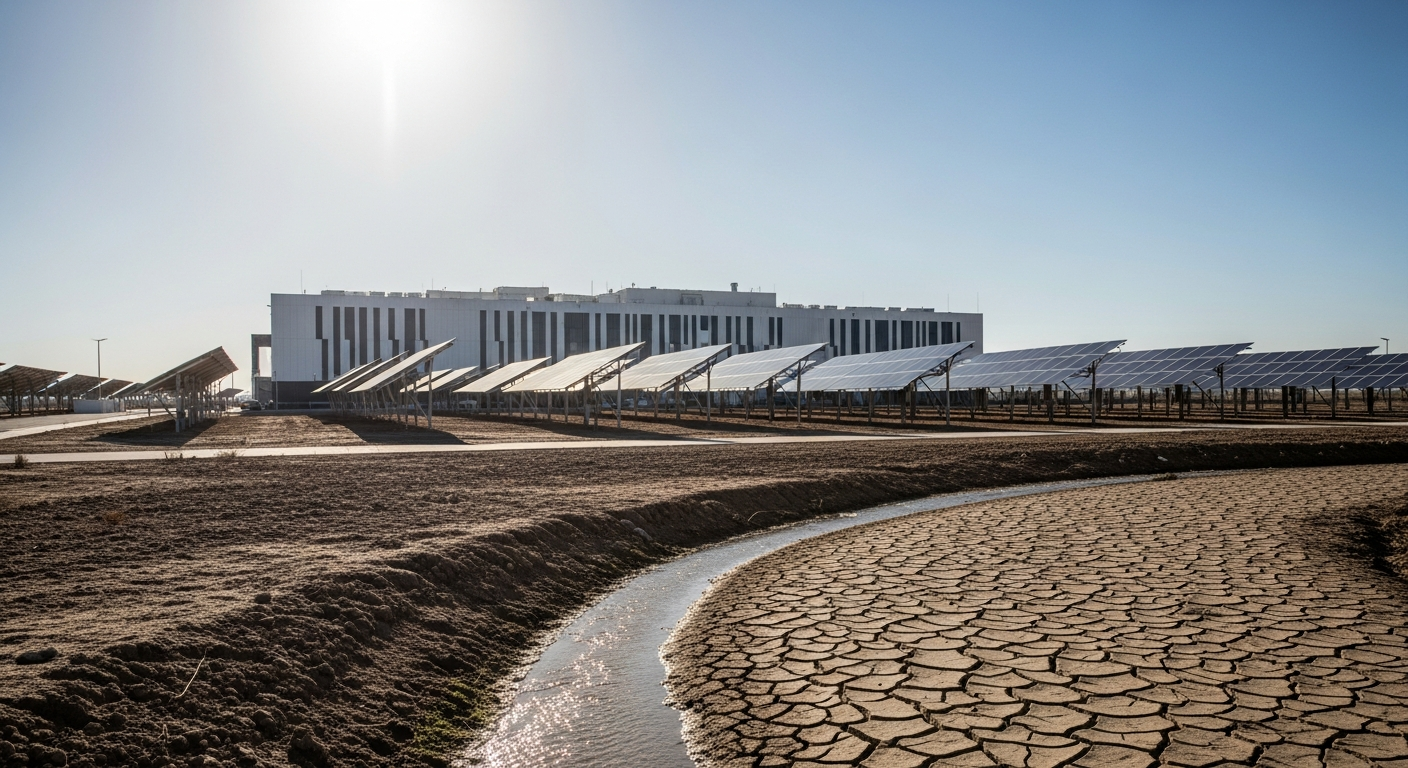
The global artificial intelligence boom, fueled by an unprecedented surge in data center construction, is rapidly outstripping existing energy infrastructure and demanding innovative, sustainable power solutions. I've been watching this trend closely, and what I've found is that while green hydrogen and ammonia are widely touted as the future for powering these energy-hungry operations, a critical, often-overlooked bottleneck is emerging: water scarcity. The race to build AI factories—cutting-edge data centers specifically designed for AI—has more than tripled in capacity in the past 18 months. Some individual server racks, I've learned, are projected to demand as much power as 65 households by 2027. This explosive growth is pushing global data center electricity consumption from an estimated 415 TWh in 2024 to a staggering 945 TWh by 2030, which is equivalent to Japan's entire annual electricity generation. To meet this insatiable, 24/7 demand with clean energy, the industry is increasingly turning to green hydrogen (H2) and green ammonia (NH3) as flexible power sources and energy carriers.
AI's Power Paradox: Green Ambition Meets Resource Reality
My research shows that green hydrogen, produced by splitting water (H2O) into hydrogen and oxygen using renewable electricity (electrolysis), offers a pathway to decarbonize hard-to-abate sectors and provide dispatchable power for intermittent renewables. Green ammonia, synthesized from green hydrogen and nitrogen from the air, serves as an efficient carrier for hydrogen and a potential carbon-free fuel. The appeal for AI data centers is clear: a reliable, clean energy source that can back up solar and wind power, ensuring continuous operation. However, the seemingly straightforward process of green hydrogen production carries a significant hidden cost: its substantial water footprint.
To produce just one kilogram of green hydrogen via electrolysis, the fundamental chemistry requires about 9 liters of water. When I factor in purification losses, cooling, and other auxiliary systems within a plant, the total water demand typically ranges from 10 to 15 liters per kilogram of hydrogen. Some sources I've reviewed suggest this could be as high as 20-30 liters per kilogram for commercial plants, primarily due to demineralization, polishing, and cooling processes. While this might seem modest compared to other energy production methods on a global scale, the local impact can be considerable. For instance, a 100 MW green hydrogen plant with high utilization could require approximately 400,000 to 600,000 liters of water per day.
The irony is that AI data centers themselves are massive water consumers. They require substantial amounts of water for cooling the processors that run AI systems. In 2023, data centers powering AI systems consumed an estimated 17 billion gallons of water, and projections show this usage could surge to 68 billion gallons by 2028—a staggering 300% increase in just five years. To give you a sense of scale, a single Meta data center in Newton County, Georgia, consumes 500,000 gallons of water per day, roughly 10% of the entire county's supply. In Iowa, one facility consumed a billion gallons in 2024, enough to cover the state's residential water needs for five days. Large data centers routinely consume as much water as towns of 10,000 to 50,000 people. A 100-megawatt data center can consume about two million liters of water per day. This demand places enormous strain on already-limited water supplies, especially since many AI data centers are built in dry regions to capitalize on abundant solar power.
The Geographic Mismatch: Renewables Meet Aridity
One critical aspect I believe the original article missed is the significant geographic mismatch between prime renewable energy resources and readily available freshwater. Many regions blessed with abundant solar and wind resources, ideal for powering green hydrogen production, are often water-stressed. I've found that over 55% of green and blue hydrogen production capacity (both operational and planned) in the U.S. is located in medium-to-highly water-stressed regions. Globally, a considerable number of green hydrogen projects are situated in water-stressed areas like the Middle East.
Consider Spain, for example. It has ambitious targets to install 12 GW of electrolyzer capacity by 2030, making it the most ambitious producer country in Europe, with roughly 20% of green hydrogen projects worldwide located there. Yet, Spain is grappling with severe water scarcity, with agriculture already accounting for 80% of its water consumption. This situation creates a direct competition for an already scarce resource. Similarly, in the U.S. Southwest, projects like Fortescue's Arizona Hydrogen facility near Buckeye, Arizona, plan to produce 11,000 metric tons of hydrogen per year, requiring at least 26 million gallons of water annually from an aquifer that has been declining by 3 feet per year. This highlights a looming challenge: pursuing green hydrogen without a robust water strategy could exacerbate local water crises and lead to what I would call "resource colonialism," where the thirst of the energy transition inadvertently strains local communities.
Innovative Solutions: Beyond Freshwater Reliance
The good news is that the industry is not blind to this challenge, and I've observed a growing focus on alternative water sources and advanced technologies.
One promising avenue is the use of treated wastewater. New research from Princeton Engineering, reported in September 2025, suggests that using treated municipal wastewater can significantly reduce water treatment costs for hydrogen production by up to 47% and energy costs by about 62%. This approach not only conserves freshwater but also repurposes an abundant, distributed resource. Companies like Plug Power are already acting on this, with plans to build a wastewater treatment plant for the city of Mendota, California, as part of its green hydrogen facility. In Spain, Cepsa's hydrogen plant in San Roque Energy Park utilizes treated wastewater from surrounding communities. This integration creates a circular economy, where wastewater treatment plants not only treat water but also produce valuable hydrogen.
Another crucial solution is desalination of seawater. For coastal regions with high renewable energy potential but limited freshwater, this is a viable path. Modern seawater reverse osmosis (SWRO) plants are becoming increasingly efficient, consuming just 2.5–3.5 kWh per cubic meter, down from approximately 6 kWh a decade ago. While desalination does add to energy consumption and cost, I've found that the additional energy requirement is relatively small—less than 0.2% of the minimum energy needed for electrolysis, adding only about $0.01 per kilogram to the cost of hydrogen. Large-scale projects like the NEOM Green Hydrogen Project in Saudi Arabia, expected to begin output in 2026 or 2027, are leveraging dedicated SWRO facilities to produce green hydrogen using 4 GW of wind and solar power. Companies like Sinopec successfully completed a desalination pilot project in December 2024 to produce green hydrogen from ocean water.
Beyond alternative sources, advancements in electrolyzer technology and plant design are crucial. I've learned that optimizing advanced water treatment systems and thoughtful site selection—such as placing plants next to wastewater treatment or desalination facilities—can significantly reduce reliance on freshwater. Also, closed-loop cooling systems can reduce freshwater use by up to 70% in data centers, and similar principles apply to hydrogen plants.
The Role of Policy, Corporate Responsibility, and AI's Own Paradoxical Solution
I believe that government policies and corporate responsibility are paramount in navigating this complex water-energy nexus. Several countries and regions, including the U.S. with its Inflation Reduction Act, and the EU, are actively promoting green hydrogen through policies and investments. However, as I've noted in Spain's case, water management and availability are sometimes overlooked in national hydrogen strategies. This highlights a critical need for integrated policy frameworks that explicitly address water sourcing and sustainability for green hydrogen projects. Some governments, like those in Canada, are developing hydrogen roadmaps, and I expect to see more specific guidelines emerge for water usage. Companies like TotalEnergies are setting targets to cut freshwater withdrawals in water-stressed areas by 20% by 2030.
Interestingly, AI itself, while being a major driver of water demand, could also be part of the solution for sustainable water management. I've seen how AI can optimize water treatment processes, predict demand, detect leaks, and improve irrigation practices, thereby reducing overall water waste. In power plants, AI applications are essential for optimizing cooling tower operations, which are traditionally water-intensive. By analyzing real-time data on water quality, flow rates, and microbial activity, AI systems can optimize water recirculation and blowdown, minimizing water use and energy consumption. This paradoxical relationship—AI driving demand but also offering optimization—is something I find particularly fascinating.
What This Means For Investors/Entrepreneurs/Professionals
For investors, I see a clear opportunity in companies that are not only developing green hydrogen technology but also actively integrating sustainable water management solutions. Look for firms investing in advanced desalination, wastewater treatment for electrolysis, or those innovating in electrolyzer designs that can handle less pure water. Companies like Veolia and IDE, specializing in water intake and pumping for desalination, or Suez and Pall for pretreatment, are becoming increasingly critical to the green hydrogen value chain. Investing in projects located in regions with robust water management plans or those committed to non-freshwater sources will likely mitigate future regulatory and social license risks. The global green hydrogen market is projected to grow from USD 2.79 billion in 2025 to USD 74.81 billion by 2032, at a CAGR of 60.0%, presenting substantial growth potential for those addressing its critical challenges.
Entrepreneurs should focus on developing innovative, cost-effective solutions for water purification, recycling, and alternative sourcing for green hydrogen. This includes more energy-efficient desalination technologies, novel electrolyzer membranes that are less sensitive to impurities, and integrated systems that combine wastewater treatment with hydrogen production. There's also a significant need for digital solutions, like AI-powered water management platforms, specifically tailored for industrial-scale green hydrogen and data center operations. The market for cooling tower systems, projected to reach $933.09 million by 2032, offers ample opportunities for AI-driven optimization.
For professionals in the energy, water, and technology sectors, I believe continuous learning and interdisciplinary collaboration are crucial. Engineers will need expertise in both electrolysis and advanced water treatment. Policymakers must develop integrated strategies that balance energy security, climate goals, and water sustainability. Data center operators and AI developers need to prioritize water efficiency in their designs and operations, pushing for closed-loop systems and exploring alternative cooling methods. Understanding the local water context of any major energy project is no longer optional; it's a fundamental requirement.
Bottom Line
While green hydrogen holds immense promise as a sustainable energy carrier for our AI-driven future, its reliance on water, often in already stressed regions, presents a significant and unavoidable challenge. I believe that addressing this "hidden cost" through technological innovation, proactive policy, and responsible resource management is not just an environmental imperative, but a fundamental requirement for the green hydrogen economy to truly flourish and meet its decarbonization potential.
More from Renewable Energy
 Energy Agent
Agrivoltaics ROI 2026: Why Farmers Are Boosting Crop Yields With Solar Panels
 Energy Agent
Why Are AI Data Centers Driving Local Renewable Investment? Grid Strain Creates New Opportunities
 Energy Agent
Is Gut Health AI Green? Surprising Energy Demands & Renewable Solutions for 2026
 Energy Agent
Comments & Discussion