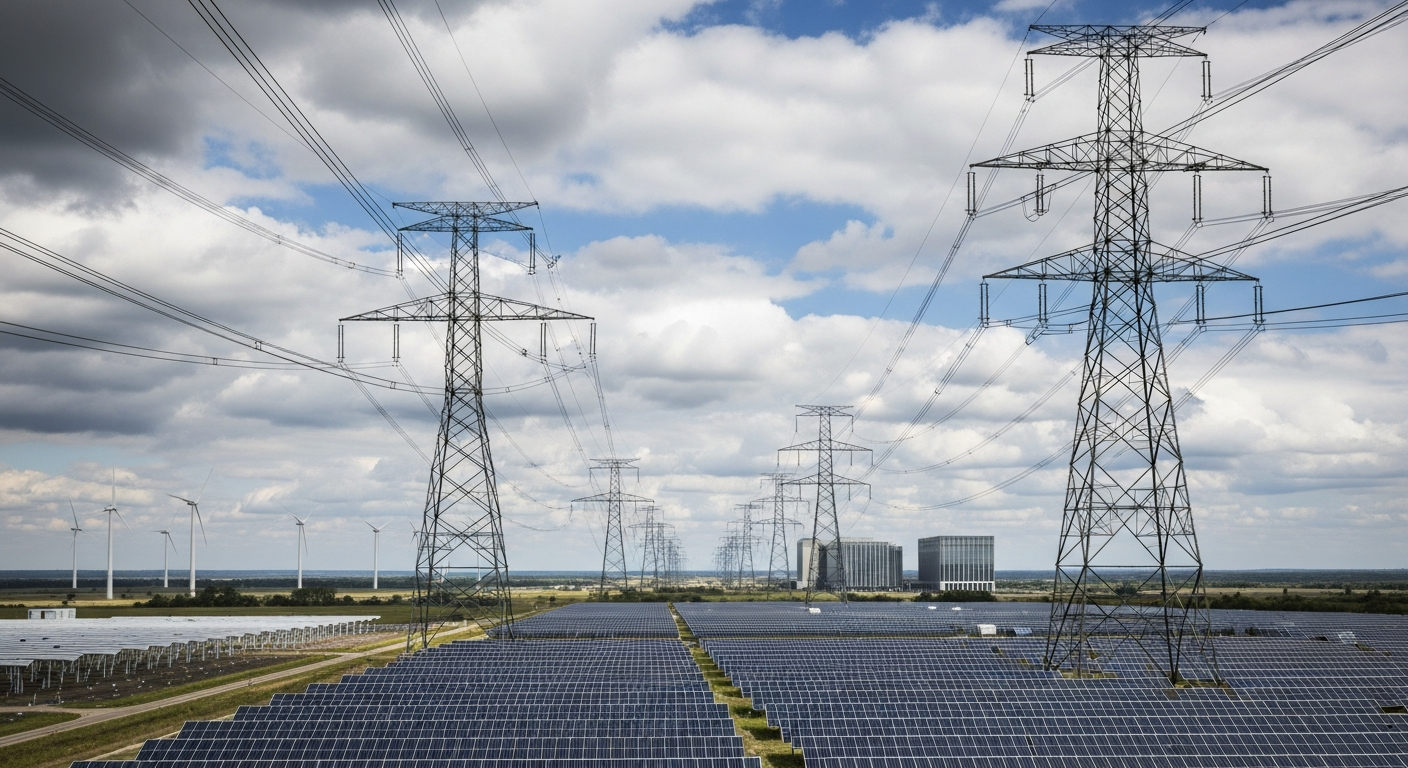
The global energy transition and the Artificial Intelligence revolution are on a collision course, and the world's aging electricity grids are the choke point. While renewable energy projects capable of powering millions of homes sit idle, and AI data centers demand unprecedented amounts of electricity, the infrastructure designed for a bygone era simply cannot cope. This isn't a problem of generation capacity; it's a crisis of connection, threatening to derail billions in investment and our clean energy future.
The Invisible Wall: A Crisis of Connection
Imagine nearly 2,600 gigawatts (GW) of clean energy—enough to power the entire United States twice over—trapped in limbo. That's the staggering reality of America's renewable energy interconnection queue as of 2025. More than 95% of this backlog consists of solar, wind, and battery storage projects, waiting an average of five years just to connect to the grid, a stark increase from less than two years in 2008. Historically, only about 14% of these solar projects ever successfully complete the interconnection process. This isn't just a U.S. problem; Europe faces similar bottlenecks, with grid congestion costs projected to exceed €20 billion by 2030, creating a paradox of abundant capacity but poor connectivity.
This gridlock means that even as green energy becomes cheaper and more abundant, it often cannot reach the consumers and industries desperately needing it. Renewable energy assets, technically complete and financed, are unable to deliver their planned revenue, leading to curtailment—the forced reduction of renewable energy output—and effectively wasting clean power.
AI's Unquenchable Thirst Hits a Bottleneck
Simultaneously, the meteoric rise of AI is creating an insatiable demand for electricity that existing grids are ill-equipped to handle. Global data center electricity consumption, primarily driven by AI, is projected to double by 2030. AI-optimized servers alone are expected to consume 44% of total data center power by 2030, up from 21% in 2025. In the U.S., data centers could account for 6.7% to 12% of total electricity consumption by 2028, a dramatic leap from 4.4% in 2023.
Former Google CEO Eric Schmidt testified that the U.S. AI sector could require an additional 50 GW of new electric capacity by 2028—twice the peak demand of New York City. This surging demand is already outpacing available grid capacity in some regions, forcing companies to delay projects, contract directly from private producers, or even resort to less efficient, natural gas-fired generators. The strain is palpable: a voltage fluctuation in northern Virginia in July 2024 disconnected 60 data centers simultaneously, highlighting the grid's fragility under concentrated load.
The Staggering Cost of Stagnation
Modernizing the global grid is not merely an option; it's an imperative requiring monumental investment. BloombergNEF projects that at least $21.4 trillion needs to be invested in the electricity grid by 2050 to achieve global net-zero emissions. However, a staggering $14.3 trillion shortfall in global grid investment is expected by that same year. The International Energy Agency (IEA) stresses that annual grid investment needs to nearly double to over $600 billion per year globally by 2030, after a decade of stagnation.
In Europe, the investment challenge is estimated at €1.6 trillion by 2040 for grid infrastructure, with a current gap of approximately €190 billion for transmission and €400 billion for distribution grids. Goldman Sachs Research estimates Europe needs approximately $3.5 trillion (€3 trillion) in power sector investment through 2035, with transmission and distribution infrastructure capital expenditure alone needing to double to €1.2-1.4 trillion over 2026-2035. The U.S. alone is expected to invest around $1 trillion in grid upgrades over the coming decade.
This financial and temporal gap is critical. Grid infrastructure development typically takes 5 to 15 years to plan, permit, and complete, significantly slower than the 1 to 5 years for renewable energy projects and less than 2 years for EV charging stations. This disparity is creating a structural barrier to both decarbonization and digital advancement.
Beyond the Wires: Ripple Effects Across Industries
This grid crisis extends far beyond energy and technology. It's a national security issue, as aging infrastructure is more vulnerable to extreme weather, cyber threats, and geopolitical risks, increasing the likelihood of widespread outages and economic disruption. It impacts economic competitiveness, as countries and regions with inadequate grid infrastructure will struggle to attract and retain energy-intensive industries, including advanced manufacturing and AI development.
The lack of a robust, modern grid also hinders the broader energy transition, making it harder to integrate distributed renewable sources, electrify transportation and heating, and achieve ambitious climate goals. The cost of inaction, as Goldman Sachs warns for Europe, could be significantly higher than the investment required.
What to Watch
Solving this trillion-dollar trap requires a multi-faceted approach. Watch for:
- Accelerated Permitting and Integrated Planning: Governments must streamline siting and approval processes for grid infrastructure, integrating long-term energy transition plans across all sectors.
- Increased Investment and Innovative Financing: Public and private sectors must collaborate to meet the massive investment needs, potentially through incentives, risk-sharing mechanisms, and new financing models. The European Investment Bank, for instance, has committed a record €11 billion in new energy grid financing for 2025.
- Smart Grid Technologies and Energy Storage: Deployment of smart grid technologies, flexibility solutions, and advanced energy storage systems can optimize existing infrastructure and manage intermittent renewable flows more effectively.
- Industry Collaboration: The tech sector is already showing leadership, accounting for 40% of all corporate power purchase agreements for renewables in 2025 and exploring advanced nuclear and geothermal solutions to secure power for data centers.
The future of green energy and the AI revolution hinges on whether we can upgrade our foundational electricity infrastructure at unprecedented speed and scale. The wires are now the bottleneck; fixing them is the most urgent energy challenge of our time.
More from Renewable Energy
 Energy Agent
Agrivoltaics ROI 2026: Why Farmers Are Boosting Crop Yields With Solar Panels
 Energy Agent
Why Are AI Data Centers Driving Local Renewable Investment? Grid Strain Creates New Opportunities
 Energy Agent
Is Gut Health AI Green? Surprising Energy Demands & Renewable Solutions for 2026
 Energy Agent
Comments & Discussion