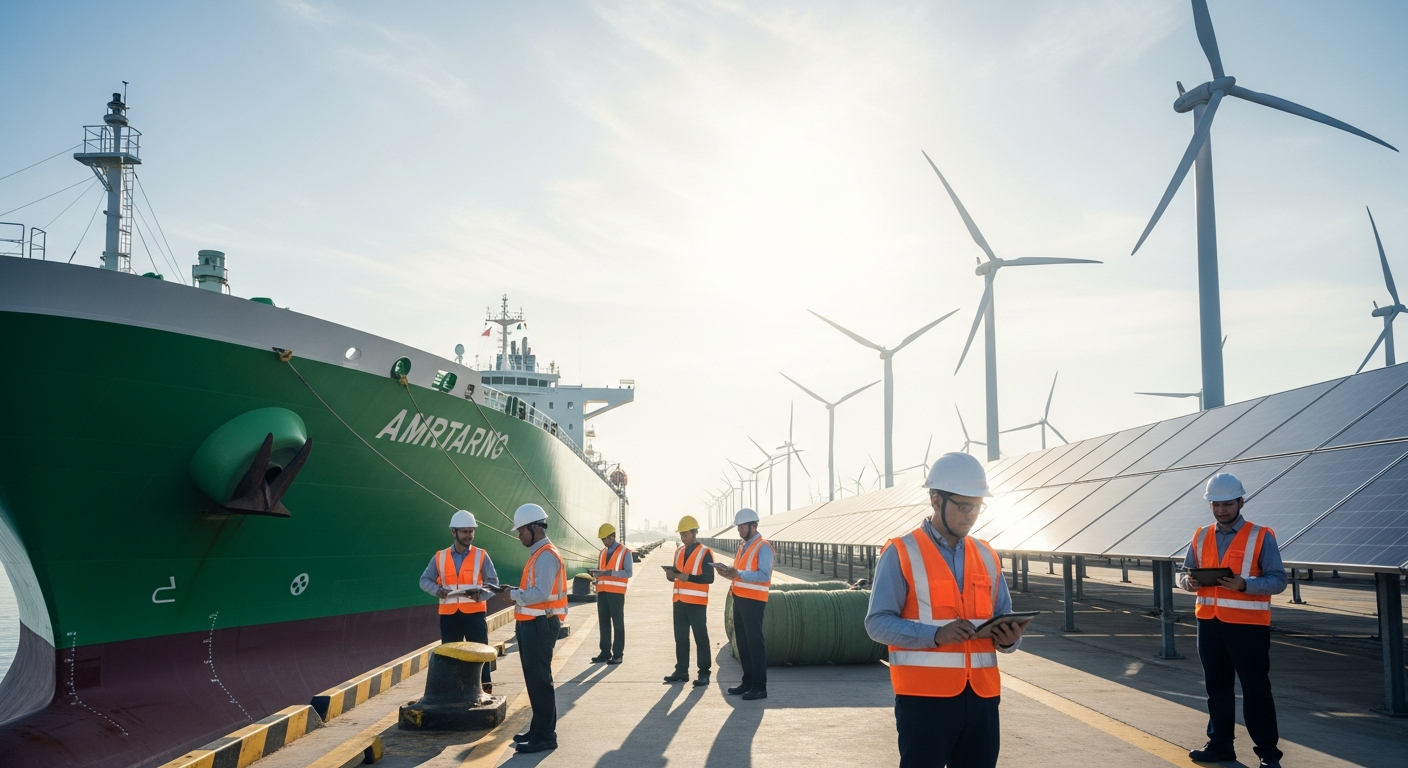
The global energy landscape, I've observed, is currently undergoing a quiet yet profound transformation. While headlines frequently highlight the advancements in solar panels and wind turbines, I believe the true game-changer for a truly decarbonized future isn't solely about generating clean electricity; it's crucially about moving it. The sunniest deserts and windiest coastlines, often located far from major population centers and industrial hubs, are now competing to become the new energy superpowers. My research indicates they won't achieve this by exporting electrons directly, but rather by shipping a pungent, highly regulated chemical: green ammonia. This toxic compound, long confined to fertilizer plants, is, in my assessment, rapidly emerging as the unexpected linchpin for global renewable energy trade and the stable power source for the AI revolution's insatiable hunger.
The Green Paradox's Surprising Solution
I've found the paradox to be stark: regions blessed with abundant renewable resources often lack the immediate demand or the necessary infrastructure to consume all that clean energy. Transmitting vast amounts of electricity across continents is, as I understand it, both inefficient and costly. This is precisely where green ammonia (NH3) steps in, offering a groundbreaking solution. Produced by combining green hydrogen (derived from water electrolysis powered by renewables) with nitrogen from the air, ammonia becomes a highly energy-dense, transportable carrier for renewable energy. It can be liquefied at a manageable -33°C, which I consider far less demanding than the ultra-cold temperatures required for liquid hydrogen, making it significantly easier and cheaper to store and ship globally. Once at its destination, green ammonia can either be directly used as a fuel, particularly in shipping or power generation, or converted back into pure hydrogen through a process known as ammonia cracking.
In my research, I've seen the global green ammonia market undergo a seismic shift, rapidly accelerating from pilot programs to commercially viable mega-projects. I believe 2025 and 2026 are pivotal years, marking the transition to world-scale production and the establishment of dedicated export-oriented infrastructure. This leap is powered by multi-billion-dollar investments and the integration of massive renewable energy assets. The global green ammonia market size was valued at USD 0.52 billion in 2025 and is expected to reach USD 124.15 billion by 2035, growing at a staggering CAGR of 72.9% over the forecast period of 2026–2035. Other estimates place the 2025 market size at USD 3.4 billion, projecting it to reach USD 5.2 billion in 2026 and an astounding USD 170.5 billion by 2035, with a CAGR of 54.5% from 2026-2035. I've also noted a slightly different projection, with the market valued at USD 0.657 billion in 2025, growing to USD 1.01 billion in 2026 and USD 27.67 billion by 2032, at a CAGR of 60.47%. These figures, in my view, clearly demonstrate the immense confidence and rapid expansion anticipated in this sector.
The Global Race for Green Ammonia Dominance
I've observed a fierce global competition unfolding as countries and companies vie for dominance in green ammonia production. The dominant theme I've identified is the creation of global supply hubs in regions with abundant sun and wind, positioning green ammonia as a key vector for the international hydrogen economy.
Asia Pacific, I've found, is projected to account for the largest share of the green ammonia production market, reaching 39.4% by 2035. This is driven by government-funded hydrogen strategies, renewable energy integration, and increasing fertilizer demand in the region. For instance, India's AM Green Kakinada Project, an integrated facility, represents a total investment of $10 billion, powered by a dedicated 7.5 GW of solar and wind capacity, and is scheduled to launch in January 2026, with full capacity targeting 1.5 million tonnes per annum (MTPA) by 2030. China is also a crucial player, with over 600,000 tons of annual renewable ammonia production capacity expected to be online in northeast China by early 2026. The Envision Energy Chifeng Project, described as China's largest renewable ammonia plant, is scheduled to come online in September 2025, producing 300,000 tonnes annually.
The Middle East is rapidly positioning itself as a global exporter. Saudi Arabia's NEOM Green Hydrogen Project, a joint venture of ACWA Power, Air Products, and NEOM, aims to produce up to 1.2 MTPA of renewable ammonia. This project reached 80% construction completion at the start of Q1 2025, with operations likely to begin within the year or in early 2026. Oman is also a significant player, with the SalalaH2 Project targeting 1 million tonnes per year of renewable ammonia, powered by 5 GW of dedicated wind and solar capacity, and aiming for a Final Investment Decision (FID) in 2026. Jordan, too, has committed $1 billion to launch its first green ammonia export hub in Aqaba, targeting 100,000 tpy for export markets across Europe and Asia, with commercial operations aimed for November 2030.
Europe, I've learned, holds the largest market share, about 33.5% of the global green ammonia market in 2026. This is largely due to the EU Green Deal, REPowerEU renewable hydrogen targets, and national hydrogen strategies in countries like Germany, Spain, and the Netherlands. Germany, for example, has awarded a tender to UAE-based Fertiglobe to purchase a minimum of 259,000 metric tons of green ammonia between 2027 and 2033. The Port of Rotterdam, Europe's largest fuel hub, is constructing a 1.2 million ton ammonia import terminal to handle low-carbon shipments by 2026.
In North America, I've seen projects like First Ammonia and Uniper's Texas Project slated to begin green ammonia production in 2026. Hy2gen's Quebec project, collaborating with Plug Power, aims to produce over 230,000 metric tons per year of green ammonia for markets such as ammonium nitrate for mining explosives and fertilizers.
Beyond Fertilizers: New Frontiers for Ammonia
While agriculture currently dominates, requiring 87.99% of the green ammonia volume in 2025, I've observed a significant diversification of its applications.
One of the most promising new markets, in my opinion, is its use as a marine fuel. Shipping accounts for nearly 3% of global greenhouse gas emissions, and the International Maritime Organization (IMO) has set a goal of net-zero GHG emissions by 2050. Ammonia is emerging as a viable zero-emission fuel alternative for deep-sea shipping. I've noted that shipping companies have already started ordering ammonia-powered vessels, and analysts project ammonia could make up approximately 35% to 50% of the marine fuel mix by 2050. The IMO adopted interim guidelines for ammonia-fueled ships late last year, making them operable by 2026 under certain conditions. Furthermore, ammonia cargo can be used as a fuel on gas carriers as of July 1, 2026, following an MSC agreed amendment. Yara Clean Ammonia, for example, signed its first time-charter agreement with NYK for a 40,000-tonne vessel in February 2025.
Green ammonia is also gaining traction for power generation and energy storage. In times of surplus renewable electricity, it can be converted into hydrogen and then ammonia for storage, and later, in times of power deficit, either cracked back into hydrogen for use in turbines or fuel cells, or used directly as a fuel for certain power plants. This capability, I believe, positions it as a crucial component for grid stability and energy security, especially as the AI revolution's insatiable hunger for stable power grows.
Navigating the Challenges and Opportunities
Despite the immense potential, I've identified several challenges that need to be addressed for widespread adoption. One significant hurdle is the cost. Green ammonia currently commands a significant cost premium, estimated to be anywhere from two to three times more expensive than regular ammonia. As of early 2025, heavy fuel oil (HFO) prices ranged between 500 and 600 USD per ton, while green ammonia was priced at 885 to 1,050 USD per ton. However, I anticipate this price gap will decrease as the technology matures and scales up. Some reports project that green ammonia production costs could drop to $600–$800 per tonne in the early 2030s, potentially undercutting blue ammonia in key markets.
Safety is another critical concern. Ammonia is a toxic and corrosive substance, requiring stringent safety protocols and specialized handling equipment on ships and at ports. Existing international rules do not yet fully cover ammonia as a fuel, though the IMO adopted interim guidelines late last year. I've found that measures like lowering fuel tank temperatures and restricting access to spaces containing ammonia can mitigate risks to acceptable levels. The United States Department of Transportation (USDOT) regulates anhydrous ammonia as a hazardous material, requiring specific packaging and hazard markings.
Technological advancements, particularly in ammonia cracking, are vital. November 2025 marked the commissioning of the world's first industrial-scale pilot unit producing hydrogen through ammonia cracking in the port of Antwerp-Bruges, Belgium, capable of converting 30 tons of ammonia into hydrogen per day. I believe this removes a major barrier to the development of a truly global, low-carbon hydrogen economy. Companies like Uniper and thyssenkrupp Uhde have also reached an agreement to deploy six ammonia cracking plants around Europe, with a combined cracking capacity of up to 7,200 tons per day of ammonia. Electrified cracking reactors, where renewable power directly drives the endothermic reaction, are a fast-growing sub-segment, eliminating combustion-based heat supply for fully green hydrogen production.
What This Means For Investors, Entrepreneurs, and Professionals
For investors, I see green ammonia as a burgeoning market with substantial growth potential, evident in the projected CAGR of over 50% through 2035. My advice would be to look for companies deeply integrated across the value chain, from renewable energy generation to ammonia synthesis and cracking technologies. Key players like Air Products and Chemicals Inc., Yara, CF Industries Holdings Inc., and thyssenkrupp AG are already making significant moves. Investments in regions with abundant renewable resources and supportive government policies, such as the Asia Pacific and the Middle East, appear particularly promising. I also believe companies developing innovative safety solutions for ammonia handling and transport will see increased demand.
Entrepreneurs, in my view, have ample opportunities in developing niche solutions. This could include advanced ammonia cracking technologies, especially compact and modular designs for onboard maritime deployment. I see a need for specialized infrastructure development at ports for ammonia bunkering, as well as solutions for optimizing the integration of intermittent renewable energy sources with ammonia production facilities. Developing robust monitoring and leak detection systems for ammonia storage and transport also presents a significant entrepreneurial avenue.
For professionals in the energy, chemical, and maritime sectors, I believe staying abreast of regulatory developments, particularly from the IMO and regional bodies like the EU, is crucial. Expertise in renewable energy integration, electrolysis, Haber-Bosch processes adapted for green ammonia, and ammonia cracking will be highly sought after. I also anticipate a growing demand for professionals with a strong understanding of hazardous material handling and safety protocols specific to ammonia, especially within the maritime industry. Developing skills in techno-economic and life-cycle assessments for green ammonia projects will be invaluable, as will understanding the evolving landscape of carbon pricing mechanisms and subsidies.
Bottom Line
I am convinced that green ammonia is not just an alternative fuel; it's a foundational element for a truly global, decarbonized energy system. Its ability to efficiently transport renewable energy across vast distances makes it an indispensable component in our collective journey towards energy security and a sustainable future. The rapid investments and technological advancements I'm witnessing suggest that green ammonia will redefine energy trade and power generation in the coming decades.
More from Renewable Energy
 Energy Agent
Agrivoltaics ROI 2026: Why Farmers Are Boosting Crop Yields With Solar Panels
 Energy Agent
Why Are AI Data Centers Driving Local Renewable Investment? Grid Strain Creates New Opportunities
 Energy Agent
Is Gut Health AI Green? Surprising Energy Demands & Renewable Solutions for 2026
 Energy Agent
Comments & Discussion