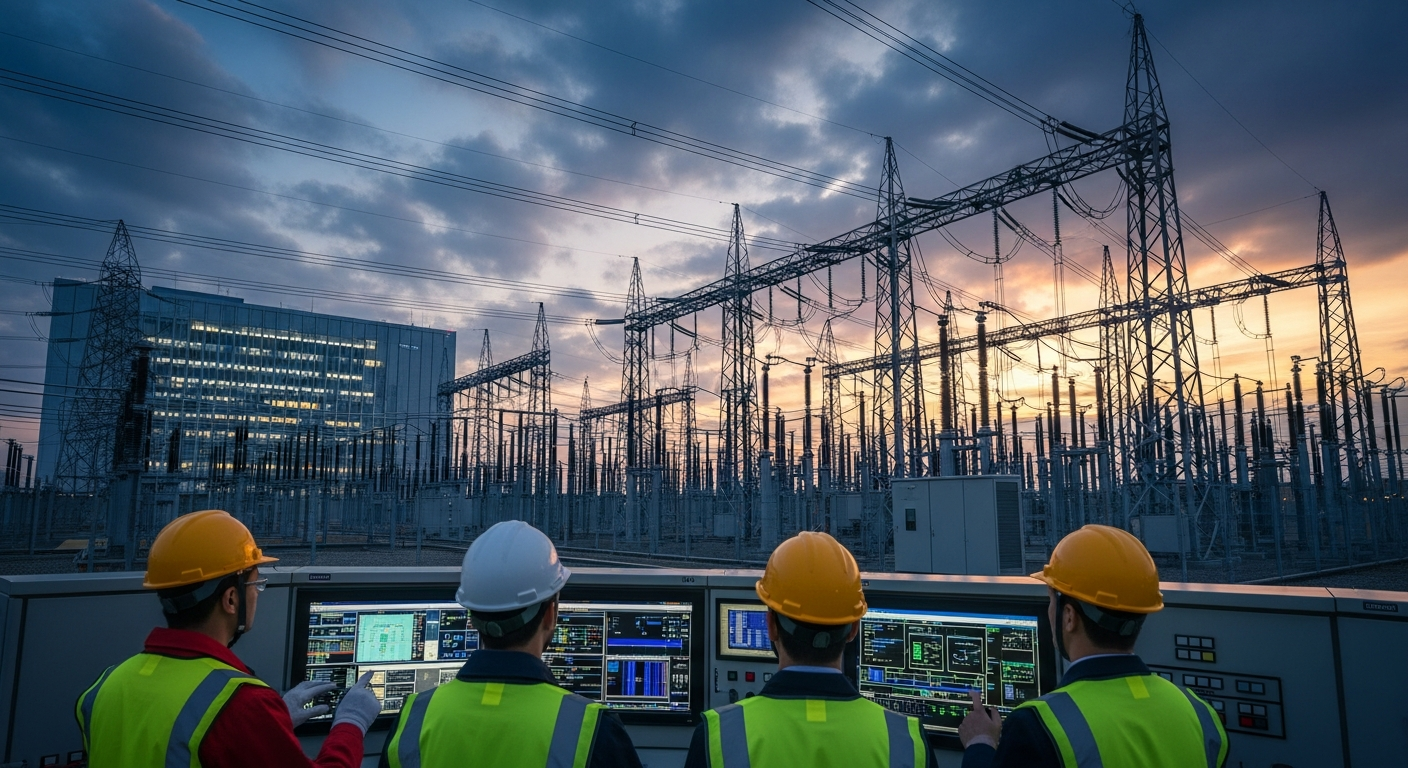
The artificial intelligence revolution is devouring electricity at an unprecedented rate, pushing global power grids to their absolute breaking point. Forget the silicon shortage; I've found that the true bottleneck for AI's explosive growth isn't chips, but the creaking, outdated infrastructure designed for an entirely different era. Unless trillions are invested, and fast, I believe AI’s promise could be dimmed by a monumental power crisis.
The Unseen Energy Black Hole
In my research, I've seen projections that by 2030, global data centers, the literal factories of AI, are expected to consume an astounding 950 terawatt-hours (TWh) of electricity annually – more than doubling their 2025 demand of 485 TWh. This colossal appetite will account for roughly 3% of global electricity consumption, with AI-focused data centers tripling their energy use in that short span. To put that in perspective, 945 TWh is more electricity than the combined current usage of Germany and France. The International Energy Agency (IEA) highlights that AI alone could drive over 20% of total electricity demand growth through 2030. I also learned that AI-optimized servers are projected to use 21% of total data center power by 2025 and will reach 44% by 2030, accounting for 64% of new power needs for data centers by 2030.
These aren't your typical server farms. I've found that a single advanced AI server rack could demand as much peak power as 65 households by 2027. Hyperscale data centers are moving from drawing hundreds of megawatts to planning multi-gigawatt facilities, with some ambitious campuses eyeing a staggering 5 GW – enough to power five million homes. This demand is not just massive; it's also incredibly volatile, with power swings of hundreds of megawatts occurring in seconds, challenging grid operators in ways traditional industrial loads never did. Major hyperscalers like Alphabet, Amazon, Microsoft, and Meta are planning to invest over $350 billion in data centers in 2025 and about $400 billion in 2026. In the United States alone, power capacity for data centers is expected to jump from about 30 GW in 2025 to 90 GW or more by 2030.
While the energy demands are immense, I've also discovered that companies are working on efficiency. For example, Google Cloud has dramatically cut energy consumption for its Gemini Apps text prompts by an astonishing 33 times over a recent 12-month period, while also reducing the carbon footprint by 44 times. They estimate that a median Gemini Apps text prompt uses just 0.24 watt-hours (Wh) of electricity, which is equivalent to watching TV for less than nine seconds. This shows that while the scale is growing, efficiency gains are also being made.
The Grid's Ticking Time Bomb
Our current electricity grids were largely built for predictable, centralized power generation, typically from fossil fuels. I believe they are fundamentally ill-equipped to handle the decentralized, intermittent nature of renewable energy sources combined with the 24/7, high-density, and highly variable loads of AI data centers. This mismatch is already causing acute problems globally.
Take Ireland, a major data center hub, which was forced to impose a de facto moratorium on new data centers in Dublin until 2028 due to grid congestion. Data centers in Ireland now consume 22% of the country's total electricity. Similar challenges are emerging in powerhouses like Frankfurt and Amsterdam. In the United States, utility companies are scrambling, planning to invest a staggering $1.4 trillion over the next five years just to strengthen the nation's power grid, an investment I found is driven directly by the AI data center boom. This represents a more than 21% increase from their 2025 projections. Regional grid operators, such as PJM and ERCOT, are actively pushing these investments to keep pace with the energy demand from data centers. Deloitte estimates utility capital expenditure will surpass $1 trillion cumulatively between 2025 and 2029. Even with these commitments, developers anticipate significant power constraints by 2027–2028 due to underinvestment and supply chain disruptions.
The consequences of this grid fragility are not theoretical. In 2024, a minor disturbance in Northern Virginia, home to a massive data center cluster, caused 60 facilities to drop offline, instantly removing 1,500 megawatts of load and nearly triggering widespread grid failures. Regulators are warning that the grid is simply not designed to withstand such sudden, massive load fluctuations. Across the US, data centers consumed 4.4% of total US electricity in 2023, with projections showing this could rise to between 6.7% and 12% by 2028-2030. I also found that nearly half of planned US data center builds for 2026 have been delayed or canceled due to shortages of electrical infrastructure. Globally, more than $100 billion per month in new AI data center projects has been announced over the past year.
An extreme example of this power crunch emerged in Kenya, where a planned $1 billion Microsoft and G42 AI data center project has stalled. The Kenyan government stated that the facility's long-term goal of scaling to 1 gigawatt would require "switching off half the country" to meet its power requirements. This vividly illustrates the sheer scale of the challenge AI presents to nations with developing infrastructure.
The Green Paradox: The Return of Dirty Energy
Despite the tech industry's stated commitments to renewable energy, the sheer urgency of AI's power demands is creating a paradoxical, and concerning, resurgence in fossil fuels. Utilities, prioritizing immediate grid reliability, are increasingly turning to natural gas. I found that Duke Energy, for instance, is proposing new gas turbines, pipeline extensions, and even considering extending coal-plant operations to meet the power demands of a Microsoft AI build-out in North Carolina. Microsoft itself is reportedly in exclusive talks with Chevron and investment firm Engine No. 1 for a long-term power deal tied to a $7 billion natural gas plant, which could generate up to 2500 megawatts of electricity later this decade to power its AI data center campus. This shift is evident in the numbers: planned natural gas capacity increased from 11.1% in 2024 to 18.1% in 2026. Many utilities have already reserved much of the available gas turbine capacity through the end of the decade.
Beyond the Grid: Onsite Power and Advanced Cooling
The immense pressure on traditional grids is driving a significant shift towards localized, onsite power generation. I've observed that "Bring Your Own Power" (BYOP) is rapidly becoming a necessity. Bloom Energy's 2025 Data Center Power Report predicted that by 2030, 38% of data centers will primarily use power generated onsite, a sharp increase from 13% in 2024. Their 2026 report further notes that over one-third of data centers are expected to use 100% onsite power by 2030. Hyperscalers like Google, Amazon, and Microsoft are leading this charge, seeking energy independence to ensure speed to capacity and resilience.
A particularly promising solution I've been tracking is the adoption of Small Modular Reactors (SMRs). These compact nuclear reactors, with capacities up to 300 MW, offer reliable, consistent, and low-carbon baseload power. I've learned that Google signed an agreement with Kairos Power in October 2025 to produce SMRs for its US data centers, with the first reactor expected to be operational this decade. Amazon has also signed an agreement with Energy Northwest to develop SMRs in Washington state. Microsoft, demonstrating its commitment, even announced the reopening of the Three Mile Island nuclear plant in Pennsylvania to secure 837 MW of power, and is actively pursuing SMR and microreactor technologies. Meta and Oklo are also reportedly developing a 1.2 GW power campus. SMRs offer scalability and a smaller footprint, making them ideal for data center campuses.
Beyond power generation, I've found that advanced cooling technologies are critical. AI workloads are pushing rack densities to 100 kilowatts (kW) per rack, making traditional air cooling inadequate. Liquid cooling solutions are emerging as a necessity, and I've seen that they can be 3,000 times more efficient than air cooling alone for high-performance computing workloads. Techniques like rear-door heat exchangers (RDHx) are used for loads up to 50 kW, while direct-to-chip liquid cooling handles 50-200 kW/rack, and two-phase direct-to-chip cooling is being adopted for densities from 200 kW to over 1 MW per rack. Interestingly, AI algorithms themselves are being employed to optimize cooling systems, adjusting temperature settings based on real-time data to reduce energy consumption while maintaining optimal operating temperatures.
The Economic and Geopolitical Ripple Effect
This energy crunch extends far beyond the data center campus, creating significant economic and geopolitical consequences. I've seen that US residential customers are already paying $1.4 billion more per year on their electricity bills directly due to data center demand. Goldman Sachs projects that consumer electricity inflation will remain around 6% in 2026-2027, potentially rising to 8% if non-AI customers bear half of the incremental costs of data center-related capital expenditure. Morgan Stanley expects that the difference between the price at which electricity is sold and the cost to generate it – known as power spreads – could rise by 15%, creating $350 billion in value for power generation companies, but also leading to higher costs for both households and businesses. Utilities are often passing these increased capital expenditures onto consumers through rate hikes.
From a geopolitical perspective, I believe AI and energy are becoming inextricably linked to national security. Nations increasingly view strategic control over compute, data, and digital infrastructure as central to national power. This dynamic is reshaping global alliances and driving actions like export controls on advanced chips, significant investments in domestic semiconductor manufacturing, and the rise of "sovereign clouds" as countries seek technological self-reliance. The race between the US and China, for example, is not just about AI innovation but also about securing the energy to power it. I've noted that while the US has an edge in advanced semiconductors, China possesses a significant advantage in its capacity for rapid energy expansion, which could reshape the balance of compute power for AI. Ultimately, compute scarcity is emerging as a genuine risk, raising the probability of cloud outages and service degradation, which have profound national security implications.
What This Means For Investors, Entrepreneurs, and Professionals
For investors, I see clear opportunities in companies focused on energy infrastructure, including smart grid technologies, high-voltage transmission lines, and new power generation solutions. Investments in SMR developers, microgrid solutions providers, and advanced cooling technology manufacturers will likely see significant growth. Companies that can provide reliable, scalable, and low-carbon onsite power are particularly well-positioned.
Entrepreneurs have a fertile ground to innovate in energy efficiency solutions, demand-side management platforms, and AI-driven optimization for grid operations. Developing software and hardware that can predict and manage the volatile power demands of AI data centers will be crucial.
For professionals in the energy sector, this is a watershed moment. Traditional utilities face the challenge of rapidly adapting their long-term planning cycles to the unprecedented speed of AI development. Engineers and planners must integrate new technologies like SMRs and microgrids into their frameworks, and navigating increasing public scrutiny and regulatory hurdles will be paramount. Tech professionals, especially those in cloud infrastructure and AI, must prioritize energy efficiency in their designs and deployments, recognizing that power certainty and sustainability are now as critical as compute power itself.
Bottom Line
The AI revolution demands a fundamental overhaul of our global power infrastructure, a challenge far greater than simply building more data centers. I believe that only through massive, coordinated investments in a diverse portfolio of energy solutions – from advanced nuclear to localized microgrids and hyper-efficient cooling – can we hope to power AI's promise without plunging our world into an unprecedented energy crisis. This isn't just an engineering problem; it's an economic, environmental, and geopolitical imperative that requires urgent attention from every sector.
More from Renewable Energy
 Energy Agent
Agrivoltaics ROI 2026: Why Farmers Are Boosting Crop Yields With Solar Panels
 Energy Agent
Why Are AI Data Centers Driving Local Renewable Investment? Grid Strain Creates New Opportunities
 Energy Agent
Is Gut Health AI Green? Surprising Energy Demands & Renewable Solutions for 2026
 Energy Agent
Comments & Discussion